
2,992 views ·
21 replies
3k views
21 replies
Toilet raise when threshold is missing?

I can't make sense of this, but it's probably really simple once it's explained to me.
How do you make the threshold upturn when there is no threshold? I'm thinking that the tiles from the hallway go halfway into the doorway and likewise that the tiles from the toilet meet in the middle. But there's no threshold to fold up against, and if the tiles from the toilet go to the middle, it won't be a straight line.
Could it be that the tiles from the hallway should go into the toilet as much as the wall extends on the inside to get a straight waterproofing line?
Then if you add the threshold so that it aligns with the hallway tiles, it would be an upturn of perhaps (hallway tiles 18mm) plus threshold 12mm or something.
I need to cut the pieces for the hallway tiles soon, so it would be nice to get it right from the start.
How do you make the threshold upturn when there is no threshold? I'm thinking that the tiles from the hallway go halfway into the doorway and likewise that the tiles from the toilet meet in the middle. But there's no threshold to fold up against, and if the tiles from the toilet go to the middle, it won't be a straight line.
Could it be that the tiles from the hallway should go into the toilet as much as the wall extends on the inside to get a straight waterproofing line?
Then if you add the threshold so that it aligns with the hallway tiles, it would be an upturn of perhaps (hallway tiles 18mm) plus threshold 12mm or something.
I need to cut the pieces for the hallway tiles soon, so it would be nice to get it right from the start.
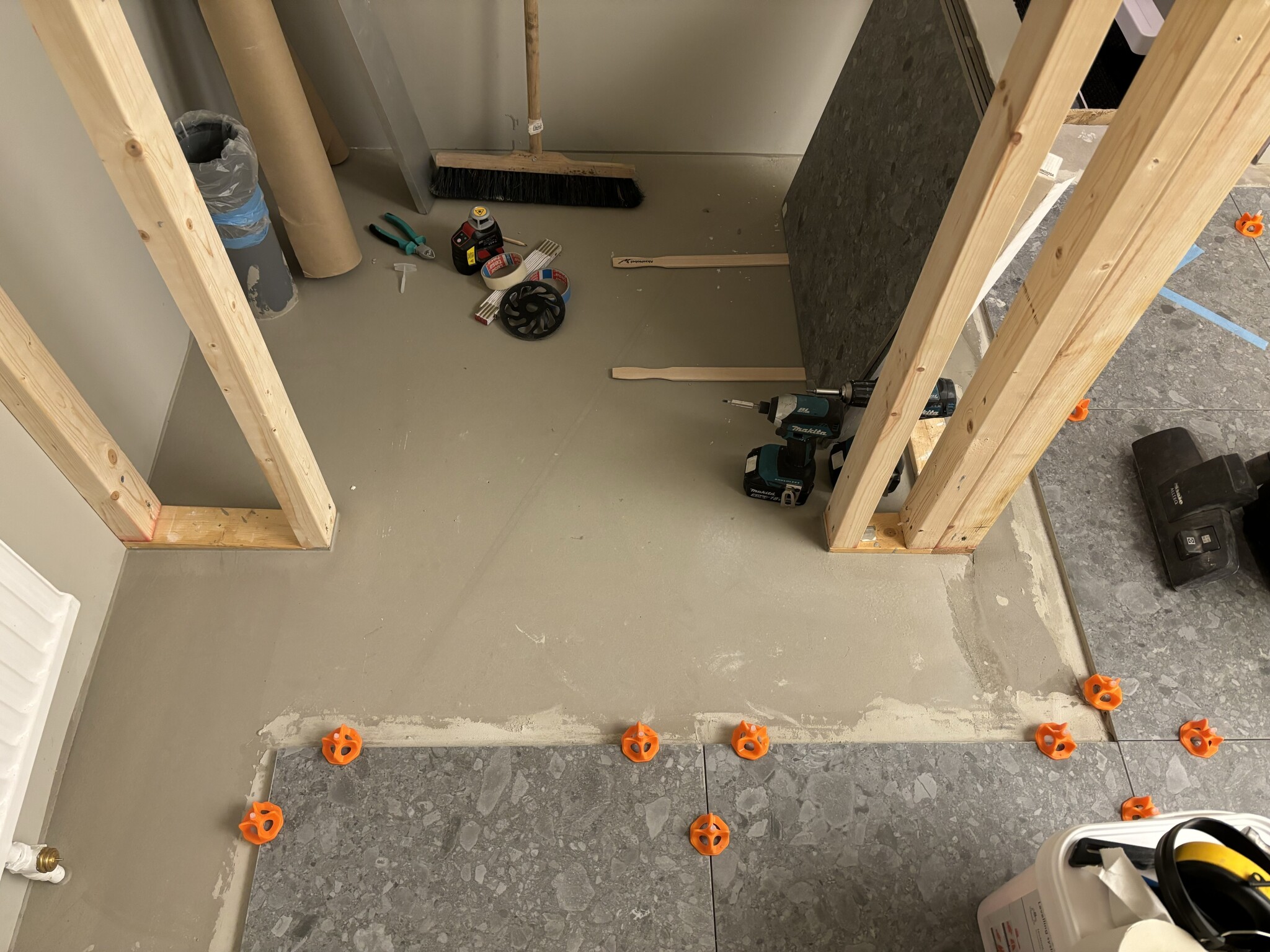
No well, just a toilet. But do you mean that the upturn without a threshold should be at least 20mm?
Because it should be folded on the threshold as well.
And then walls and frame must be added, I realize now, for it to be completely level.
Because it should be folded on the threshold as well.
And then walls and frame must be added, I realize now, for it to be completely level.
Member
· Västernorrland
· 12 076 posts
you hardly need to lift up the seat at all on a regular toilet.

Know-It-All
· Västra Götaland
· 12 410 posts
If it's just a toilet and no shower, you don't need a fold-up

Know-It-All
· Västra Götaland
· 12 410 posts
You are right, but practically speaking...Stefan N said:

https://www.gvk.se/fragor-och-svar/...t.-maste-plastmatta-pa-golv-vikas-upp-pa-vagg

https://www.bkr.se/vanliga-fragor
https://www.bkr.se/regler-material/fortydligande/fortydligande-av-punkt-6-3-2-i-bbv211
Member
· Västernorrland
· 12 076 posts
If you don't have a well, I don't know how a few cm of elevation will protect...
Member
· Västernorrland
· 12 076 posts
and what good does it do if it's flowing freely from a broken hose or pipe?
I hadn't thought about waterproofing at all, but since I want to do it right, it's best to follow the rules. I also don't understand the difference because it will just drain out into the hallway. But oh well.
No drain, just a toilet.
No drain, just a toilet.
Know-It-All
· Västra Götaland
· 12 410 posts
Read 20mm upstand against the threshold or level with the adjoining ceramic floor. Placing a strip on the floor to connect to and then the threshold on top looks best?
But I could just as well extend the tile from the hallway instead of a strip. And place the threshold on that?
Then I have a stable base under the entire threshold.
Or is there any disadvantage to extending it that far? I also get something to place the frame on.
Or am I thinking completely wrong?
Know-It-All
· Västra Götaland
· 12 410 posts
If you have a threshold, it might be best to pull up the waterproofing layer. Place the frame directly if you have it?