
881 views ·
3 replies
881 views
3 replies
To plaster basement interior wall or not?
Hello,
We live in a brick house with concrete walls and a slab and drainage from the 50s. We have had leaking stormwater pipes and as a result, we've had moisture issues in two areas of the basement where what I believe is mold has grown on the net wallpaper and behind it where the plaster has become porous and has come off. I have now removed the net wallpaper and all loose plaster about 2 sqm and wonder how I should best address this. The plan has been to replaster and paint with lime paint. It’s an old larder where I now plan to have an Elfa system and tools instead. The pipes will, of course, be fixed as well. The plaster is about 3-5mm thick.
1. Do you have to plaster concrete walls inside the basement? Can you instead use a concrete grinder to remove the remaining plaster and try to get a somewhat even surface on the concrete? Should you then have some form of primer?
2. If we keep the plaster, how do you easily remove paint from plaster in order to paint anew?
3. Which plaster is recommended?
I would gratefully welcome tips on how you would have done this!
We live in a brick house with concrete walls and a slab and drainage from the 50s. We have had leaking stormwater pipes and as a result, we've had moisture issues in two areas of the basement where what I believe is mold has grown on the net wallpaper and behind it where the plaster has become porous and has come off. I have now removed the net wallpaper and all loose plaster about 2 sqm and wonder how I should best address this. The plan has been to replaster and paint with lime paint. It’s an old larder where I now plan to have an Elfa system and tools instead. The pipes will, of course, be fixed as well. The plaster is about 3-5mm thick.
1. Do you have to plaster concrete walls inside the basement? Can you instead use a concrete grinder to remove the remaining plaster and try to get a somewhat even surface on the concrete? Should you then have some form of primer?
2. If we keep the plaster, how do you easily remove paint from plaster in order to paint anew?
3. Which plaster is recommended?
I would gratefully welcome tips on how you would have done this!
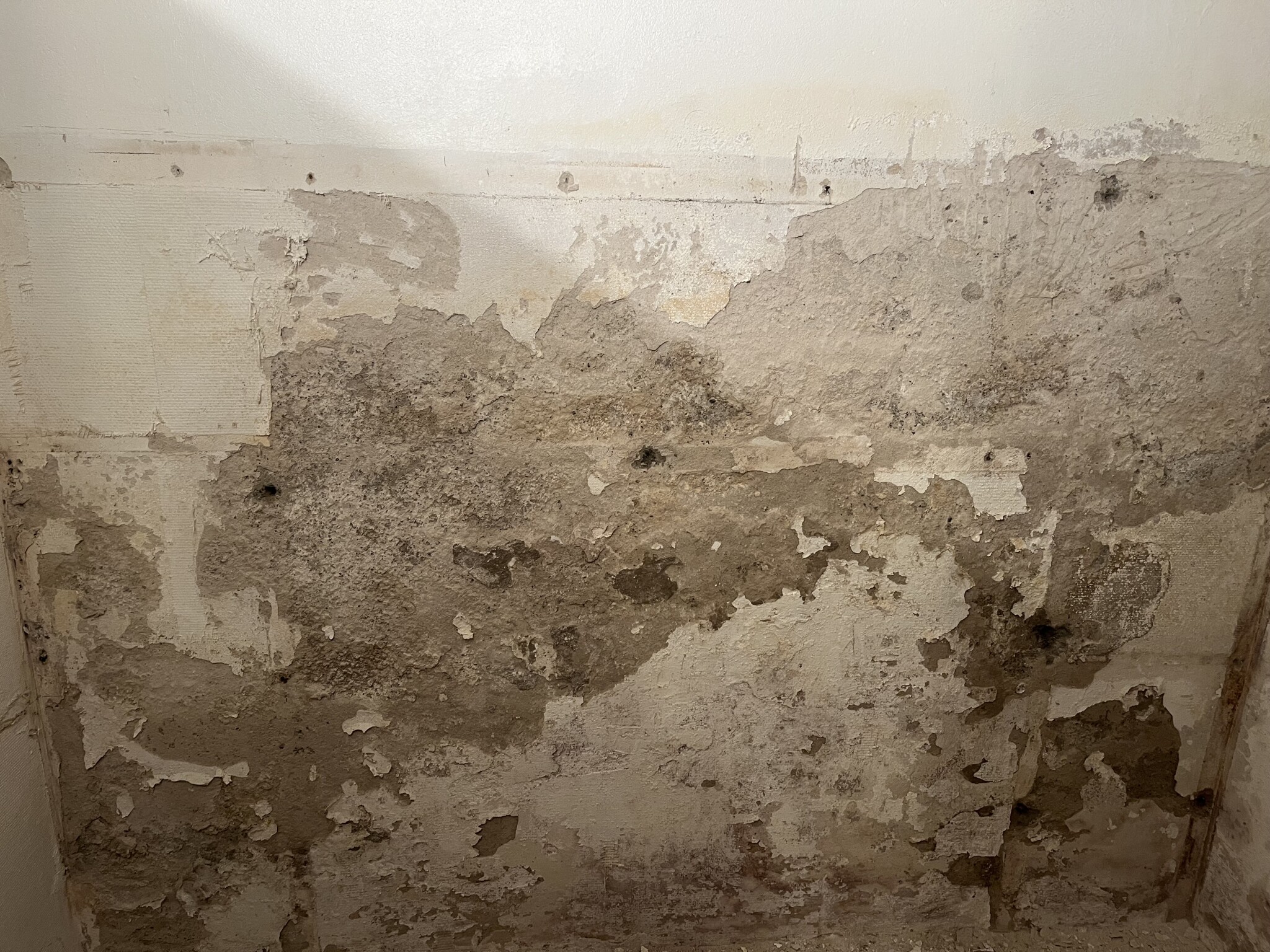
The entire picture of the situation isn't there. Are the 2 sqm a separate wall or part of a larger wall? Because I would probably choose to plaster with plaster mortar C. If there is existing undamaged plaster left, it's easy to get the level right. The seam won't be invisible, but that might be okay for you.
Another thought you had is concrete grinding. If you mean using a diamond cup on an angle grinder, I advise against it. It produces so much dust that you can't see your hand in front of you.
You also mentioned some pipes that aren't in the picture. Given it's a 50s house, I want to point out the risk that asbestos may have been used in the pipe insulation.
Another thought you had is concrete grinding. If you mean using a diamond cup on an angle grinder, I advise against it. It produces so much dust that you can't see your hand in front of you.
You also mentioned some pipes that aren't in the picture. Given it's a 50s house, I want to point out the risk that asbestos may have been used in the pipe insulation.
Hi and thank you for your reply!P proffsrik said:The whole picture of the situation isn't there. Are the 2 sqm a separate wall, or is it part of a larger wall? Because I would probably choose to plaster with cement mortar C. If there is existing undamaged plaster left, it's easy to get the level right. The seam won't be invisible, but maybe that's okay with you.
Another thought you had was concrete grinding. If you mean a diamond cup on an angle grinder, I advise against it. It creates so much dust that you can't see your hand in front of you.
You also mentioned some pipes not in the picture. Given a 50s house, I want to point out the risk that asbestos may have been used in the pipe insulation.
It's a total of 2 sqm, part of a larger wall, where the rest of the plaster that hasn't fallen off is painted with some form of plastic paint.
Yes, I was thinking of an angle grinder with a diamond blade. I saw there were some you could connect a vacuum to, but that might be difficult anyway?
Thank you for mentioning the asbestos thing; the neighbor with the same house just said yesterday that they had asbestos in their pipes, so it's most likely the same for us.
Further considerations:
- I also wondered if it might be easier to skim coat with cement filler, do you have experience with that?
- How do you remove the remaining plastic paint from the other intact plaster?
Thanks again!
Personally, I have tested Biokleen paint remover. It worked somewhat well. Still a lot of manual work to peel off plastic paint even though it sometimes came off in large sticky pieces. For me, it didn't need to be "spotless" but just diffusion-open as I later tiled over it.
What becomes most labor-intensive depends on how large the rest of the wall surface is otherwise. If the "good" plaster is still relatively loose and the surface isn't too large, it's quite easy/quick to knock down with an electric chisel hammer with a wide chisel. (this also creates dust, but not at all like with a diamond cup) Then you can replaster the entire wall.
I don't believe in plastering over existing plastic paint, then it's better to let it stay where it is and replaster where it has come off. Admittedly, you can remove the paint with a diamond cup almost without resistance, but you won't be able to keep the angle grinder straight enough so that it doesn't occasionally gouge much deeper into the plaster and create large holes, especially not with nearly 0 visibility.
It all depends on how nice you want it to be. I have painted with silicate paint directly on concrete ceilings indoors without primer and it holds well several years later. So if you want to paint directly on the concrete, it can probably turn out quite okay.
What becomes most labor-intensive depends on how large the rest of the wall surface is otherwise. If the "good" plaster is still relatively loose and the surface isn't too large, it's quite easy/quick to knock down with an electric chisel hammer with a wide chisel. (this also creates dust, but not at all like with a diamond cup) Then you can replaster the entire wall.
I don't believe in plastering over existing plastic paint, then it's better to let it stay where it is and replaster where it has come off. Admittedly, you can remove the paint with a diamond cup almost without resistance, but you won't be able to keep the angle grinder straight enough so that it doesn't occasionally gouge much deeper into the plaster and create large holes, especially not with nearly 0 visibility.
It all depends on how nice you want it to be. I have painted with silicate paint directly on concrete ceilings indoors without primer and it holds well several years later. So if you want to paint directly on the concrete, it can probably turn out quite okay.
Click here to reply
Similar threads
-
Plaster interior wall on wood/lightweight concrete
Building Materials and Construction Technology -
How do we most easily plaster/render newly built interior wall of plasterboard according to the attached image? What tools should we use to get the texture?
Building Materials and Construction Technology -
Time Estimate for Plastered Interior Walls (New Construction)
Building Materials and Construction Technology -
Plastering an interior wall
Building Materials and Construction Technology -
Interior wall of aerated concrete: plaster or drywall?
Building Materials and Construction Technology