We have a Haki scaffolding under our terrace. I can say that it is quite a struggle to crawl on all fours to drag each individual Haki beam out from this storage area (ceiling height about 80cm - 1m) and then crawl back in with each heavy part after use! As many know, each individual Haki beam weighs quite a bit.
Therefore, I've been thinking about a more convenient way to get the Haki scaffolding out from under the terrace. One idea I have is to have the Haki beams lying on a EUR pallet on which I've mounted transport wheels. I then think I'll lay some type of U-rails on the ground in which the transport wheels can roll. That way, I can pull out the entire EUR pallet when I need the scaffolding, and when I'm done, I can easily stack all the Haki parts on the pallet again and then push it back under the terrace.
The Haki scaffolding is quite heavy in total, but there are durable transport wheels, and you can have many. Regarding the U-rails: They need to withstand rain and outdoor conditions, and I'd like to keep the cost down. I've googled a bit for suitable rails but haven't really found anything good.
Do you have any better ideas? Tips on U-rails that can be purchased? Has anyone solved a similar problem in another way?
All tips are welcome.
To avoid some of the hassle with moisture etc., consider "hanging" the U-tracks instead. Protrusions and other issues might become too much of a hassle, but it's worth considering.
I would have used sliding door fittings. Suggestion: jula. They are affordable.
Would probably also hang everything on the patio since I guess the ground isn't level or dry/clean from dirt.
Start with an empty pallet or two and go up with a stud in each corner to a rolling cart.
I would have used sliding door fittings. Suggestively Jula. They are good value.
I would probably also hang everything on the terrace since I guess the ground is not flat or dry/clean from dirt.
Start from an empty pallet or two and go up with a stud in each corner to a trolley.
The ground underneath is quite flat and nice, with gravel/shingle that I laid out.
I wouldn't build a hanging structure in this case. It's about considerable weights. I think the original idea sounds good. Just choose large enough wheels so it rolls even if the surface isn't perfect. And maybe lay out some ordinary paving stones to roll on? Perhaps drainage stones if you want some guidance?
I usually build a "hedge" from scaffold parts, but it works quite poorly in practice since you always need one of the parts that's been used for the hedge. Ideally, something with different "compartments" at different heights would be best.
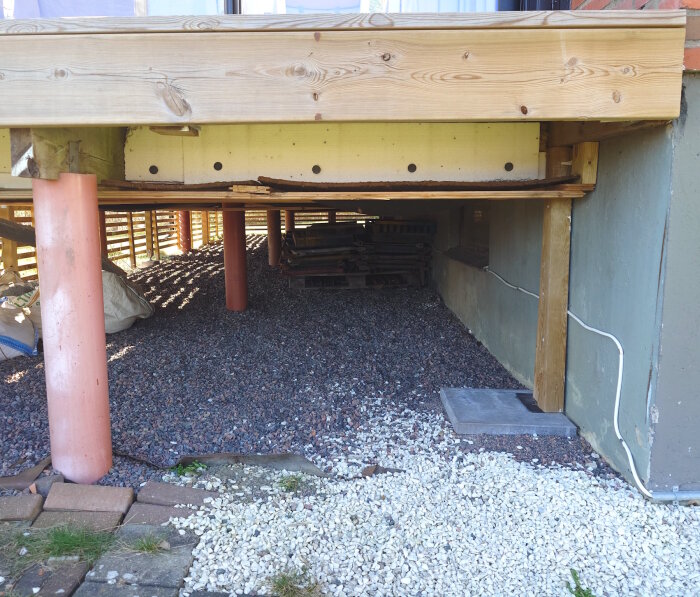
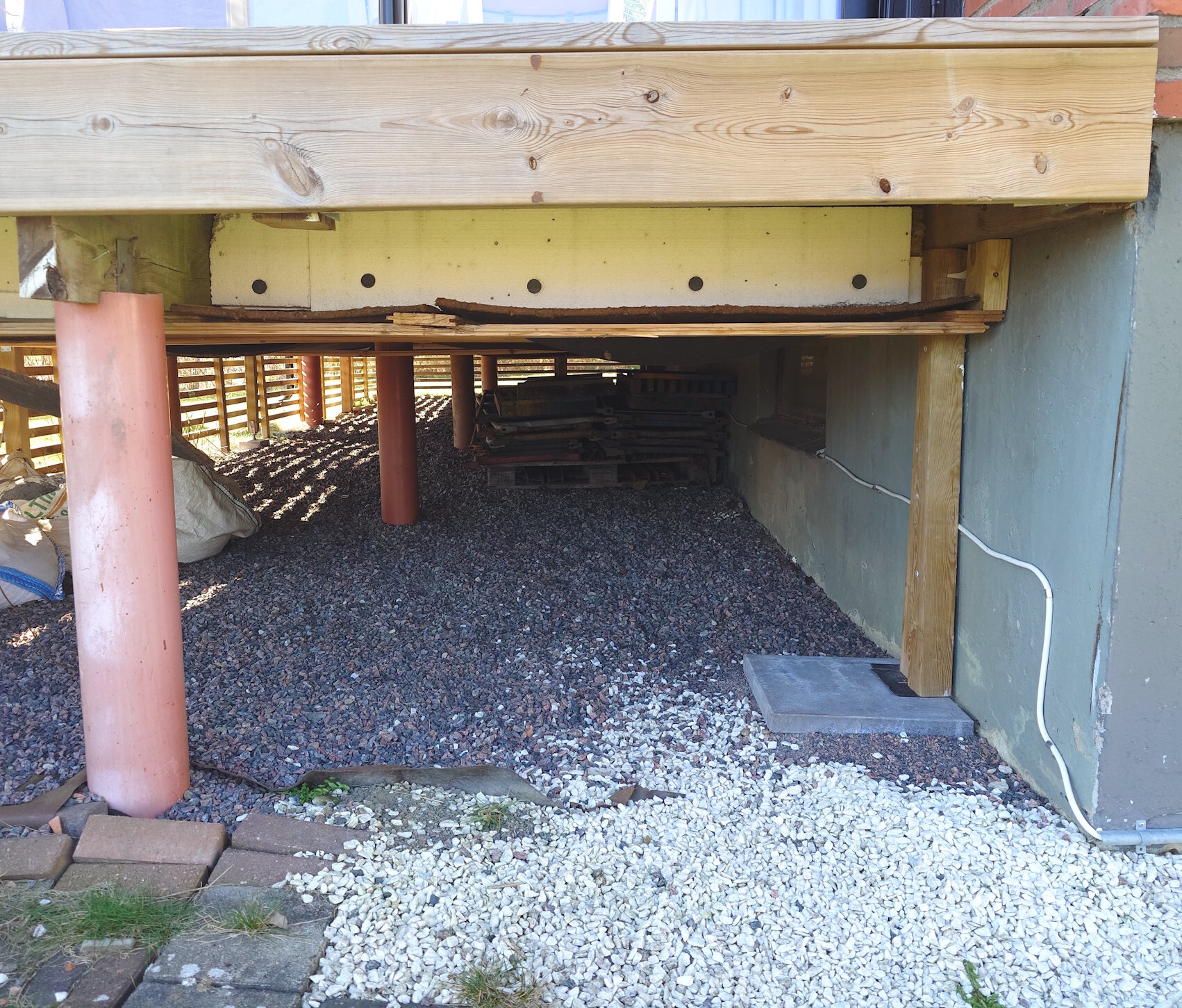
Thanks for your comments! Here's a picture of how it looks under the deck today:
In the darkness inside, you can glimpse the structure.
Here you get an idea of the surface/grusett. As you can see, it is quite straight/flat. However, there is a slight slope down towards the camera. A small summary follows:
Suspended construction:
Plus:
+ No need to think about the surface.
+ Less friction/easier to pull out.
Minus:
- Can it handle the weight?
- Cannot pull it out further than the rail, i.e., up to the edge of the deck
Rolling construction:
Plus:
+ Easier to build
+ Can handle almost all weight
+ Can be pulled out further than the edge of the deck, e.g., to the place where the structure is to be mounted.
Minus:
- More friction, harder to pull in and out.
- A good rail is needed so that the wheels do not get stuck in the grus. Wheels must not fall out of the rail.
- Rail needs to withstand moisture from ground/rain.
Adequately sized puncture-free tires for 100-200 each, suitable for hand trucks. They roll quite well and you avoid crawling underneath and fixing flats annually...
Lay slabs as you were advised above. Even if the slabs move a bit, you should be able to get the stand out with some force; if it gets bad, lift the slab and rake the gravel. Low effort for significant results.
Moderately sized puncture-proof tires for 100-200 each, like for dollies. They roll quite well and you avoid having to crawl under and fix punctures annually...
I would recommend "hard" wheels, like scaffolding. These puncture-proof rubber tires tend to get a bit flattened when they stand for a long time under load, which makes it surprisingly difficult to get them rolling afterwards.
They have a dark and smooth top side which I think might work well against the wheels. I plan to join two strips together, making a total of 6mm, for extra stiffness/durability in the rail. On each edge of each strip, I screw a 45x45 pressure-treated beam. This way, a U-rail is formed that gives 21cm width for the wheels to roll in.
I plan to screw the two rails together with boards underneath - similar to a railway track. These boards will also lift the rails a bit from the ground.
They can handle 130 kg each and don't have rubber that deforms if standing long under load.
Carts:
I will screw these wheels onto the pallet, but I plan to "recess" the wheels somewhat into the pallet, so the unit doesn’t build too much in height. The height is important to avoid hitting the deck. However, the wheels must obviously stick down enough so that the pallet doesn't hit the 45x45 beams, so maybe let the wheels stick down 6 cm?
With the load I am planning, I need to build 3 "carts," so the rail needs to be quite long.
Thanks for the input!
What I meant by board was just X number of cross boards that keep the two rails at a constant distance from each other.
However, considering your input, I should probably also run boards along each rail, and then I actually don't need double masonite anymore since the longitudinal boards provide the stiffness for each rail.
Thanks for the input!
What I meant by board was only X number of crossboards that hold the two rails at a constant distance from each other.
However, with your input in mind, I should probably also run boards along each rail, and then I don't actually need double masonite anymore since the lengthwise boards provide rigidity for each rail.
/Martin
If you want rigid rails, you can place a 45*70 on the base and screw a 28*95 on each side.
Printed and oil-hardened notwithstanding, but as I said, I don't believe a wooden construction becomes particularly durable in constant ground contact. If wood must necessarily be used, I agree with @fribygg about building it entirely with pressure-treated decking timber. Superiorly cheapest if nothing else (even cheaper than non-treated timber).
Vi vill skicka notiser för ämnen du bevakar och händelser som berör dig.


Algol said: