Yes, that works too. I wanted to avoid visible screw heads, but one of those isn't particularly ugly.
Anyway - I have now bought those support brackets from IKEA, as well as very short screws ("system screws"?), the ones that come with many of their products.
In a few days, I should probably have tested it. But first, the lower countertop needs to be installed. That's the first step.
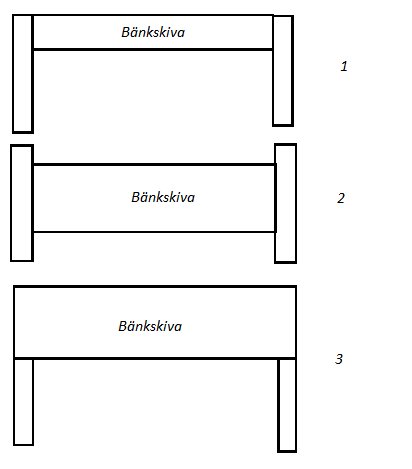
Should the cover panels
1) align with the top edge of the countertop
2) or should they extend an extra cm to create a lip?
3) end just under the countertop, which rests on the cover panels and thus becomes a couple of cm longer?
My original idea was that they should go up, just past, for two reasons:
1) It creates a small lip, so if there are items on top, there is perhaps less risk of them sliding off (a not-so-great argument since they can still slide off the front, which lacks a lip)
2) It provides a nice finish, I think. I recall that the cover panels (from IKEA) have painted ends. Then you would place the cut end down and the nice side upwards. If it turns out that both ends are delivered unpainted, this argument doesn't hold, and in that case, I would align the cover panel with the top edge of the countertop and get a corner strip.
3) There is also a countertop under the machines, which sits between the cover panels (120 cm wide), making it align nicely if the upper countertop is also 120 cm wide. It might look odd if the upper countertop rests on the cover panels and then becomes about 122.6 cm wide.
This argument applies to both options 1 and 2.
What do you think looks best or is the smartest option?
The sides naturally end under the countertop, so the whole setup doesn't have to hang by the screws. The countertop can protrude a few millimeters, which looks best. If things roll off the counter, you'll have to fix it with tape and chewing gum.
No covering panels or countertop in place yet; I will first try to get some special plinth manufactured at a joinery, which I thought the covering panels should stand on, to keep it consistent around the whole room.
But the washing machine and its countertop are in place!
An alternative for mounting a countertop that is to "float" which is quite laborious:
Construct brackets:
Locate the vertical studs (at least 2) and drill 20mm holes at least 100mm into the wall.
Buy 2 x 20mm solid rod/tube profile 600mm long and a flat bar 30x4x200mm.
Drill a 20mm hole in the center of the flat bar and countersink screw holes in the corners. Slide the flat bar onto the rod/tube profile 100mm in and weld it in place.
Install the brackets:
Insert the brackets into the holes in the wall and screw them in place.
Prepare the countertop:
Use a router to cut two (or as many as you need) grooves 500x20mm and 20mm deep.
Install the countertop:
Position the countertop and secure it with either strong adhesive or thinner locking clips that you screw in from underneath.
Voilà! A floating countertop that can withstand some load depending on the hardening of the rod/tube profile!
I have a similar question and hope someone is active in the thread soon.
I am going to mount a countertop on the wall (tiled wall) and I am wondering what I should use to ensure it can support a baby or a 2-year-old lying on the countertop for diaper changes.
I am also considering having a cabinet under the sink.
My options are:
1. 45x45 battens on the long side and the short sides.
2. 19x27 pine strip on the long side and the short sides.
Unfortunately, this is OT and really boring. But... I strongly recommend not having such a big child (or any child at all) on a surface 90 cm above the floor during changes. The risk of falls and injuries might be low but still very unnecessary to take.
This is unfortunately OT and really boring. But... I really want to strongly recommend not having such a big child (or any child at all) on a surface 90 cm above the floor during changes. The risk of falls and injuries is perhaps low but still very unnecessary to take.
Where do you usually change a child's diaper, on the floor?
Yes, actually on the floor then when it was about such things. It is all too common with head injuries and other unfortunate incidents when children fall off changing tables. Especially after they have become so big that they have learned to turn over and roll around and such. With the best of intentions.
I have a similar question and hope someone is active in the thread soon.
I am going to mount a countertop in the wall (tiled wall) & I wonder what I should use for it to withstand a baby-2-year-old lying on the countertop for diaper changes.
I'm also considering having a cabinet under the washbasin.
My options are:
1.Studs 45x45 on the long side and short sides.
2.Pine list 19x27 on the long side and short sides.
3.Brackets from Svedbergs
[link]
Or from IKEA
[link]
2 at the back and 1 on each short side.
The main thing is that it should hold for a child to lie on it as mentioned.
Grateful for answers!
If you have a wall both at the back and on each side, almost any of those will do, provided that the width of the board is not several meters.
If you don't have a wall on one of the sides, you need a bracket for support, like below.
If you have a wall at the back and on each side, any of those options will do, as long as the width of the board isn't several meters.
If you don't have a wall on one of the sides, you'll need a bracket for support, something like below.
[image]
Thanks, I have a wall at the back and on both sides.
Also asking you:
Is there any measurement for approximately how far in the studs are located? I'm thinking about what length the screw should be to make sure it attaches.
If you have tiles and plaster, it is likely about 2 cm to the stud. Keep in mind that you might also perforate a waterproof layer in a bathroom if you screw into it. If it is indeed a bathroom.
If you have tiles and plasterboard, it should be about 2 cm to the stud. Keep in mind that you might be perforating a waterproof layer in a bathroom if you screw into it. If it's a bathroom, that is.
That's correct, it's a laundry room. The concept of perforating a waterproof layer is a bit foreign to me, what does it mean?
I was planning to apply silicone in the hole, then plug it, and then screw in the screw—have I solved that problem then?
If it is a wet room, there is usually a waterproof membrane behind the tiles, and it should preferably be tight. Silicone should be sufficient to seal on the wall in a laundry room.
Vi vill skicka notiser för ämnen du bevakar och händelser som berör dig.





Fulkemisten said: