
8,095 views ·
18 replies
8k views
18 replies
The wall turns to powder (putting up a shelf)
Hello!
I'm going to help my colleague who has had some trouble setting up an Elfa system on the wall in his bedroom. When he tries to drill holes, it seems like everything just pulverizes. He’s been able to make a hole with a regular screwdriver as he says he doesn’t need a hammer drill. He says that it pulverizes and that a little further in, it becomes somewhat harder.
How can I help him? Is there a good anchor I can show him or another good approach?
Thank you in advance!
I'm going to help my colleague who has had some trouble setting up an Elfa system on the wall in his bedroom. When he tries to drill holes, it seems like everything just pulverizes. He’s been able to make a hole with a regular screwdriver as he says he doesn’t need a hammer drill. He says that it pulverizes and that a little further in, it becomes somewhat harder.
How can I help him? Is there a good anchor I can show him or another good approach?
Thank you in advance!
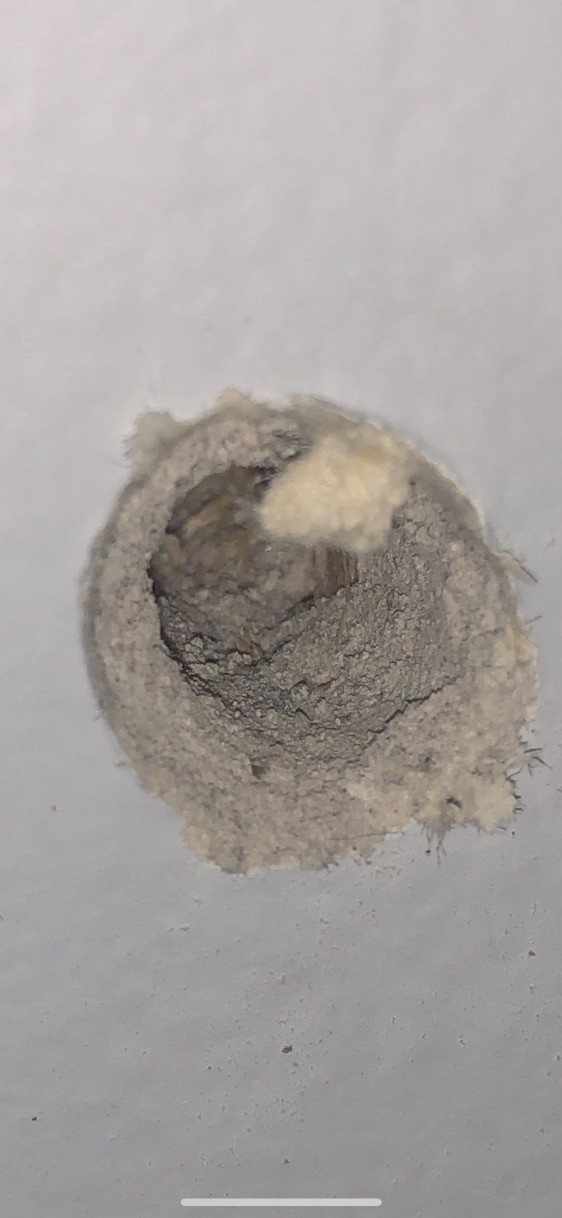
How deep is the powder? In old houses, the plaster can be 2-3 cm thick in some places. Additionally, he might have managed to hit a joint, so is the problem the same in several places?
It's an old building, so that sounds reasonable. I think it's about 2 cm as you say. He hasn't made more holes, just the one in the picture. Should we try making additional holes, and how far away from the first should they be? Or is there a special plug or something else that works in the hole he has already made?Viktor.J said:
A 2 cm hole for setting up a shelf sounds very flimsy regardless. When I've hung up things, I usually use 8-10mm wall plugs and fairly sturdy screws. They are probably 5-6 cm long at least. My advice, as an amateur, is to get real wall plugs and the correct screws, drill quite deep, at least a couple of cm into what is hopefully harder material. There must be brick, rubble, concrete, etc. somewhere. If he still doesn't get a "hold," try moving a few cm in a different direction as it might be a joint he has hit. If this still doesn't work, perhaps some more research is needed. If it's an apartment, he can talk to neighbors; if it's a house, he should know what the walls are made of and then make a new plan. A last resort could be to use something like chemical anchors.
He drilled a little longer than that but he didn't dare to do more as it turned to powder in the first 2 centimeters. But good to know. I'll probably refer to the size of the plugs and screws you mention. Maybe he even should borrow a stud finder, which might make things easier.2 cm hole for putting up a shelf sounds very weak regardless. When I've hung things up, I usually use 8-10mm plugs and fairly strong screws. They are probably at least 5-6 cm long. My advice, as an amateur, is to get proper plugs and right screws, drill quite deep, at least a couple of cm into what is hopefully harder. Somewhere there must be brick, slag stone, concrete etc. If he still doesn't get a "grip", try moving a few cm in another direction because it might be a joint he's hit. If this still doesn't work, maybe more research is needed. If it's an apartment, he can talk to neighbors, if it's a house, he should know what kind of walls it has and then make a new plan. A last resort could be to use something like chemical anchors.
It is very unusual to have plaster on a wooden wall. So a stud finder is unlikely to help. If I were him and worried about holes and damage, I would first find out what kind of wall it is...
Okay, good to know. I'll ask him to ask the association or a neighbor so we can get more information.
I don't have the exact year of construction but it's an apartment in Stockholm in a building from around the 1920s. It has high ceilings, moldings, and herringbone parquet flooring. Hope that helps.

Hi. It's difficult not to repair the wall when it's this porous. I would do it this way:D dantom said:Hi!
I'm helping my colleague who has had some trouble setting up an Elfa system on the wall in his bedroom. When he tries to drill holes, it seems like everything just crumbles. He's been able to make the holes with a regular screwdriver as he says he's not needed a hammer drill. He says it crumbles and a little further in it becomes somewhat harder.
How can I help him? Is there a good plug I can recommend or any other good approach?
Thanks in advance!
Drill all holes to about 7 cm's depth. For those holes that have porous material around them, scrape them out until it becomes solid or a maximum of a fist's size. Repair with gypsum plaster. Allow to dry for 24h. Now you have a solid base to make new holes. Regards
Last edited:
Very unusual it is hardly, in older buildings it is often plank 》reed mat (or other reinforcement) 》plaster as the construction of the wall.
It might also be worth using lightweight concrete screws, like 'wall dog', at least 50 mm. Pre-drill with a regular carbide drill bit without impact and make the holes as small as possible, then perhaps use twice as many screws as if you had a nice concrete wall. Some screws won't hold, but overall on a rail, it's not a problem.
From the 1920s, it's likely a thick lime plaster which can only hold very light items with a nail (no plugs), and underneath this, I would guess there are solid wood or brick walls. I would continue drilling to find out what the wall is made of. Even better is to ask the board of the association as they surely know the wall composition.
The plaster, as mentioned, can't hold anything heavy, in my experience. Certainly not an Elfa system or a television. But in a 1920s house, there's definitely something behind it that you can hang anything on. Not like 1970s houses with single gypsum and then air, or blue concrete. Back then, they probably thought the heaviest thing to hang up was a pinned-up poster from OKEJ with Samantha Fox.
The plaster, as mentioned, can't hold anything heavy, in my experience. Certainly not an Elfa system or a television. But in a 1920s house, there's definitely something behind it that you can hang anything on. Not like 1970s houses with single gypsum and then air, or blue concrete. Back then, they probably thought the heaviest thing to hang up was a pinned-up poster from OKEJ with Samantha Fox.