
18,936 views ·
15 replies
19k views
15 replies
The Indecisive's Wondering - plaster above underfloor heating?
Is it a good idea to lay gypsum floorboards over underfloor heating to reduce impact sound through the wooden joists to the lower floor? That is, 12.5 mm gypsum, foam, and 15 mm engineered flooring over waterborne underfloor heating in chipboard.
Is it a reasonable trade - impact sound reduction against slower heat transmission and higher supply temperature?
The construction company and the HVAC guy think my suggestion is incomprehensible. I called technical support at Uponor. Got the answer that the limit is 40 mm of wood over underfloor heating. And we're quite far from that.
Should I stand my ground? Spending a lot of money on the house.
Is it a reasonable trade - impact sound reduction against slower heat transmission and higher supply temperature?
The construction company and the HVAC guy think my suggestion is incomprehensible. I called technical support at Uponor. Got the answer that the limit is 40 mm of wood over underfloor heating. And we're quite far from that.
Should I stand my ground? Spending a lot of money on the house.
The floor chipboard is in place. In some rooms, heating plates and pipes are already installed.
If gypsum is to be used, it should be above the underfloor heating.
If gypsum is to be used, it should be above the underfloor heating.


Good MathiasS! I've calculated the heat transfer, and sure, the supply temperature increases, but not by many degrees. What do you think about the reduction of impact sound? Is it worth the effort?
220 mm floor joists with floor chipboard and laminate above. The ceiling on the lower floor is 22mm tongue and groove.
220 mm floor joists with floor chipboard and laminate above. The ceiling on the lower floor is 22mm tongue and groove.
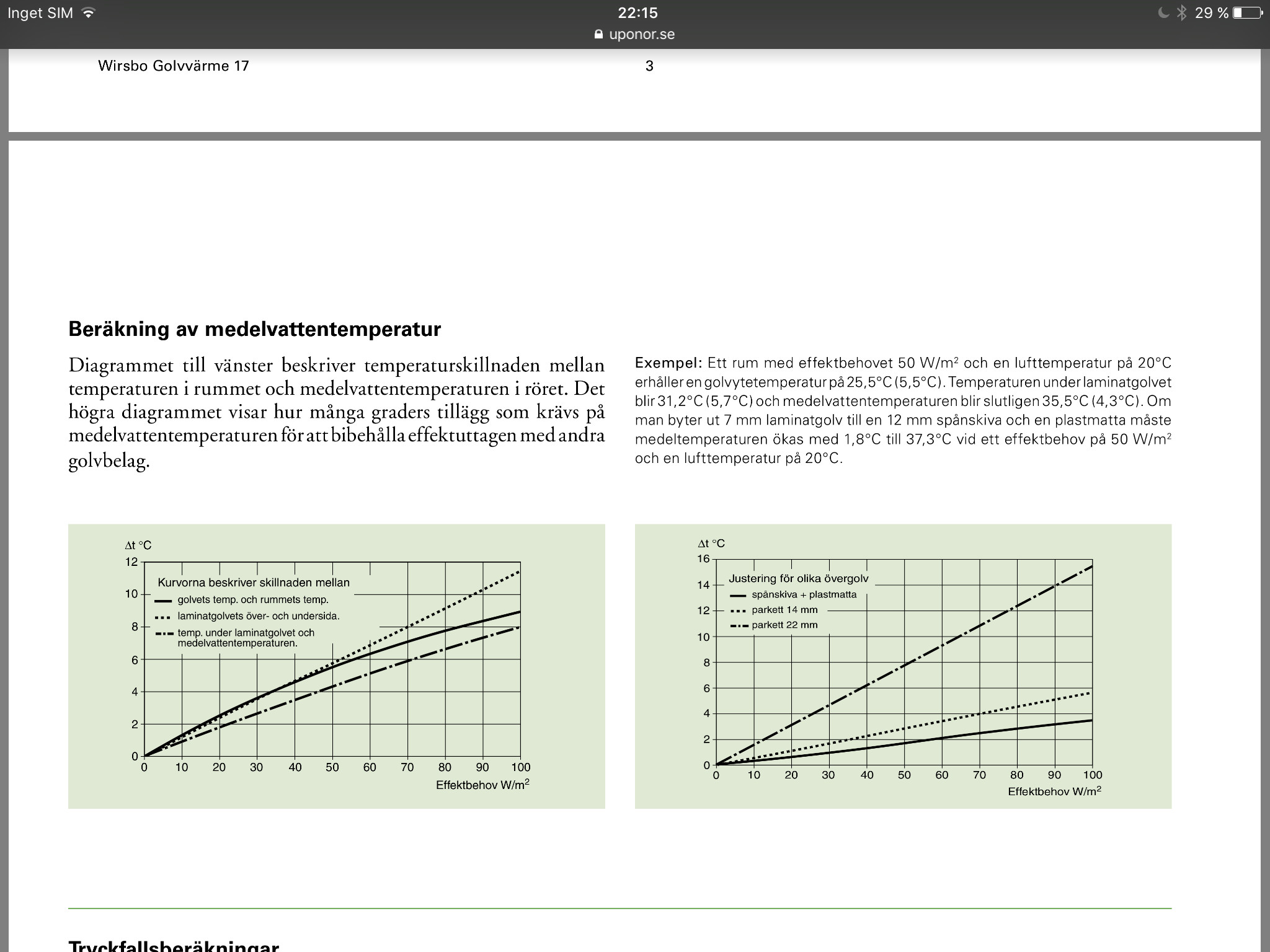
Maybe unclear screenshot.
https://www.uponor.se/~/media/count.../bld_ufh_5013_122002_17_handbok.pdf?version=1
Page four.
At 50w/m2 the supply temperature needs to increase by an estimated 3 degrees. I can live with that.
Last edited:
It will be floor gypsum. Despite the plumber's protests. He predicts a very "sluggish" system because "gypsum insulates more than wood." That's where I made up my mind. I am familiar with U-values and thermal conductivity. Additionally, the upstairs will meet new building standards. Between 200 and 300 mm of insulation in the building envelope. All windows will be insulated glass with a U-value around 1. I don't think the underfloor heating will ever need to deliver more than 50w/m2.
I will report back next winter.
Thank you
I will report back next winter.
Thank you
I had the same discussion with Uponor and LK a couple of years ago.
The most important thing to consider was that the intermediate flooring is properly insulated so that the underfloor heating goes upwards. So it is possible to lay double gypsum and a thick flooring material if you want, but as mentioned, you must ensure that the insulation in the intermediate flooring is of the appropriate grade.
So if you have an older house where you might not know what the insulation looks like, you might want to avoid putting too much above the underfloor heating.
It is essentially the same principles that apply with underfloor heating on a concrete slab; the insulation under the slab determines how much heat will go upwards, and what you place on top of the underfloor heating negatively affects this.
The most important thing to consider was that the intermediate flooring is properly insulated so that the underfloor heating goes upwards. So it is possible to lay double gypsum and a thick flooring material if you want, but as mentioned, you must ensure that the insulation in the intermediate flooring is of the appropriate grade.
So if you have an older house where you might not know what the insulation looks like, you might want to avoid putting too much above the underfloor heating.
It is essentially the same principles that apply with underfloor heating on a concrete slab; the insulation under the slab determines how much heat will go upwards, and what you place on top of the underfloor heating negatively affects this.
Member
· Västra Götaland
· 257 posts
We often screw drywall onto underfloor heating pipes. Particularly in bathrooms with wooden joists. Sometimes we also use double drywall if the floor is wobbly, the second layer is usually exciting to screw 


Yes, if he claims that gypsum insulates more than wood. Then I wouldn't listen to his recommendations on that matter after that. Because that's not true.Husvagnsthord said:It will be floor gypsum. Despite the HVAC guy's protests. He predicts a very "sluggish" system because "gypsum insulates more than wood." That's when I made up my mind. I know about U-values and heat transmission. Additionally, the upper floor will meet new building standards. Between 200 and 300 mm insulation in the building envelope. All windows with insulated glass and U-values around 1. I don't think the underfloor heating will ever need to deliver more than 50w/m2.
I'll report back next winter.
Thanks
If it's footstep noise you want to get rid of, I can recommend decibeX. We used it when we renovated the attic and ended up with a very pleasant and quiet floor underneath.
http://www.decibex.com/se/
http://www.decibex.com/se/
Hi!
I am in the exact same situation. How did you install the floor gypsum boards? According to LK's installation instructions, the plate should be screwed and then the entire surface should be glued with LK floorfix and then gypsum.
It's not a bathroom with tiles that will be done directly, shouldn't it be enough with construction adhesive (PL400) and screws?
Did you also screw the plate?
I am in the exact same situation. How did you install the floor gypsum boards? According to LK's installation instructions, the plate should be screwed and then the entire surface should be glued with LK floorfix and then gypsum.
It's not a bathroom with tiles that will be done directly, shouldn't it be enough with construction adhesive (PL400) and screws?
Did you also screw the plate?
Are you planning to lay tiles or stone on the floor? Surely LK doesn't require that the plates be screwed down like when you're laying wood or laminate flooring? I can't remember if we used both glue and screws to attach the floor gypsum.