
2,128 views ·
15 replies
2k views
15 replies
Tear up tiles with electric heating?
Page 1 of 2
Hello,
We are planning to renovate the kitchen where there are tiles with electric heating. The idea is to tear up the floor and install regular parquet.
The tiles only extend to the kitchen furnishings but go under the fridge, freezer, and dishwasher. The substrate is chipboard, which we aim to damage as little as possible.
The electric cable is connected to a fuse that is also used for the ceiling light in the boiler room (basement) and laundry room (basement). The regulator for the floor is mounted on the wall in the kitchen, and the wires go directly down to the floor where they are embedded.
I understand that the power needs to be cut before we can start tearing up the floor and that just removing the fuse is not enough. So the question is whether I can disconnect this myself somehow, or do I need to have an electrician come for it?
We are planning to renovate the kitchen where there are tiles with electric heating. The idea is to tear up the floor and install regular parquet.
The tiles only extend to the kitchen furnishings but go under the fridge, freezer, and dishwasher. The substrate is chipboard, which we aim to damage as little as possible.
The electric cable is connected to a fuse that is also used for the ceiling light in the boiler room (basement) and laundry room (basement). The regulator for the floor is mounted on the wall in the kitchen, and the wires go directly down to the floor where they are embedded.
I understand that the power needs to be cut before we can start tearing up the floor and that just removing the fuse is not enough. So the question is whether I can disconnect this myself somehow, or do I need to have an electrician come for it?

Unscrew the thermostat from the wall and disconnect it, you have a thinner wire which is the sensor from the floor, a thicker one with 2 wires, the heating cable itself, which are usually connected together, and finally 3 loose wires that are phase, neutral, and ground, these should be removed and insulated. Note that I am not an electrician, but this is how I remember it, though I might be wrong, you'll probably get help from someone better than me soon 
Thanks! However, I want to be sure that the power to the floor is truly cut off so you don't get a shock when you start tearing it up.
This is how it looks:


Not the prettiest solution, you might wonder if it's homemade from the start perhaps?
This is how it looks:
Not the prettiest solution, you might wonder if it's homemade from the start perhaps?
Buy yourself a test pen, it's absolutely worth having at home. https://www.jula.se/catalog/el-och-...n/testinstrument/testpennor/testpenna-008167/
What should I use it for? I can measure current with the multimeter, right? And getting to the wiring in the floor before tearing it up is quite difficult? Or do you mean that the pen can detect from a distance if there is current in the heating coil?nexustwins said:
Here are some pictures of what it looks like in the box:

http://i.imgur.com/tReME0j.jpg

http://i.imgur.com/Jh2mODv.jpg

http://i.imgur.com/kTW1r8g.jpg
Does this bring any clarity? Can I safely cut the power here myself or do I need to get an electrician here?
http://i.imgur.com/tReME0j.jpg
http://i.imgur.com/Jh2mODv.jpg
http://i.imgur.com/kTW1r8g.jpg
Does this bring any clarity? Can I safely cut the power here myself or do I need to get an electrician here?
Yes, that's true, but in this case, the fuse that connects to the floor is also linked to the laundry room and parts of the boiler room. Sure, you can manage without it for a day or so, but you never know how long it will take to tear up the floor.RoBo said:
Moreover, I've read in other threads that even if you unscrew the fuse, you can still get power, but that's of course if something is wrongly connected. You should be aware that it's entirely possible if you don't have full control over the wiring in the house.

If you can ensure that the black cable is the heating cable, it should be the one. And you disconnect it in the junction box. Then the floor is without power. You should also remove the sensor cable, so open the thermostat and disconnect the sensor there. When you connect, ensure with the help of the multimeter that you have indeed tripped the correct circuit breaker.
The procedure is as follows:
1. Test the instrument, i.e., measure on something you know is live, preferably in the junction box you will be working on, before you cut the power.
2. Cut the power, measure to ensure that the power is indeed cut in the junction box.
3. Check the instrument again against something with power. There have been incidents where someone measured with the instrument, with the incorrect measurement range connected, the instrument gets damaged, and shows no voltage. So it's important to test the instrument both before and after the measurement.
The procedure is as follows:
1. Test the instrument, i.e., measure on something you know is live, preferably in the junction box you will be working on, before you cut the power.
2. Cut the power, measure to ensure that the power is indeed cut in the junction box.
3. Check the instrument again against something with power. There have been incidents where someone measured with the instrument, with the incorrect measurement range connected, the instrument gets damaged, and shows no voltage. So it's important to test the instrument both before and after the measurement.
Thanks! I spoke with the electrician, and they could come out this afternoon to cut the power in the floor. It feels a bit safer, even though the instructions here seem simple and good. I perceive that it's not entirely certain the floor will be 100% powerless by just following the instructions, so it feels better if someone who knows how to do it comes here to sort that out. Just hoping it doesn't cost several thousand kronor. The instructions are probably correct; it should just be some cable that needs to be disconnected in the box, but you never know what people have done during installation.
The instructions are probably correct; it should just be some cable that needs to be disconnected in the box, but you never know what people have done during installation.The electrician came out and indeed there were just a couple of wires in the box that needed fixing
Tried to break up some of the floor tonight and it was definitely tougher than I expected. The construction seems to be as follows: Some type of white filling at 1-2 mm, then a layer of plaster, on top of which someone has cast a few cm only where the heating cable lies, and then tiles with grout on top.
I started with a crowbar and chisel but realized it was taking way too long so I switched to the hammer drill and a chisel which went faster, but the problem with the chisel is that it tends to go down into the chipboard which isn’t so good.
Here's what it looks like right now:

http://i.imgur.com/Ye84ule.jpg

http://i.imgur.com/Mrfhg0L.jpg

http://i.imgur.com/MFuS4Eg.jpg

http://i.imgur.com/qBU2dVM.jpg

http://i.imgur.com/dgHWvx9.jpg
I suspect that if the holes don't become more than what's on the last picture, you can fill them with some type of filler. It probably won't be noticeable when you lay down the step mat and parquet, I assume?
A real chisel that is wide would probably have minimized the risk of holes like these, but unfortunately, it seems not very easy to get hold of. The one Biltema has is a bit too large (spade chisel, 50 x 400 mm):
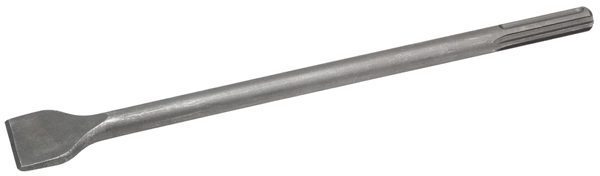
http://www.biltema.se/sv/Verktyg/Skarverktyg/Betong--och-kakelborr/Mejsel-SDS-Max-2000030952/
Maybe this one at Jula is better: Bosch Spade Chisel SDS+(40x250 mm): http://www.jula.se/catalog/verktyg-...r/borr/bilningsmejslar/spadmejsel-sds-181799/
Tried to break up some of the floor tonight and it was definitely tougher than I expected. The construction seems to be as follows: Some type of white filling at 1-2 mm, then a layer of plaster, on top of which someone has cast a few cm only where the heating cable lies, and then tiles with grout on top.
I started with a crowbar and chisel but realized it was taking way too long so I switched to the hammer drill and a chisel which went faster, but the problem with the chisel is that it tends to go down into the chipboard which isn’t so good.
Here's what it looks like right now:
http://i.imgur.com/Ye84ule.jpg
http://i.imgur.com/Mrfhg0L.jpg
http://i.imgur.com/MFuS4Eg.jpg
http://i.imgur.com/qBU2dVM.jpg
http://i.imgur.com/dgHWvx9.jpg
I suspect that if the holes don't become more than what's on the last picture, you can fill them with some type of filler. It probably won't be noticeable when you lay down the step mat and parquet, I assume?
A real chisel that is wide would probably have minimized the risk of holes like these, but unfortunately, it seems not very easy to get hold of. The one Biltema has is a bit too large (spade chisel, 50 x 400 mm):
http://www.biltema.se/sv/Verktyg/Skarverktyg/Betong--och-kakelborr/Mejsel-SDS-Max-2000030952/
Maybe this one at Jula is better: Bosch Spade Chisel SDS+(40x250 mm): http://www.jula.se/catalog/verktyg-...r/borr/bilningsmejslar/spadmejsel-sds-181799/
Used the left chisel in the picture today:

It worked really well!
The question is whether the thin white layer that remains needs to be removed too? Or is it perhaps not a problem to lay stepfoam and parquet on it?

http://i.imgur.com/TyG4UER.jpg

http://i.imgur.com/QHhusVZ.jpg
It worked really well!
The question is whether the thin white layer that remains needs to be removed too? Or is it perhaps not a problem to lay stepfoam and parquet on it?
http://i.imgur.com/TyG4UER.jpg
http://i.imgur.com/QHhusVZ.jpg