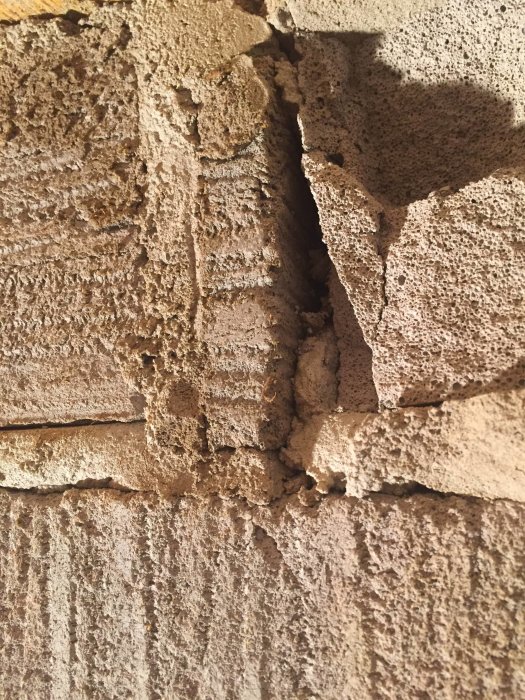
Is there a wooden beam structure between the floors? In that case, the simplest thing would be to tear down a bit of the ceiling in the room to see which direction the floor joists run. My guess is that it is the corridor walls that are load-bearing, but I would have played it safe and checked.
Those in the forum who seem to know a lot about the question usually want to know what the trusses look like and how they go, as well as the age of the house and what is known about how the house is built (concrete, wood, etc.).
It is about 10 cm thick in concrete with plaster on one side and tiles on the other.
Does this really make sense? For several reasons, I have a hard time believing that information. It's more likely a half-brick wall. But as BirgitS pointed out, more information is needed. The most important is the construction year. What is the floor structure between the ground and upper floor made of? Wood or concrete? Do you have any pictures from the outside?
Don't know what the roof trusses look like or if it's a wooden floor structure. Might have to tear it down to find out.
The house was built in 1956.
A picture from the outside probably won't help much, I think, since the house is covered with "fusktegel". If it can help anyway, I will take a picture tomorrow when it's light.
Regarding whether the wall is made of concrete, I don't know why I wrote that. It was crystal clear in my head that what I meant is that the wall is made of some kind of stone. It's hard, that is. Poorly expressed by me.
Then it becomes clearer. The wall is made of brick so that it can support the tiles in the laundry room. In 1956, no serious builder would have come up with the idea of putting tiles on a wooden structure... Then it's important to find out what the floor slab is made of, wood or concrete. But if you have fake brick, it should be wood. How thick are the exterior walls?
Behind the brick, there is wood anyway. That's as much as I know.
The outer walls are difficult to measure due to the faux brick. But I have measured and subtracted a bit for the faux brick and the air gap between the wood and the brick, and come to a total of 16 cm.
Then we can conclude that it's a wood construction in the outer wall. I feared it was light concrete, but we can rule that out now. It is definitely a wood joist structure between the floors. The corridor walls are definitely load-bearing, so you can demolish the red-marked wall.
It's a bit of a shame, because it's a waste of capital. Have you considered the alternatives?
The reason I want to remove the wall is to have a larger laundry room with storage. The room next door is just an empty room without electricity installed. Unpainted walls and ceiling. I have no idea what it has been.
I would say that one wall along the entire hallway is a heart wall, meaning it's load-bearing.
The red wall is probably not load-bearing, since it is made of concrete and is about 10cm thick, so it is likely lightweight concrete, it could also be blåbetong.
Lightweight concrete can be easily drilled with a regular metal drill.