Hi, we are renovating our house and considering the possibility of removing a wall to open up between the kitchen and dining area. But before we contact a designer and make a construction notification, I'm thinking about the size of the beam.
We only have 210cm in height up to the underside of the joists, so if the beam is too large, it doesn't feel worth the trouble to continue the process.
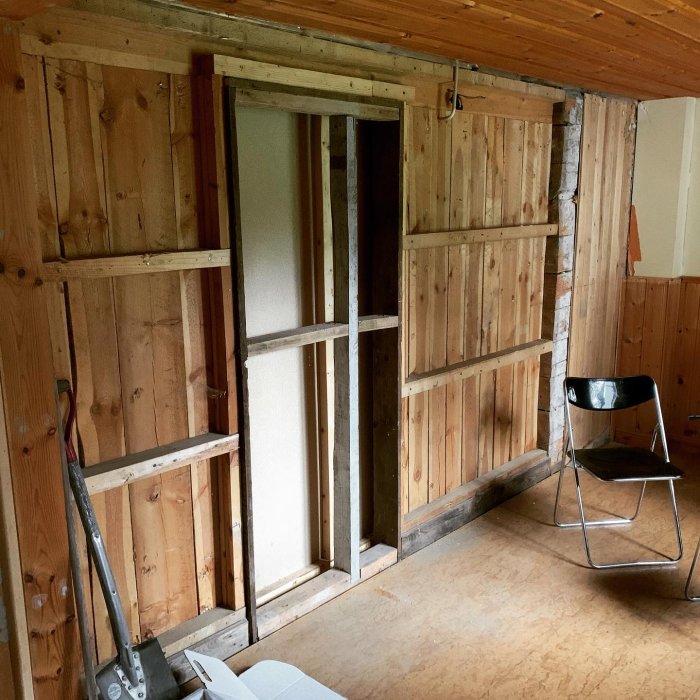
It is the plank wall in the picture that we would like to remove. The opening will be approximately 3 meters exactly. So my idea is to insert a "sword" or a stiffener at the end of the timber part, notch it out, and place the beam on it. At the other end, there will be a post.
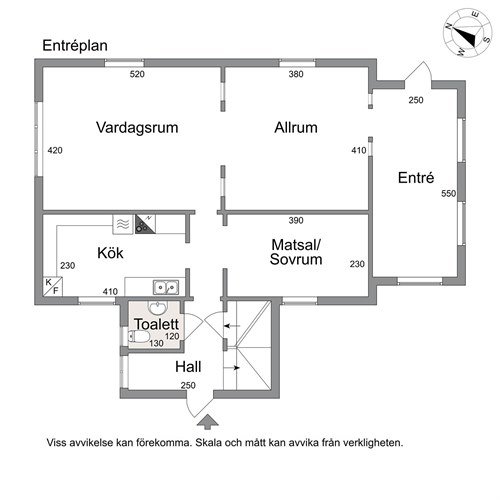
The house is 9.3 m long and 6.8 m deep/wide. Located just south of Stockholm.
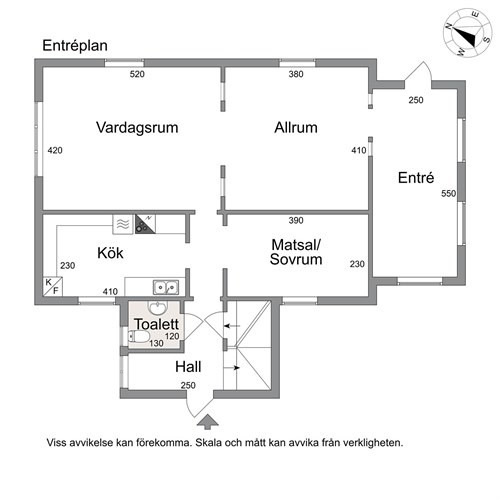
Old picture from the prospectus. The kitchen is now in the "living room," and it's the wall towards the "dining room" that we would like to open up to.
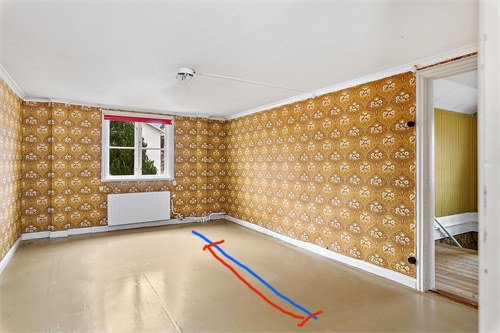
And a picture of the upper floor where I tried to draw out where the wall goes on the floor below.
So what do you think? Is a HEA 140 sufficient? Or do we need an even thicker beam?
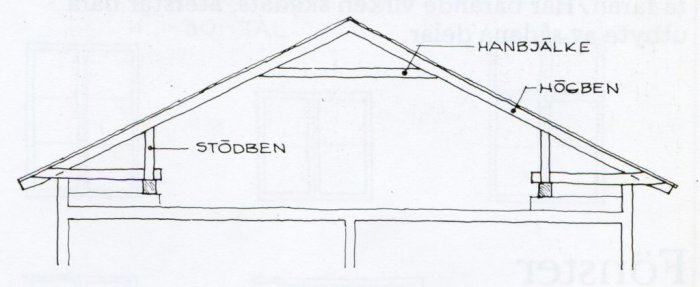
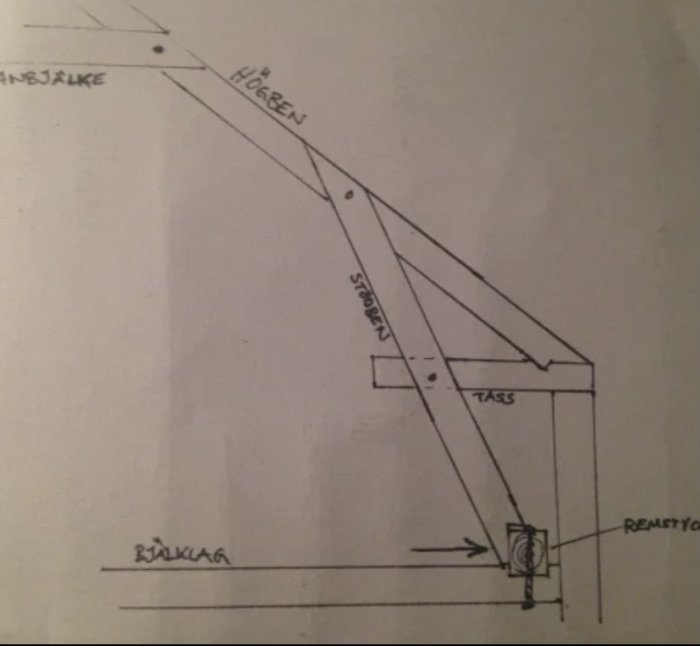
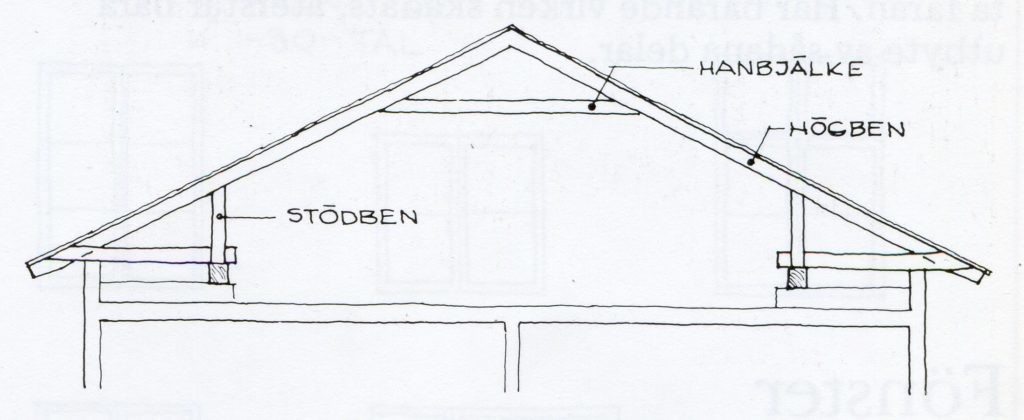
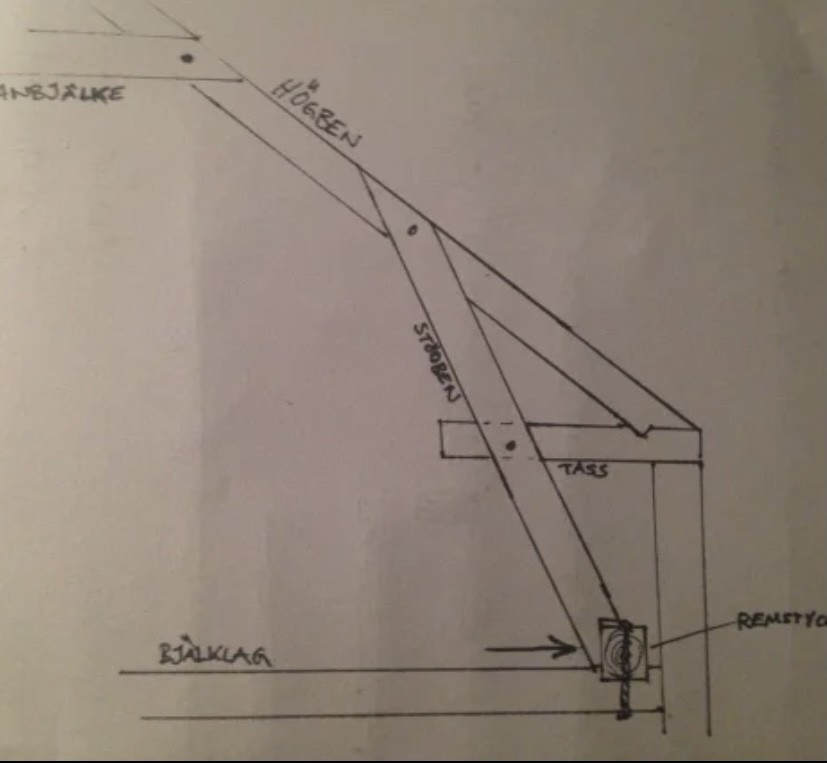
Hi, I've tried to find a picture of trusses like the ones we have, but can't find any exactly similar. But the trusses resemble those in this picture. Just that the lower part of the support legs is attached almost out at the outer wall and then it slopes inward and is attached to the high leg about 80-100cm in from the vertical line of the outer wall, see picture 2. The ceiling in the upstairs bedroom is attached to the collar beams. So we have maybe just over a meter from the collar beam up to the ridge. The outer walls that the high legs rest on go about 40cm higher than the floor level upstairs. I'll get back to you with the dimensions of the timber.
The house was built in 1840 as a worker's residence but then underwent a major renovation sometime between 1900-1920 where the roof angle was increased and the upper floor was built. Also, facade bricks were added and it was roughcasted.
Some form of roof loads affects the beam, if your drawings are to be used as a guide. Probably, HEA 140 is too weak. In which snow zone is the house located?
Some form of roof load is affecting the beam, if your drawings are to guide. Probably HEA 140 is too weak. In which snow zone is the house located?
Thanks for taking the time!
I had assumed that the wall was only to support the floor joists/underarm. Since the support legs are so close to the outer walls and the collar tie is 2/3 up to the ridge.
It feels difficult to install a beam that should be walkable under if it is much higher than 150 since it needs to be covered with something as well.
A follow-up question on whether something stronger than an HEA140 is required
Is there any beam that would withstand that which is <150 high, like HEB140?
Alternatively, how large an opening do you think it is possible to make with an HEA/B 140?
It is difficult with such an old house when you cannot see it in reality. There are probably ways to reduce the roof loads through measures in the attic if it is not actively used. Every decimeter reduction of span works wonders. One possibility when space is limited in height is to use glulam lying flat. 165x315 lying flat is equivalent to just under 90x270 standing. The corresponding possibility with steel does not exist since the profiles are fixed.
It's difficult with such an old house when you can't see it in reality. There are probably ways to reduce the roof loads through measures in the attic if it is not used actively. Every decimeter reduction of the span works wonders. One possibility when space is limited in height is to use glulam beams lying down. 165x315 lying corresponds to just under 90x270 standing. There is no equivalent possibility with steel since the profiles are fixed.
Our only bedrooms are in the "attic" so it is used. Or are you referring to the knee walls and the space above the bedrooms, between the collar beam and the ridge?
The knee walls are empty except for a box with some Christmas decorations, so there is the possibility to do something more or less whatever. The knee walls are almost 2 meters wide, which means we don't have sloped ceilings in the attic in the living area. We had a carpenter here when we bought the house who said that the walls to the knee walls had no load-bearing function, even though they are constructed of horizontal timber. But we think that the large knee walls with lots of visible timber give charm so we have chosen to keep them. The space above the collar beam I can't access, the gap between the roof boarding and the knee wall is about 7cm, so then I have to tear down the ceiling to get access.
I can take some photos at the end of the week and measure the dimensions of the joists and rafters if you think that can help and make a difference?
I don't mind making the opening a few decimeters smaller, but I find it difficult to estimate what I should support the beam on then. Because at one end, along the wall towards the hall, there is a cellar wall underneath which I hope can take the load, otherwise, I can stiffen up the wall in the cellar. And at the other end of the beam, there is a part of the original timber frame which I thought could support the beam. It's unclear how I should support the load if I'm going to make the opening smaller. But perhaps the engineer can help with that later on then.
Right now I'm most interested in finding out if we can have an opening that you can walk straight through and how big that opening might be. Then the most technical things can be resolved later.
Click here to reply
Vi vill skicka notiser för ämnen du bevakar och händelser som berör dig.