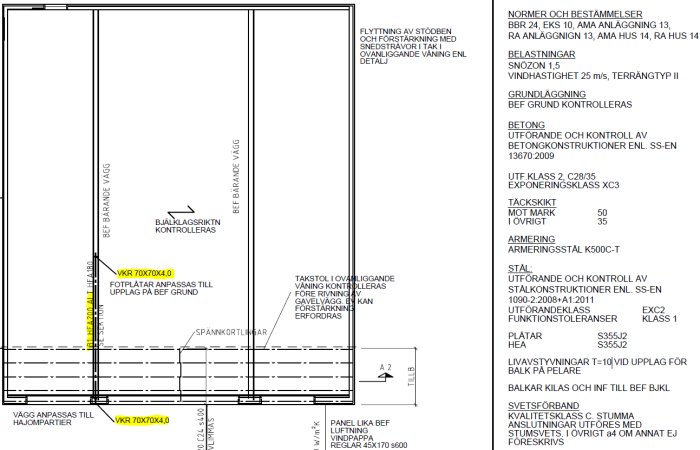
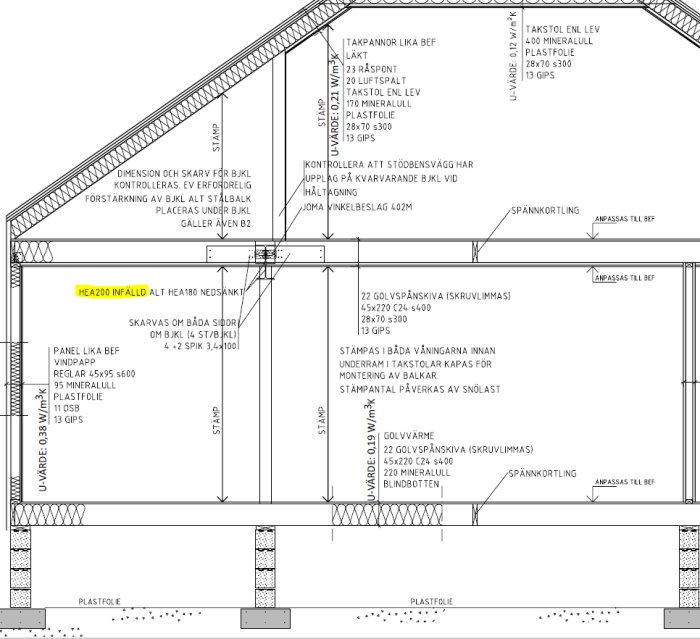
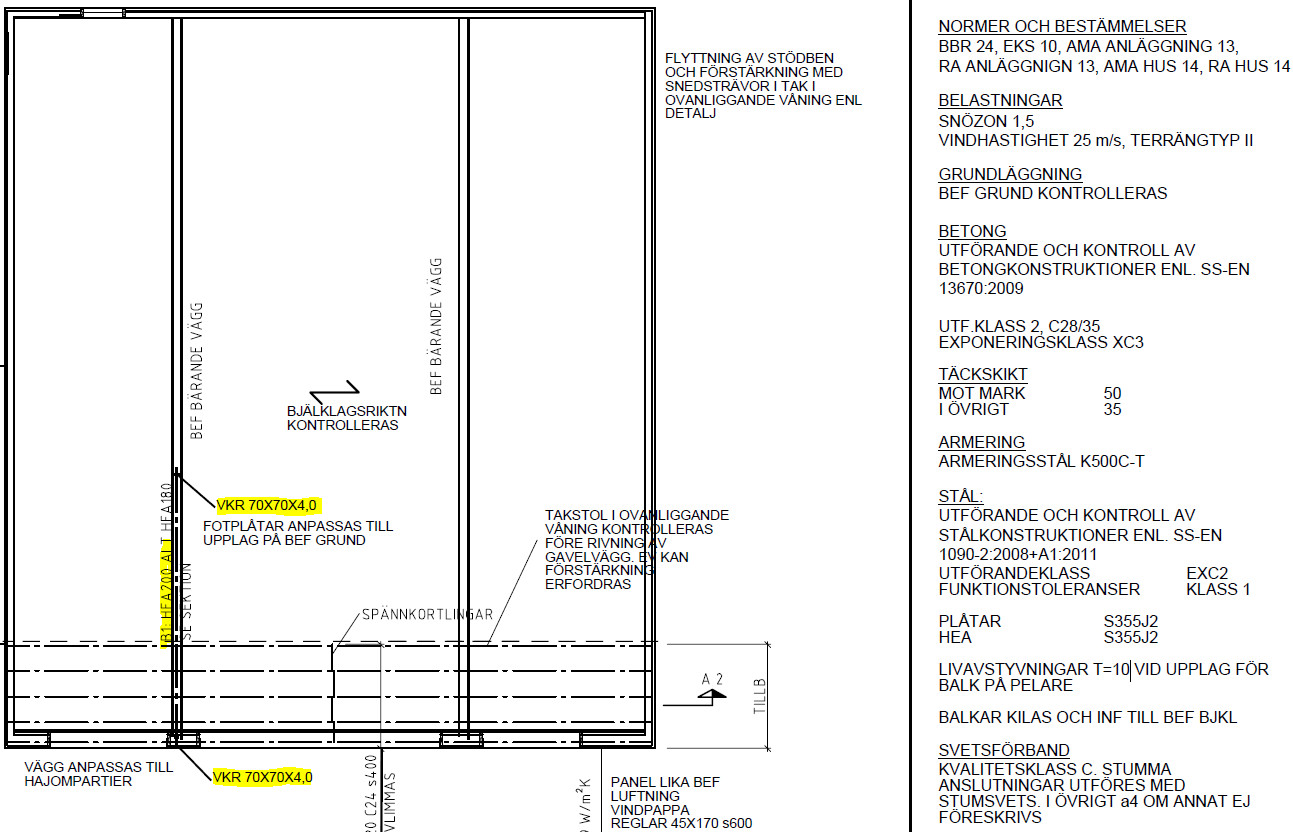
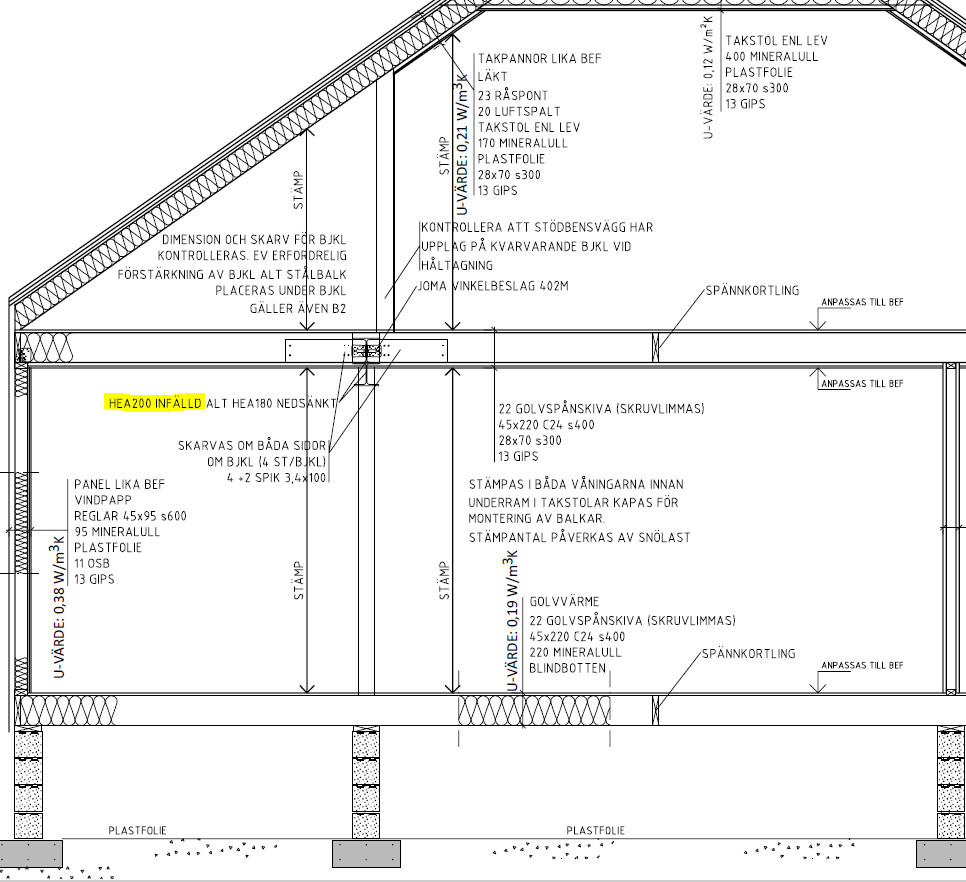
We are expanding at home and will be demolishing a load-bearing wall on the 1st floor of our 1.5-story house. I have received the neighbors' drawings who have an identical house and have done the same expansion, see attached. But there they used 2 VKR 70x70x4 as columns and an HEA200 as a beam to be embedded in the ceiling.
What are the equivalent dimensions in terms of glulam? And for HEA200, what is the equivalent in the same thickness, i.e., how wide does a 200 (195?) high glulam beam need to be?
Snow zone 1.5
You cannot translate from steel to glulam directly without considering the conditions. However, a 200 mm high glulam beam that is supposed to do the same job as a HEA 200 does not exist. The smallest glulam beam that comes close is 215x315 or 215x360 mm.
You cannot translate directly from steel to glulam without considering the conditions. However, there is no 200 mm high glulam beam that can do the same job as a HEA 200. The lowest glulam beams that come close are 215x315 or 215x360 mm.
thank you very much for the response. It's a good indication of whether it's worth digging deeper into or not (and it isn't).
A VKR profile 70x70x4 that is approximately 2.5 m high can withstand an incredibly high load, just under 200 kN, i.e., about 20 tons. From a structural strength perspective, it is an overdesign in this case. I am sure you can use glulam beams. 90x90 mm can withstand about 50 kN (5 tons) at the current height. You have to calculate it with the right conditions.
A VKR profile 70x70x4 that is about 2.5 m high can withstand an incredibly high load, just under 200 kN, that is about 20 tons. From a strength perspective, it is over-dimensioned in this case. I am sure you can use glulam pillars. 90x90 mm can handle about 50 kN (5 tons) at the current height. You have to calculate it with the right conditions.
Okay, and how would you say KKR differs? I understand it's hot-rolled versus cold-rolled, but in terms of strength and also assembling, considering potential welding? Or do you have another suggestion for assembling with the HEA beam and how it should be applied to the foundation wall?
KKR 70x70x4 can handle about 2/3 of the column load that VKR with the same profile can, which is most certainly sufficient. Welding questions are not my department. I would guess that the simplest thing is to weld a plate to the end of the column that is then bolted to the beam, but there are others here in the forum who can do it better. At the bottom end of the column, a welded plate is definitely required so that the bearing pressure does not become too high. This must be calculated with regard to the construction of the foundation wall.
KKR 70x70x4 can handle about 2/3 of the column load that VKR with the same profile does, which is certainly sufficient. Welding issues are not my department. I would guess that the simplest way is to weld a plate at the end of the column which is then bolted to the beam, but there are others here on the forum who know better. At the bottom end of the column, a welded plate is definitely required so that the bearing pressure does not become too high. This must be calculated concerning the construction of the foundation wall.
Thank you! Moving from strength to strength thanks to your input.
New question: the carpenter says it will be too tight with 70x70x4 because an existing wooden column stands outside and it will then protrude into the room. But he asked if it was okay with 100x50x4 instead. Does such have similar carrying capacity to 70x70?
The bottom end will stand directly on the foundation on a metal plate.
It depends on how it is mounted. If it is braced in the weak direction, it improves; otherwise, it becomes significantly worse. There is always an advantage with columns with a square cross-section. Then you don't have to worry about it.
It depends on how it is mounted. If it is braced in the weak direction, it will be better; otherwise, significantly worse. There's always an advantage with columns with a square cross-section. Then you don't have to worry about it.
Not sure how you mean, but if it's as I think, it should be okay in one direction since the existing wooden column will be snug against it. I'm not quite sure what to do about the other side because I don't want to build too much there since the wall will become too thick. But could you place two wooden studs on either side so that 3 out of 4 sides of the column are "clad," and put some sheet metal over the fourth side, between the studs on the side?
If I had access to the right data, I could check if this is a problem at all. Otherwise, you can compare with a standard timber frame wall. The weak direction of the studs is usually braced with noggings, so it's the load-bearing capacity in the stiff direction that becomes decisive.
If I had access to the right data I could check if this is even a problem. Otherwise, you can compare with a regular wooden frame wall. The weak direction of the studs is usually braced with noggins, so it's the load-bearing capacity in the stiff direction that becomes determining.
Thanks, but I actually stopped by the local steel shop this afternoon and shopped for an HEA200 and two kkr 70x70x4. When I saw the HEA, I realized it is by far going to be the most stable thing in our 70s paper house.
Click here to reply
Vi vill skicka notiser för ämnen du bevakar och händelser som berör dig.