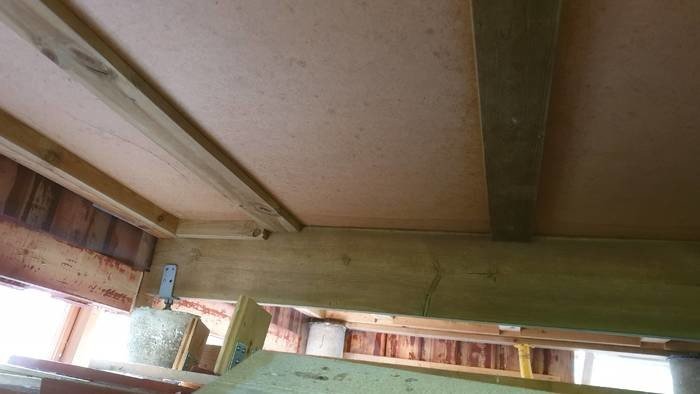
I am going to install a subfloor in an extension and plan to use 6 mm hardboard subfloor panels. Now to the question of how it should be attached. When searching around online, you get different answers.
1) Should it be screwed, nailed, and/or glued?
2) Or should it just be clamped with moldings?
The core question is whether the moisture movements in the panel can be so large that option 1) is ruled out. If there are some moisture movements, is it still okay to screw/nail but not glue?
Another question concerns whether you should tape around the edges or use some form of sealant?
I don't know what is right, but in our house with an open post foundation, it is done like this:
Split 120mm wide deck boards into strips that are 20-25mm wide, which are screwed into the floor joists from the side.
The subfloor is screwed down into these strips, and then taped at all joints (i.e., between the subfloor panels and between the panels and the beams).
If we had more space underneath, we would have screwed the decking as whole planks from underneath up into the joists.
Do you think it will dance salsa down there because of the cold?
It's probably to seal (against wind and rodents) that you need to attach it at all, otherwise it could just as well lie loose. But anyway, given that it should be attached, you want it to stay put, right? Or have I misunderstood something?
But if you usually screw it, then it's not a problem. That's exactly what I'm trying to figure out.
Suggest that you nail or screw the board in place, and cover the edges with that green sealing tape or whatever it's called. Those were the instructions I got when I was building.
I use a 6 mm trossbottenskiva of fiber cement. It can withstand any amount of moisture and is not prone to damage.
Unfortunately, it's only available at Byggmax, but it's worth the trip just for this product.
I attach a 22 x 120 mm treated board under my joists BEFORE I place them (the joists) in position.
Then with cc 600 on the joists, the boards fit perfectly. Once I've placed them, I secure them with a few screws.
I use a 6 mm trossbottenskiva of fibercement. It can handle as much moisture as you want and is not susceptible to damage.
Unfortunately, it's only available at Byggmax, but it's worth going there just for this product.
I attach a 22 x 120 mm treated board under my joists BEFORE I place them (the joists) in position.
Then with cc 600 on the joists, the boards fit perfectly. Once I've placed them, I screw them in with a few screws.
Good luck!
I am aware that fibercementskivor exist and understand that they are dimensionally stable. I've intentionally chosen not to use these because they are inflexible and brittle.
So the question now pertains to hard board made of träfiber.
For an oil-hardened subfloor board, you don't need to worry about moisture movement. It is quite dead in its structure. I screwed my boards in place, although the insulation's backing should suffice. I didn't use tape, just tar paper against the solid wood floor. A summer cottage with an open pier foundation. I was very careful to ensure it was tight everywhere to prevent mice from getting in. I did this in 2013 and it looks good in my opinion.
For an oil-hardened subfloor panel, you don't need to worry about moisture movement.
[image]
Good, now it’s starting to take shape! It certainly seems like many people screw them down. But I am still interested in what the industry practice is. Does anyone know?
The boards are mounted with the smooth side down and clamped with battens (type 25x25 mm) that are attached to the floor joists. Use corrosion-resistant staples, nails, or screws for fastening.
Isn't anyone following the manufacturer's instructions?
Excerpt from Monteringsanvisning_Trossbottenboard.pdf (bolist.se):
It's never wrong to follow the installation instructions. For my part, I think it's overkill with a clamping strip because it takes extra time. Then the insulation has worse contact because the strip is in the way. It's not worth it.
The floors I have opened from the 80s-90s have had the boards laying loose. I have done both myself. Recently, I used a few drywall screws sporadically because that's what I had in my pocket.
Vi vill skicka notiser för ämnen du bevakar och händelser som berör dig.