
9,757 views ·
19 replies
10k views
19 replies
Strengthening wooden beams
Page 1 of 2

I am currently working on my bathroom renovation.
My broken-up floor looks like this:
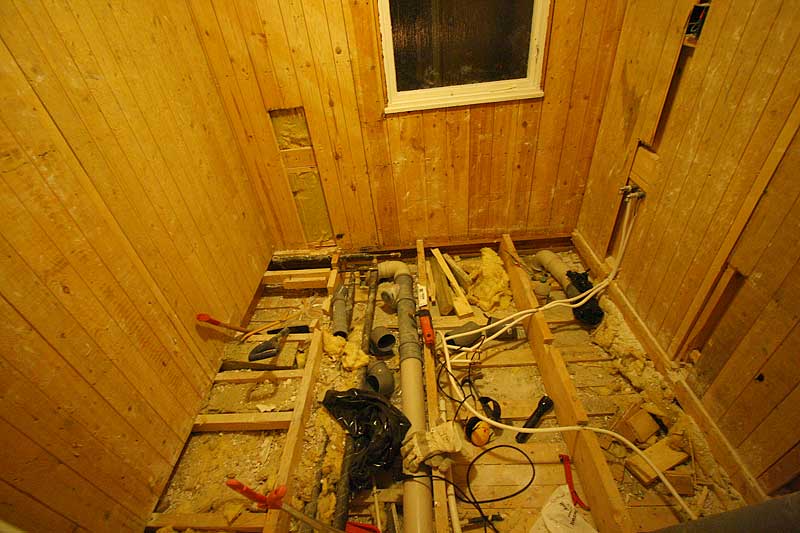
The room is 2.10m X 2.12m in size.
The beams are 21x4.5cm in thickness and are spaced at most cc60.
The drainage and water pipes run crisscross in the wooden framework as seen.
I intend to install slotted chipboard, self-leveling compound, at least 15mm, with reinforcement mesh and then tiles.
The floor is mostly level except for the lower left in the picture where it is 12mm lower than the rest of the floor.
The drainage to the right in the picture is the drain for the toilet. The left drainage is the shower and sewage ventilation that goes downward in the picture.
Do I need to install 22x45 beams to complement the old ones, with holes for drainage, with 75mm holes in the beam at least for the sewage ventilation?
Is it perhaps better to bite the bullet and simply run all the plumbing on the floor below?
My broken-up floor looks like this:
The room is 2.10m X 2.12m in size.
The beams are 21x4.5cm in thickness and are spaced at most cc60.
The drainage and water pipes run crisscross in the wooden framework as seen.
I intend to install slotted chipboard, self-leveling compound, at least 15mm, with reinforcement mesh and then tiles.
The floor is mostly level except for the lower left in the picture where it is 12mm lower than the rest of the floor.
The drainage to the right in the picture is the drain for the toilet. The left drainage is the shower and sewage ventilation that goes downward in the picture.
Do I need to install 22x45 beams to complement the old ones, with holes for drainage, with 75mm holes in the beam at least for the sewage ventilation?
Is it perhaps better to bite the bullet and simply run all the plumbing on the floor below?
Hmm, a little study of Träguiden shows that there aren't really any extreme problems:
http://www.traguiden.se/TGtemplates/popup1spalt.aspx?id=1251
Ex: 21cm high and 4.5 wide, I can cut 105mm (50% of the height) deep and 16.8cm long
If you want, you can reinforce with, for example, 19mm k-plywood at the bottom according to:
http://www.traguiden.se/TGtemplates/popup2spalt.aspx?id=4621&contextPage=5946
Then you can breathe a little easier.
http://www.traguiden.se/TGtemplates/popup1spalt.aspx?id=1251
Ex: 21cm high and 4.5 wide, I can cut 105mm (50% of the height) deep and 16.8cm long
If you want, you can reinforce with, for example, 19mm k-plywood at the bottom according to:
http://www.traguiden.se/TGtemplates/popup2spalt.aspx?id=4621&contextPage=5946
Then you can breathe a little easier.

Don't understand the problem... If you don't have full height over the pipes, just add a strip... Then Tongued and grooved 22mm chipboard...
Then apply quick-drying self-leveling compound.... You can apply it without needing to reinforce... The slope towards the shower is easiest made by, after spreading all the compound, scooping up the compound from the shower drain... you need to scoop a lot to ensure there is a slope...
But for it to work, you should line the drain so no compound seeps into the drain...
Then apply quick-drying self-leveling compound.... You can apply it without needing to reinforce... The slope towards the shower is easiest made by, after spreading all the compound, scooping up the compound from the shower drain... you need to scoop a lot to ensure there is a slope...
But for it to work, you should line the drain so no compound seeps into the drain...
Yes, but the floor has cracked before so I really want it to be as stiff and stable as possible. Do you mean that reinforcement is not needed? I will be using pre-routed chipboard flooring for waterborne underfloor heating.Milkshaken said:I don't understand the problem... If you don't have full height over the pipes, you just put on a strip... Then 22mm chipboard with tongue and groove... Apply quick drying filler on top of that... You can apply it without reinforcing... You create the slope towards the shower most easily by, after spreading all the filler, scooping up the filler from the shower drain... you have to scoop a lot to ensure there's a slope... But for it to work you need to seal the drain so that no filler seeps into the plumbing...
Although the tracked chipboards are considerably weaker than the regular ones. This requires the leveling layer to be self-supporting, and often the leveling compound suppliers want you to apply up to 30 mm of compound on such a board. Reinforcement should always be placed on floor chipboard, according to BBV.
By the way, what is quick-sand leveling compound? I haven't heard that term before. Do you mean a fast leveling compound?
By the way, what is quick-sand leveling compound? I haven't heard that term before. Do you mean a fast leveling compound?
I immediately thought of quick-drying screed, but that can't be right because it doesn't float.
What I don't understand is why everyone is so eager to place chipboard or gypsum on top of underfloor heating. It only slows down the system. Screed has better heat transmission. Sure, it needs to be applied a bit thicker, but it's still faster considering the comparison between floor gypsum and screed.
What I don't understand is why everyone is so eager to place chipboard or gypsum on top of underfloor heating. It only slows down the system. Screed has better heat transmission. Sure, it needs to be applied a bit thicker, but it's still faster considering the comparison between floor gypsum and screed.
I will check what the article number is called for that... Snabbslipsats is a harder bruk and is traditionally applied..... But what we use is liquid....
I will check tomorrow.....
The Snabbslipsats is called 319.... and that's not it
I will check tomorrow.....
The Snabbslipsats is called 319.... and that's not it
318, 319 are both traditional rapid screeds that are applied earth-moist, but you also have 320, which is a viscous rapid screed that can be pumped. It doesn't flow as well as leveling compounds and cannot be applied under 20 mm. If you've laid 15 mm on chipboard in a wet room, I think you have used 4320 or 644
644 is it... Serpo....
http://www.maxit.se/922/pagetype/1/url/2138/section/1/
Very easy to work with...
It's for heated floors... doesn't need reinforcement at just 15 mm... You can lay up to 50mm indeed with heating elements (as reinforcement)...
http://www.maxit.se/922/pagetype/1/url/2138/section/1/
Very easy to work with...
It's for heated floors... doesn't need reinforcement at just 15 mm... You can lay up to 50mm indeed with heating elements (as reinforcement)...
It does not depend on the thickness but on the size of the area combined with the substrate. 644 on chipboard is reinforced when a certain size of the area is reached, simply put.Milkshaken said:
and then you read the assembly instructions from the manufacturer. Page 3 under the heading "Note"
http://se.maxit-cms.com/media/22/pdf/fastofog/SERPO_trabjalklag.pdf
http://se.maxit-cms.com/media/22/pdf/fastofog/SERPO_trabjalklag.pdf