I have a floor of 6x4m with joists running lengthwise at cc600, 230x100mm joists. Since I removed a wall about 1.5m from one short side, I find the floor somewhat bouncy. If you jump gently, it sways uncomfortably much, so I want to reinforce the joist. Then the question arises how
One idea is to screw blocks between the joists, but I don't want to tear up the whole floor. So, it's one row of blocks; the question is whether that helps anything?
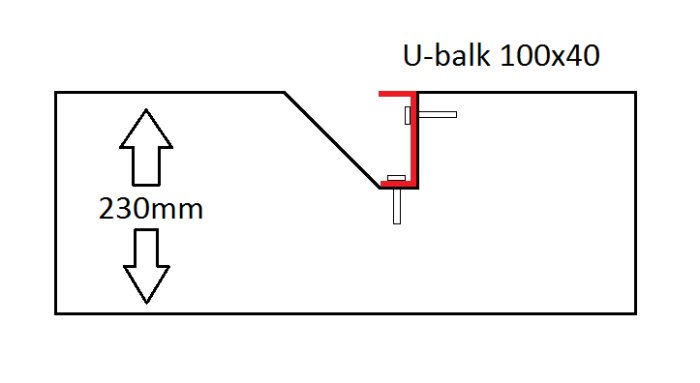
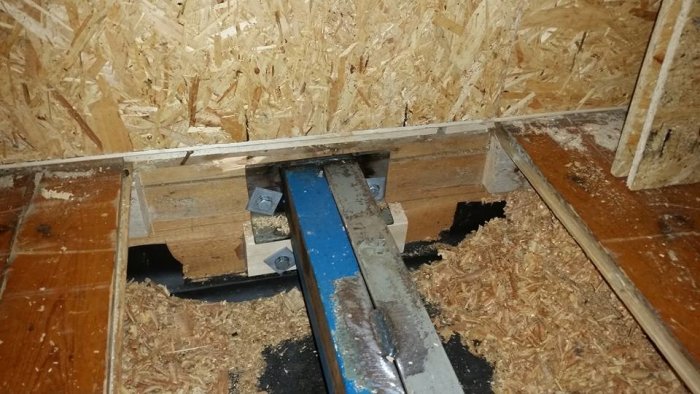
Then I got another idea, to cut into the joists and lay a steel beam across, anchoring it to the outer joists that have support from the walls below. I have a U-beam 100x40 in the works, and the image below shows how I thought.
I was wrong about the beam, it's 100x50. The downside of the method according to the picture is that the actual load-bearing capacity of the joists is drastically reduced, but the beam should be able to handle that instead. I have tried to look for some data, but it wasn't very easy.
In the worst case, I'll lay down two beams, surely that should be enough. I have the beam for free, it's all the drilling for screws that's the annoying part
The easiest way must be to support where you removed it.
Most often when you hear an opening, you place pillars on both sides of the opening and a beam in between. If you just made an opening of 1.5 m, we're not talking about a heavy-duty beam.
Why did you make the opening and can't you have an external beam in the ceiling?
Your option seems to work very well, but it becomes quite expensive and tedious to open up the entire ceiling. It's easier to build pillars of 90x90 and a beam above with, say, two 45x145 next to each other in the opening you made.
If I understand correctly, the wall you removed should only have supported a maximum of two studs in the floor joist system. This means that my dimensioning above is even a bit overdone.
I may have been unclear, I see. The wall I removed is in the room where the floor is And this is on the upper floor, on the ground floor there is a room corresponding to the one I now have on the upper floor with the wall gone. The wall I tore down stabilized the floor.
Doing anything from the ground floor is out of the question as that room is newly renovated with incredibly expensive ceiling panels, among other things.
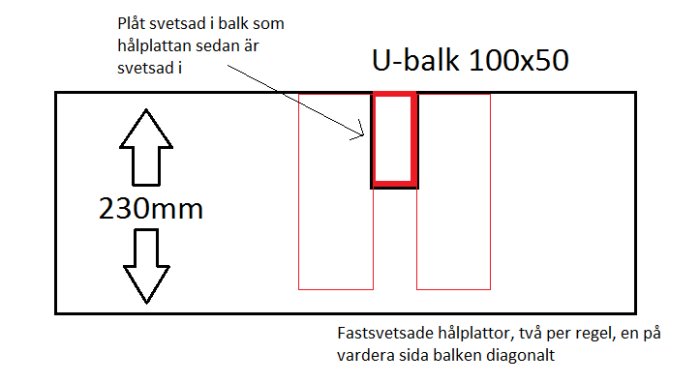
I talked to a friend today who is a carpenter and he suggested instead that I weld perforated plates on both sides of the beam and that went further down on the joist. He mentioned something about the grain and the risk of cracks under load.
It's late now, but I don't understand the construction at all.
The floor that was under a wall you removed became unstable when you removed the wall. How can a wall support an underlying floor?
Exactly right. The wall on the upper floor stabilizes the floor, maybe not in terms of load-bearing capacity but the sway was much less before. The house was built in '35 and has a plank framework, so the walls are quite robust.
This is what my carpenter thought, and I'm leaning towards it as well. First, the notching in the joist doesn't need to be so precise, and then I can avoid drilling a lot of holes in the beam. The downside is that the beam has to go up and down in the house an extra time for welding. The joists are too uneven to measure properly.
No, it doesn't seem to be for me. I'm trying to find a solution based on what I have to work with. So tearing up the entire floor or buying expensive lightweight beams is not an option. U-beams are available to me for free, and the floor structure is already supported on the lower floor, so it's really a question of whether the beam I've chosen is adequate. I'm considering placing two steel beams against each other and bolting them together on site. That way, I get more stiffness, and I don't have to carry a very heavy beam.
Conduct a test. Place the steel beam on supports with the same span you plan to apply floor load to it. 4 meters if I understand correctly. Test load by standing on it. If there is any deflection, you will deteriorate the situation in your floor with the method you propose. You remove most of the load-bearing capacity in what you have and hang everything on the steel beam that already sways with just your load on it.
An alternative and traditional method that can be performed entirely from above (you plan to open up the floor anyway to saw through all the joists). Cross-bracing. Google and look at pictures to see how it works. Use 2"3. Toe-nail from the sides at the bottom of all angled braces. From both directions. Tighten them all at the same time by tapping them down from above while checking the height on all joists with, for example, a line laser. Toe-nail from above. Replace any insulation and the floor.
Works surprisingly well. Much better than straight cross-bracing.
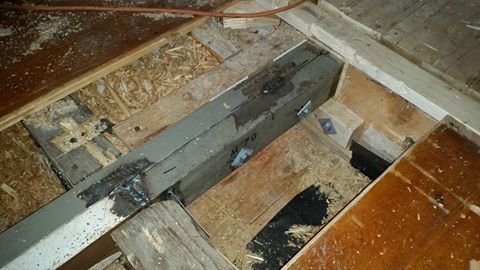
I tested swinging on the beam and it is definitely stiffer than my floor. Dad was here earlier and his first reaction was that he thought a steel beam of 100mm sounded flimsy, so I just went and got another one. I will intermittently weld them together into a square profile and weld on perforated plates according to the picture above. That should definitely do the trick.
Cross-bracing looked like an option, but since I have the beam for free and I don't want to tear up the whole floor, it will be the steel beam. Thanks for the opinions and tips!
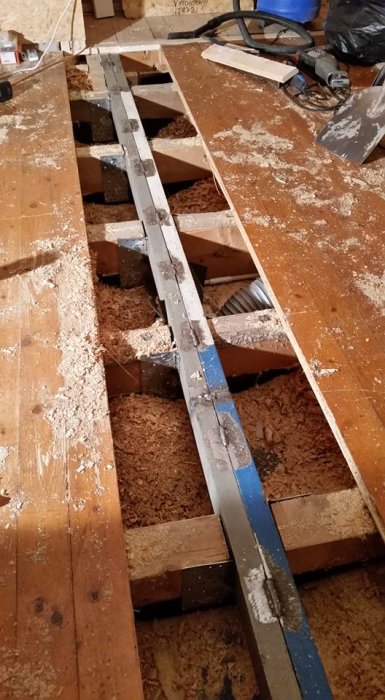
Now the beam is in place, and I'm not satisfied. It's not stiff enough, honestly hard to say if it made any difference.
I definitely haven't put in all this work for this result, so I'll just have to redo it. Or preferably add to it.
I still prefer not to tear up more floor than necessary, so I've been thinking about how I can reinforce with what's there. My idea now is krysskolva but special, of course Traditionally krysskolva seems both cumbersome and time-consuming. Driving down straight pieces is out of the question since the beams are crooked and uneven.
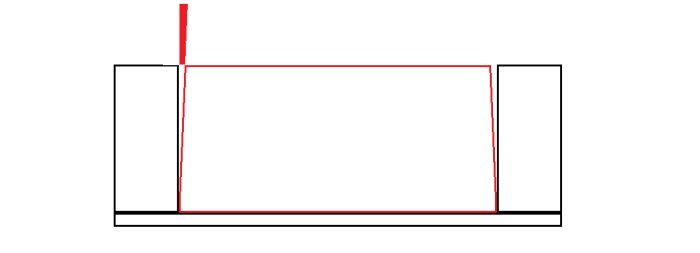
I came up with the idea to drive down a shortling with beveled edges according to the picture, that way you can lower it at an angle and then drive it straight so there's good pressure at the bottom, then you hammer down wedges from above and a lot of glue between everything and screws.
What does the panel say?
Why didn't you cross-brace traditionally right away? You wouldn't have had to take up more floor than you already have. It's the cross construction itself that absorbs the sway; if you do as you plan to, I think it will be just as shaky. But try if you want; you can always cross-brace as a last resort although I'm convinced it's the only option besides a post on the lower floor.
More images would help to understand. 6 m span with partially sawn-off floor joists doesn't sound good.... What is the steel beam resting on at the ends?
The iron beam rests on blocks that I have glued and bolted to the outer beams. The far beam in the picture rests on a reinforced plank wall on the ground floor, which in turn rests on a basement wall. The one nearer outside the picture is bolted to the gable of the house.
There is no sway at the ends of the beam, so I don't think the attachment is the problem.
Vi vill skicka notiser för ämnen du bevakar och händelser som berör dig.