
18,155 views ·
27 replies
18k views
27 replies
Strength of tongue and groove boards?
Yes, what loads can raw planks withstand?
Let's say I plan to use 20mm raw planks as a roof with a given evenly distributed load, what would be the maximum spacing between the roof beams underneath (i.e., the span of the raw planks)?
The roof will be almost flat, about 5 degrees, but we can assume 0 degrees.
Let's say I plan to use 20mm raw planks as a roof with a given evenly distributed load, what would be the maximum spacing between the roof beams underneath (i.e., the span of the raw planks)?
The roof will be almost flat, about 5 degrees, but we can assume 0 degrees.
The load X in kN/m2.anaitis said:
But what is the recommendation of 1.2m based on then? It completely depends on what you plan to have on the roof, just paper or in my case some soil and plants, snow zone 1 or 4.5? I want a value so I know how much margin there is and if I should go for thicker beams and higher centers instead.
Last edited:
Did a small test today. Attached a 22mm raw plank board with two clamps to two euro-pallets with a 1m distance. Then placed my 85kg (=0.8kN) in the middle. The board held but flexed a bit. Since the board was 95mm wide, this would correspond to about 8kN/m2 though all centered on the board. In reality, it would be even gentler as the load is distributed.
I then conclude that a 1m span will not be a problem in my case as such large loads are not relevant.
Increasing to 1.2m doesn't give much benefit in terms of fewer/thicker joists and the fact that it's not a standard distance doesn't matter in this case.
If anyone has a more scientific answer to the initial question, feel free to hit the "reply" button.
I then conclude that a 1m span will not be a problem in my case as such large loads are not relevant.
Increasing to 1.2m doesn't give much benefit in terms of fewer/thicker joists and the fact that it's not a standard distance doesn't matter in this case.
If anyone has a more scientific answer to the initial question, feel free to hit the "reply" button.

Okay, but I already have a factor of at least 3 in my favor and I haven't overloaded the board either. Admittedly, I haven't measured the deflection. Any idea what the factor might be called, roughly how large it is, or where it might be found?
It's called the safety factor, and the value usually varies; if personal safety is involved, it typically leads to a desire for a higher value.
Dimensioning is tricky; it can be a variety of different criteria that are decisive, it's rarely just the breaking load one has to consider...
A bit more information about what you want to do wouldn't hurt.
/ATW
Dimensioning is tricky; it can be a variety of different criteria that are decisive, it's rarely just the breaking load one has to consider...
A bit more information about what you want to do wouldn't hurt.
/ATW
I had thought about building a roof over the car. If it collapses, it's only material damage and not too significant.
The image upload isn't working, but it will be an additional roof connected to the house. Slope about 5 degrees and span of the roof beams at 2.5m.
But the discussion can gladly take a more general dimensioning approach and not just focus on this specific build.
Should I perhaps visit the library to learn more? Any good overall book recommendations in that case?
The image upload isn't working, but it will be an additional roof connected to the house. Slope about 5 degrees and span of the roof beams at 2.5m.
But the discussion can gladly take a more general dimensioning approach and not just focus on this specific build.
Should I perhaps visit the library to learn more? Any good overall book recommendations in that case?



No, that's indeed a risk. But I consider that risk to be small. It won't collapse all of a sudden without any warning; there will likely be indications that something is not right, such as 2 meters of snow on the roof and noticeable sagging in the wood. It would be different if one slept under the roof every night completely unaware of what it looks like.Alfredo said:
Back to focusing on the question, please!


Yes, that's probably how they reasoned when they constructed the Almösund Bridge as well.Nissepisse said:
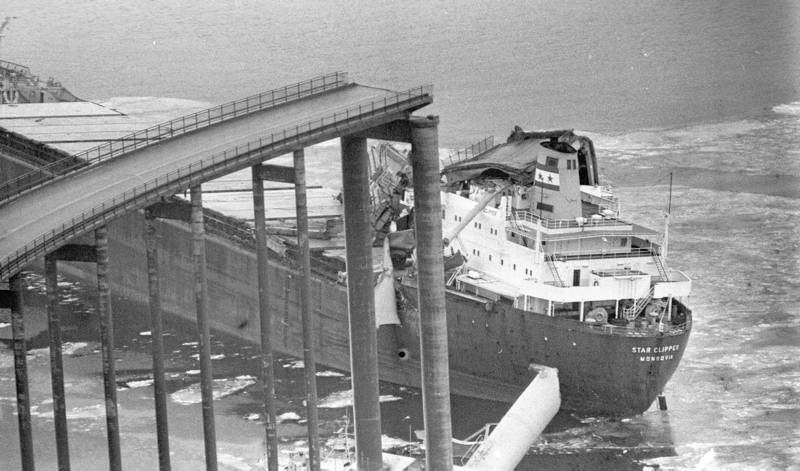
Link:
http://www.gp.se/nyheter/bohuslan/1.289285-bron-som-forsvann-detta-hande
Last edited:
I find it hard to see the connection between a bridge collapsing because a huge damn ship of maybe 20,000 tons crashes into it and the design of my carport.

Yes, the question was about the ridge boards between the rafters. It's likely not particularly dangerous if they start to break, in my opinion.Alfredo said:
Other inconveniences occur much earlier, such as sagging that damages the construction so it, for example, leaks water.
But a dangerous collapse would be if the rafters/roof beams themselves give way, or their attachment points or the standing framework breaks or skews, or everything simply collapses.