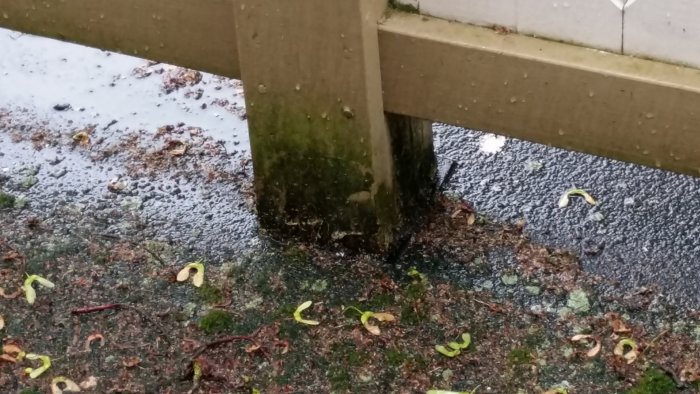
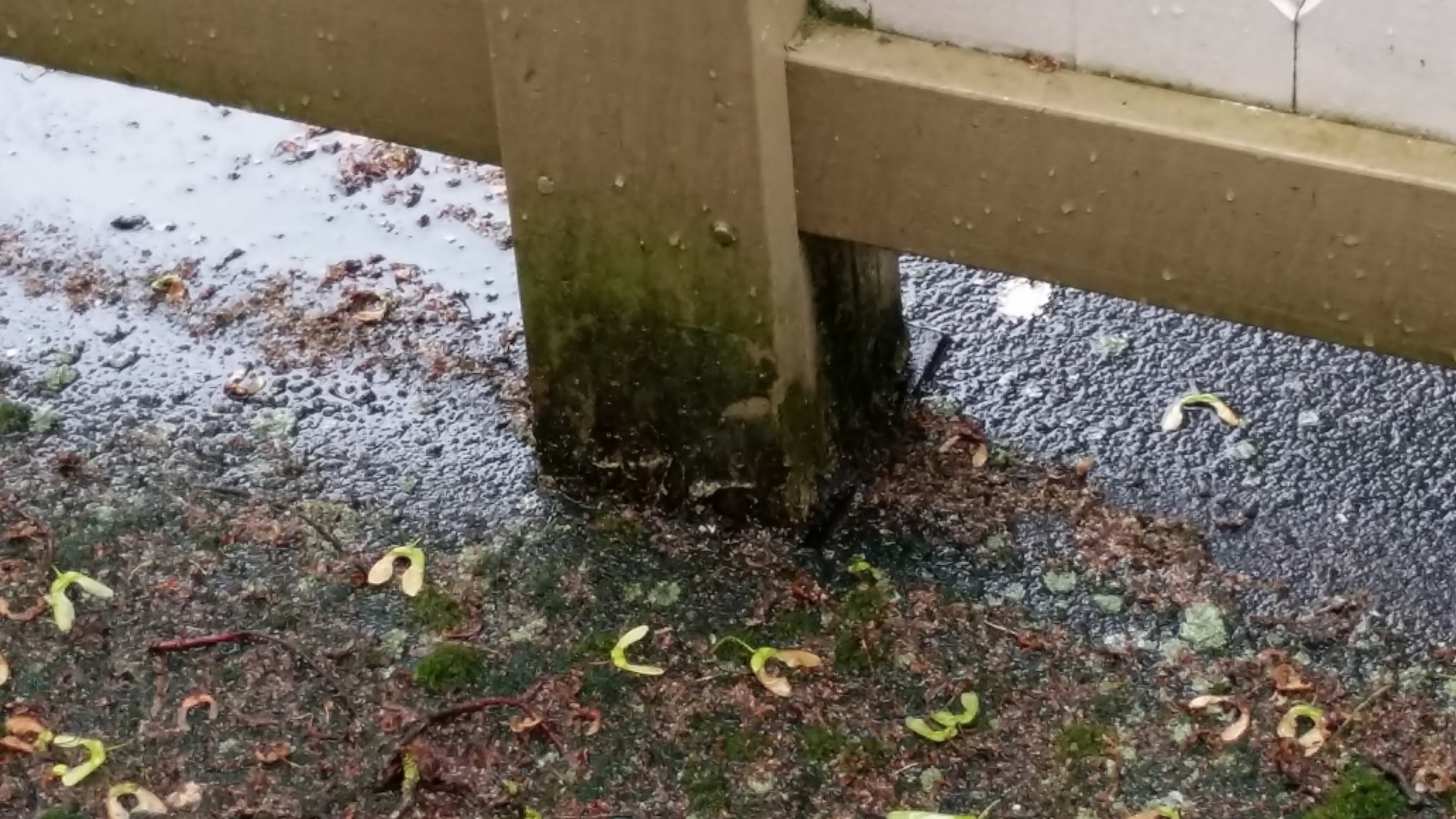
For various reasons, I have some posts for things like a balcony railing that are standing on the floor itself. I previously had through posts that were then load-bearing for the roof, but these rotted as well as the underside of the roof because I couldn't seal the penetration properly.
I built a new veranda but now with lower load-bearing posts and a roof that I then sealed from above, followed by a railing with posts standing on the reinforced surface felt. Naturally (and as expected), these posts are starting to get a bit rotten at the bottom, and I have no idea how to build something equivalent that will be long-term effective. I don't want to make holes in the roofing felt. I built knowing that I would need to replace the posts, but maybe there's a smart solution from you out there
First, lay the paving stone. Then the post. Try to cut the paving stone as small as possible, so that water drains down. Then you can (I would do this) dip the end of the post in old, well-used motor oil! Its minerals protect the wood for many years! I myself placed ordinary pressure-treated posts directly into the ground (dipped in motor oil first) almost 15 years ago. Still holding firmly.
If the posts are still loose on the roofing felt, then a "sacrificial stone" or sacrificial board/block is a good idea. However, you will probably eventually have the same problem with the bottom of the post (even if it's pressure-treated for ground contact).
An alternative to a sacrificial block is to screw one onto the bottom of the post, and let the post end a few centimeters above the roofing felt. Then you just replace the sacrificial block when it starts to deteriorate. The bottom of the post should last a long time.
Another alternative is to make the post two-part and only let one half go all the way down to the felt. This makes it easier to replace the damaged half.
Or some similar variant that suits your fence construction, so you don't have to tear everything down every time it's time to replace.
First lay the paving stone. Then the post. Try to cut the paving stone as small as possible so that water runs down. Then you can (I would do it) dip the end of the post in old, well-used motor oil! Its minerals protect the wood for many years! I myself drove ordinary pressure-treated wood straight into the ground (dipped in motor oil first) almost 15 years ago. Still holding up.
Sure. A single one. Since it is inorganic, it will never cause problems. At the same time, water will very rarely come into contact with the wood. You can use galvanized "shoes". Anything inorganic will do.
Sure. A single one. Since it is inorganic, it will never cause problems. At the same time, water will very rarely come into contact with the timber. You can use galvanized "shoes". Anything inorganic will do.
Hi and thanks for the tips,
Offerbräda.. is it simply to place the post on a piece of board the size of the post?
Also a bit curious about a 'pallningbricka' how could such a thing look?
I've made the posts so that they can be cut off a bit "just in case" and "just in case" happened much faster than I thought.
Maybe cutting them down 10mm and putting offerbrädor on somehow is smart, then I can also place them in a waste oil bath for a while..
What do the molecules in regular motor oil look like? Off the top of my head, it sounds like really bad advice, given that there are actually products specifically designed to penetrate and protect wood.
The reasoning with the sacrificial block might be good advice, if water can never get into the joint between the block and the post, but that doesn't seem particularly likely on a balcony railing?
Given that there aren't many posts, I would buy a bunch of these (or something similar), unscrew the machine-threaded part and use the U-part as a foot on the post, possibly with some sill paper underneath to protect the roofing felt. Before screwing the U-part onto the cut post, I would try to saturate the end grain with wood oil intended for that purpose. But that's just me...
Wood oil hardens oxidatively, making it more and more hydrophilic. This is bad for capillary action. Motor oil will last significantly longer, so it's actually not bad advice. Even better is warm paraffin. Think melted tea light.
The engine oil can remain in the wood, but in the summers it sweats out. Not beautiful. The engine oil might be an old tale, I knew an old man who thought it was the best rust protection for cars. The reason was probably that it was something he had for free. End grain on damp ground is probably the most difficult. Sacrificial parts of wood in various forms are a good idea. You can also lay a whole sill, which might be easier to replace in a few years than individual pieces.
Pallningsbricka or M-gängad stolpsko, offerbräda or marksten, impregneringsolja or motorolja..
Many options (I did like the motor oil option because I recently changed the oil in my ex's car and that motor oil, according to the above reasoning, would preserve until the end of time )
I will cut away the affected parts and then impregnate and prop up with one of your tips. Then painting, and voila, back to work again..
Click here to reply
Vi vill skicka notiser för ämnen du bevakar och händelser som berör dig.