
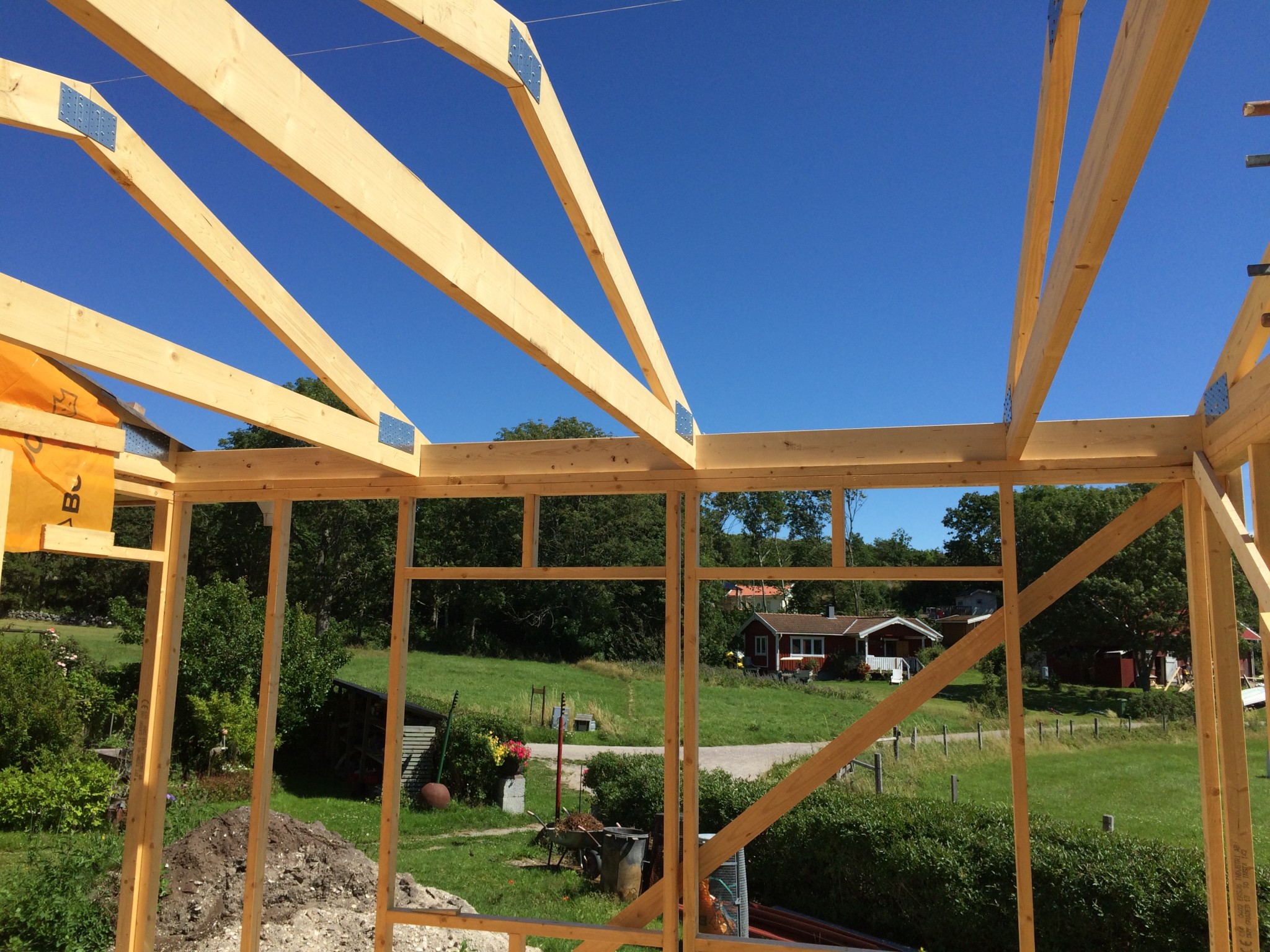
The wall plate is two layers 45x70mm...B bopakoster said:
As mentioned, is it enough to place the attic joists on a surface of 45x25mm and attach them to the spacers, or do I need to cut a 45mm wide slot in them?

It might sound a bit insufficient.
but screw metal brackets to the standing träna, both in the floor joists and rafters,
so maybe that will be enough.
The braces in the picture, are they temporary just during the construction period?
How do you plan to support the building later, so it doesn't buckle?
but screw metal brackets to the standing träna, both in the floor joists and rafters,
so maybe that will be enough.
The braces in the picture, are they temporary just during the construction period?
How do you plan to support the building later, so it doesn't buckle?
Thanks! I remembered now that I will put a layer of 45x95 studs across the roof (more insulation), which will also provide a better base for the internal ceiling studs then!KnockOnWood said:
The diagonal braces are temporary, will be replaced with 2 perforated steel straps perpendicular to each other/wall. Two because the strap only takes up tensile stress.
Now I am really confused and do not understand at all how this roof structure should be constructed.B bopakoster said:
Does anyone else perhaps understand?
@KnockOnWood Since there are window and door openings in the walls, it's not possible to place diagonal tension straps between the wall corners. The wall in the picture above has two sections that are 1x2.4m. A tension strap cross there should work, right? It's the same situation on the gable wall, a tension strap cross over two sections that are 1.2x2.4m should be sufficient, right?B bopakoster said:Thanks! I will remember to put a layer of 45x95 studs across the roof trusses now (more insulation) and that will also provide a better foundation for the ceiling joists!
The braces are temporary, will be replaced with 2 tension straps perpendicular to each other/wall. Two because the band only absorbs tensile stresses.
Or:
If the walls are clad with sheet material, they get a stabilizing function. I'm building with vertical siding on the outside and horizontal tongue and groove on the inside covered with 13mm gypsum. Could the gypsum be sufficient for lateral stabilization?
Sorry for my lack of clarity! I'll try to explain:
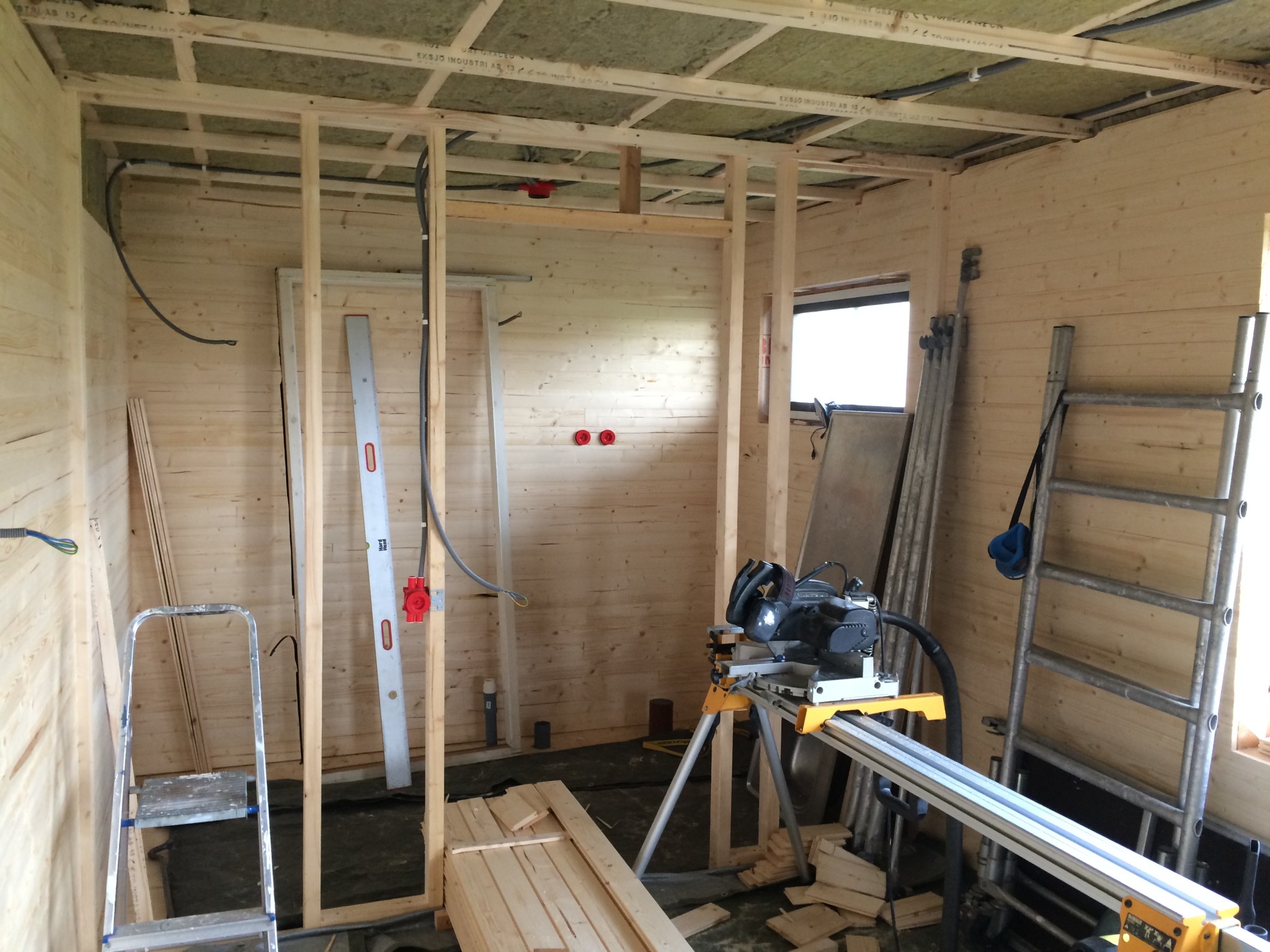
The ceiling structure consists of the trusses' bottom chord 45x145mm CC1200mm and in between, battens 45x145, so the structure consists of 45x145mm battens CC600mm.
Normally, furring strips for the ceiling are used, but I am instead adding two layers of battens to make room for more insulation and an electrical installation layer, first a layer of 45x95mm across the structure, then an additional electrical installation layer of 45x45mm across again.
PS: putting the insulation upwards instead (normal practice) is limited by the low roof pitch of 17°. DS
PPS: I did this in stage 1 of the house renovation last year, https://www.byggahus.se/forum/threads/renovering-av-gardshus-riva-helt-eller-delvis.337652/#post-3233757 one reason for two crossed layers was that I wanted the ceiling panels to run parallel with the long wall...and now I am continuing stage 2 with that construction. DS
Picture from stage one, shows the ceiling with the bottom installation layer's 45x45 battens under the 95mm insulation layer
Last edited:
OK, it sounds like you are handling it in a sensible way. Good luck with the construction!

Click here to reply
Similar threads
-
Brygga av tryggimpregnerat virke, måste den fortsätta oljas?
Lösvirke & Timmerhus -
Ni som lägger mycket tid på jämföra elpris mm
Priser, Kalkyler, Fastighetsskatt m m. -
Översyn av dränering - Första husköpare
Grund & Markarbeten -
Vad har jag hittat för brunn i trädgården?
Vatten & Avlopp -
App som mäter momentan elförbrukning/export till HAN-porten
Villalarm & Hemautomation