I currently live in a room with poor soundproofing and suffer from an unusual condition called Noxacusis.
I would like to soundproof my bedroom and would appreciate help with the types of materials and techniques to use.
I want to prevent outside noise from coming in and disturbing me.
There's a hatch in the ceiling that leads to the attic.
How should one build it so that it doesn't let sound leak through when it's closed?
I plan to install a proper air conditioning/heat pump in this room as well.
Is there a way to do this effectively so that too much sound doesn't get in through the ventilation ducts, making the soundproofing efforts futile?
I'm not an experienced builder.
From my own research, I've learned that gypsum is a common soundproofing material, but I'm not really sure.
I'm thankful for any ideas.
A standalone wall with studs and mineral wool along with tight cladding of boards, gypsum, OSB, or plywood. Soft sealant in all joints. Provides a fairly decent result against penetrating sound. No holes for electrical boxes, etc. Don't forget the door! One can have a door in the existing wall and another in the standalone wall. Both doors must be sealed! Keyholes, for example, are easy to forget.
Windows are also a weak point. 2+1 coupled are usually good so to an existing window, an additional pane can be attached and sealed.
As for the ceiling, building a separate inner ceiling with the new load-bearing walls is advantageous. The attic hatch is done the same way as if it were a door.
An AC or heat pump does not ventilate but only circulates the air in the room and adjusts the temperature. What passes between the inner and outer part is an electrical cord and two small pipes for the cooling medium. The passage is usually sealed with caulk or insulation.
The floor should not be forgotten! Sound can also enter here.
Another thing I find good is to clad the room internally with absorbing surfaces. For example, wall-to-wall carpet reduces echo in the room and provides good sound comfort.
Ventilation! The room needs supply and exhaust air and this needs to be taken from the quietest possible side and then soundproofed.
What essentially dictates how much needs to be done is the sound source. Often there are also some gaps in walls, doors, and open ventilation that can very well suffice if those are addressed first. Small holes leak sound.
I currently live in a noisy room and suffer from an unusual illness called Noxacusis.
I would like to soundproof my bedroom and would appreciate help with what types of materials and techniques should be used.
I want the sound from outside not to come in and disturb.
In the ceiling, there is a hatch leading to the attic.
How should one build it so that it doesn't leak sound when it's closed?
I'm planning to install a proper air conditioning/heat pump in this room as well.
Is it possible to do this in a way so that too much sound doesn't seep in through the ventilation ducts and the soundproofing becomes in vain?
I'm not an experienced builder.
From what I've self-taught, gypsum is a common soundproofing material, but I don't really have a handle on it.
I'm grateful for all ideas.
First of all, really unfortunate about your hearing problems. Which frequencies are the most troublesome? Or are all frequencies bothersome?
First of all, it's really unfortunate to hear about your hearing problems. Which frequencies are the most difficult for you? Or are all frequencies difficult?
I don't know which frequencies are which, but sounds that cause pain are mostly cutlery clatter, screaming voices, cars and buses, creaking in the walls, and running water. The sounds that don’t cause pain I usually hear at an elevated level.
Right next to my room, there is also a ventilation duct with a motorized fan. When it turns on, a dull, burning pain spreads through my ears.
A freestanding wall with studs and rock wool as well as tight coverage of boards, plaster, OSB, or plywood. Soft sealant in all joints. Gives a fairly decent result against intrusive noise. No holes for electrical sockets, etc. Don't forget the door! You can have a door in the existing wall and another in the freestanding wall. Both doors must be tight! Keyholes, for example, are easy to forget.
Windows are also a weak point. 2+1 coupled are usually good so to an existing window, you can add another pane that is sealed.
As for the ceiling, if you can build a separate inner ceiling with the new freestanding walls, it is advantageous. The attic hatch is made in the same way as if it were a door.
An AC or heat pump does not ventilate but only circulates the air in the room and adjusts the temperature. What goes between the inner and outer part is a power cord and two small pipes for coolant. The penetration is usually sealed with sealant or insulation.
Don't forget the floor! Sound can also come in here.
Another thing that I think is good is to cover the room internally with absorbing surfaces. For example, wall-to-wall carpet so it echoes less in the room and provides good sound comfort.
Ventilation! There needs to be supply air and exhaust air in the room, and this needs to be taken from the quietest possible side and then also soundproofed.
What really determines how much needs to be done is what the sound source is. Often, there are also some gaps in walls, doors, and open ventilation which may very well suffice if you start with those first. Small holes let sound through.
Huge thanks for such a detailed response. :3
Your words will be very useful to me.
That thing about air conditioning was especially nice to know. I assume the ventilation that already exists in the room will need some kind of extension.
I won't be able to choose where the air is taken from, but maybe it's possible to soundproof the pipes and vents in some way.
Regarding the absence of electrical boxes, could you do something similar to let power through for outlets as with the cord and pipes for AC? Currently, there are four power sockets in the room that I will probably need to do something with.
Separate inner ceiling sounds sensible. Should it be attached to the old ceiling in some way, or be completely disconnected from it?
Sturdiness from within feels like it would be best, but I'm not quite sure what possibilities I will have there.
I don't know which frequencies are what, but sounds that hurt are mostly cutlery clatter, screaming voices, cars and buses, creaking in the walls, and running water. The sounds that don't hurt I usually hear at an elevated level.
Right next to my room, there's also a ventilation shaft with a motorized fan. When it starts, a dull, burning pain spreads through the ears.
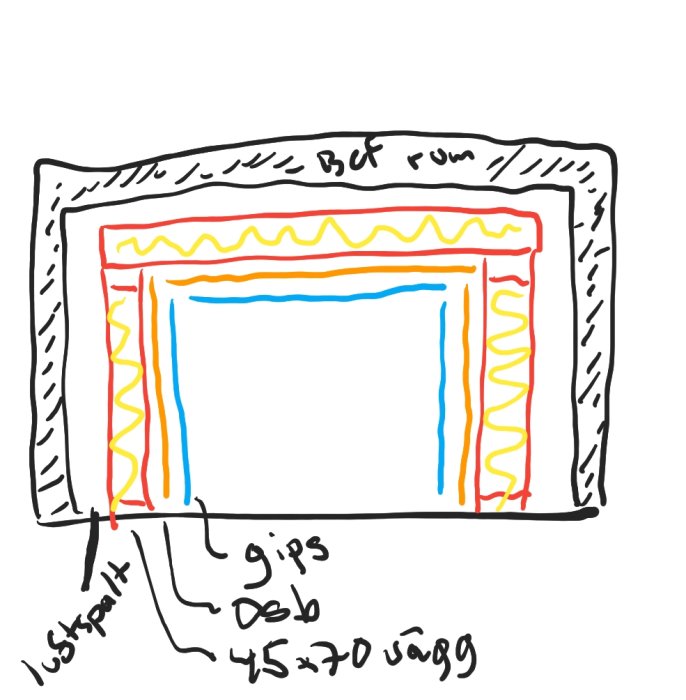
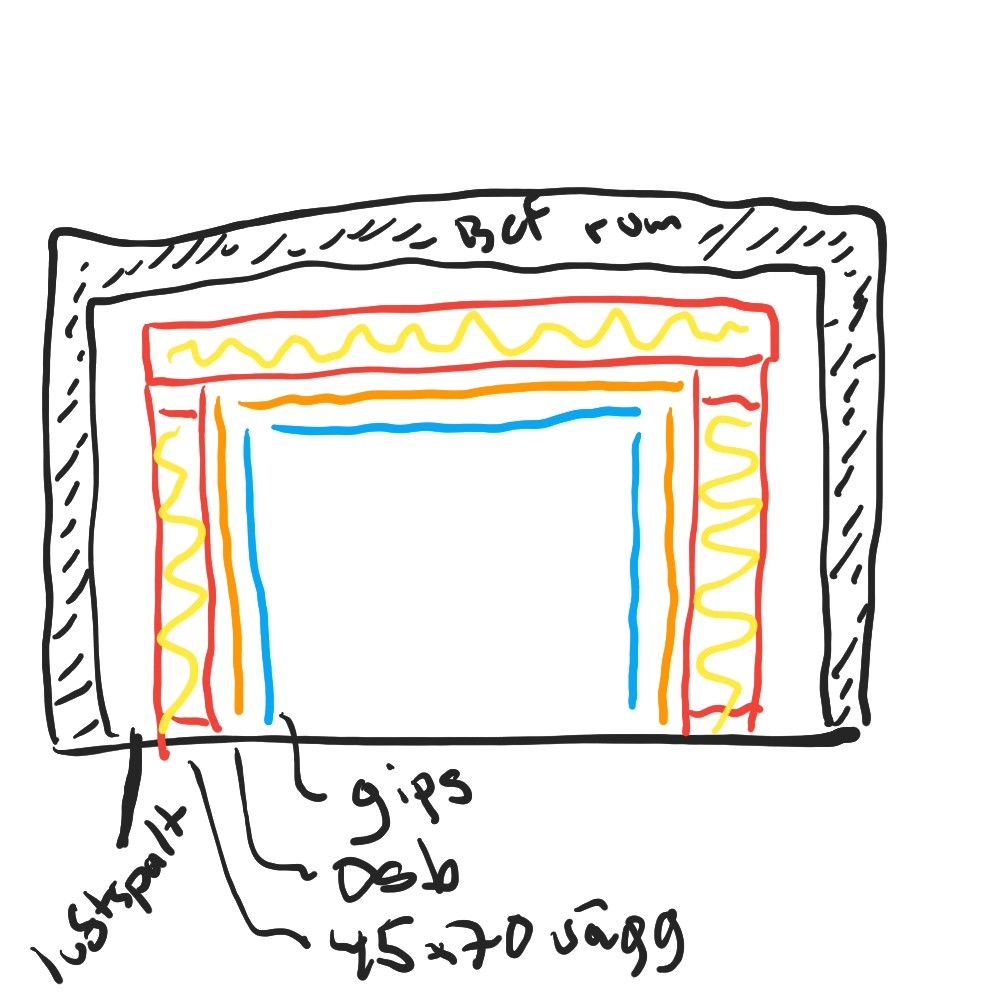
Okay, sounds like different frequencies. Johannes' description is good, what I can add is that the studs in the wall you build up should overlap, and what I mean by that is that the stud against the outer wall is only in contact with the insulation so that the sound can't propagate further to the OSB/plywood depending on what you choose. So the insulation is tracked, in other words, so you have an inner and an outer stud.
Here is a picture of how I envision the wall and ceiling of the room being constructed. Ideally, the floor would be fixed too, but it gets a bit tricky with thresholds and such
Here is a picture of how I imagine the wall and ceiling of the room are built. Ideally, the floor would be fixed too, but it gets a bit tricky with thresholds and such
[image]
Oh wow, big thanks for the picture as well. Nice. :3
I'm a bit doubtful about how good it will turn out, but most likely I'll have to be satisfied with the floor as it is, regardless of the acoustic result. Fortunately, I don't feel particularly disturbed by sounds coming through the floor.
Working with the walls, ceiling, and windows will require a significantly larger effort, and I'm now realizing that I will need two doors (i.e., entrance/exit and closet door) plus the attic hatch, which seems like it could be quite tricky.
Regarding the windows, is there a particular type of glass to look for, or does soundproofing rely more on sealing around the window or something? If I have the opportunity to invest in both, I would gladly do so, but otherwise, it would be good to know what should be prioritized.
If one were to hire professional builders for this, is there any indication of what the cost might be?
Hard to say the price as it depends on what needs to be done and how long it takes. I'm terrible at estimating time
When it comes to glass, there are laminated panes that are a bit better. Thicker is generally better and also with a greater distance between the panes.
Hard to say the price as it depends on what needs to be done and how long it takes. I'm terrible at estimating time
Regarding glass, there are laminated panes that are slightly better. Thicker is generally better and also with greater distance between the panes.
Alright, thanks a lot anyway. :3
What type of wires should you use to hang a ceiling?
Do you need special mounting devices for that?
I imagine it needs to be stable enough both for insulation purposes and also to accommodate the attic hatch.
What kind of wires should be used to hang a ceiling?
Do you need special fasteners for that?
I imagine it must be stable enough both for insulation purposes and to accommodate the attic hatch.
There are ready-made systems for ceilings. But essentially, a string in a loop/hook is enough.
If the room isn't very large, I would focus on attaching the new ceiling to the walls and perhaps support it with a string/wire in the middle so it doesn't sag too much.
Do you happen to have an acoustician in your circle of acquaintances? It might be good to talk to one if you have the opportunity And go over the ventilation a few extra times, both in terms of sound distribution and sufficient air exchange.
That thing with the ventilation duct on the other side of the wall doesn't sound fun at all. Hope it works out!
Do you happen to have any acoustician in your circle of acquaintances? It might be good to talk to one if you have the opportunity And double-check the ventilation a few times, both in terms of sound distribution and adequate air exchange.
That thing about the ventilation duct on the other side of the wall doesn't sound fun at all. Hope it works out!
Thanks. :3
Unfortunately, we don't have any acoustician in the vicinity. The best I can manage is probably to buy a sound meter and listen with my own ears if I can't find someone knowledgeable to hire.
Vi vill skicka notiser för ämnen du bevakar och händelser som berör dig.


Toppentuppen said:
Hello-hello.