I know this question has been asked several times before, but I haven't found a good answer that applies to my situation, so I’m trying with a new thread.
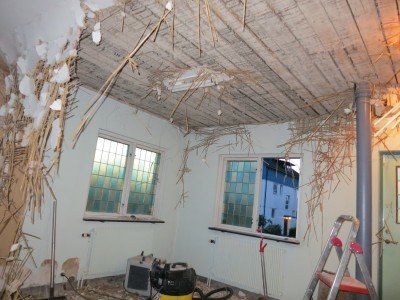
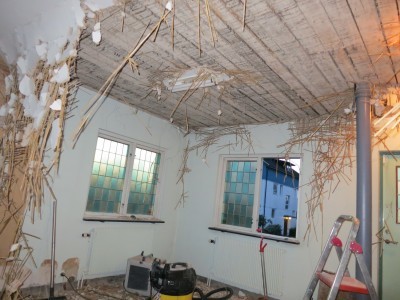
This weekend, I tore down an old plastered ceiling (I know... it was hard to do, but I didn't want to repair it). Now it's time to figure out how to rebuild it to make it right. There's sawdust in the floor joists, and that's something I don't want to meddle with. However, I'm wondering how best to construct the ceiling to soundproof it as much as possible. Primarily environmental noise; I understand that it's difficult to significantly reduce impact noise. I've read about some sort of insulation boards somewhere; is that a reasonable way to solve this? If so, what kind/type should I use?
New electrical wiring and several spotlights also need to be installed in the new ceiling, anything to consider there?
Thanks in advance for any answers, really need help here!
Most simple measures provide very little in terms of improved soundproofing.
Things that are very beneficial are to make the floor structure's own weight very large, that is, as heavy as a concrete floor structure or more.
Building with two separately suspended frameworks, distinct from each other, where one is the floor and the other is the ceiling below, and then filling with mineral wool with the highest possible density also provides significant noise reduction.
It should definitely be a good solution, the ceiling height is 2.50 at the moment so there's some room to play with.
If it's still possible to attach in some way here and there to the current beams, that would be great, otherwise, it might be heavy load on few points. Any ideas on mounting and attaching a free ceiling?
Decoupling of building elements is the most effective way to achieve good sound insulation. There are, for example, isolators resting in rubber for the suspension of ceilings. The number of plasterboards combined with loosely packed insulation (NOT high density) determines the sound reduction index. The plasterboards are overlapped, and it's important that it becomes completely airtight. The first thing you should do is determine what type of noise is perceived as disturbing and where the weak link is in the building's construction. Roofs, walls, doors, windows, etc., need to be addressed together to achieve the desired result. If the problem is, for example, road noise from a distant motorway, you most likely do not need to decouple the ceiling.
The first thing you should do is determine what type of noise is perceived as disturbing and where the weak link is in the building's construction. Roof, walls, doors, windows etc need to be addressed in order to achieve the desired result
+1 on that.
Click here to reply
Vi vill skicka notiser för ämnen du bevakar och händelser som berör dig.