
Hello!
When constructing a slab on the ground, polystyrene (common styrofoam) is typically used.
Styrofoam is actually EPS, which differs from XPS that has a closed cell structure and is more durable and resistant to moisture. XPS also has better strength.
However, XPS is more expensive compared to EPS (styrofoam).
Then I would choose a vapor barrier between the stones (capillary breaking layer) and the insulation.
When constructing a slab on the ground, polystyrene (common styrofoam) is typically used.
Styrofoam is actually EPS, which differs from XPS that has a closed cell structure and is more durable and resistant to moisture. XPS also has better strength.
However, XPS is more expensive compared to EPS (styrofoam).
Then I would choose a vapor barrier between the stones (capillary breaking layer) and the insulation.
Last edited:

Was there a question here? Or did you just want to share some things?
I agree with what you wrote about the cellplast. The most common in villa foundations, however, is EPS, probably due to its sufficiently good properties and being much cheaper.
When it comes to plastic, there are many opinions. Some consider it as a vapor barrier, but it is more common to view it as a radon barrier. And whether the plastic should lie on the gravel or between one of the cellplast layers is also a matter of debate. I personally didn't bother with plastic in our foundation, but instead laid out a radon pipe, since we have a slight radon risk in the ground here.
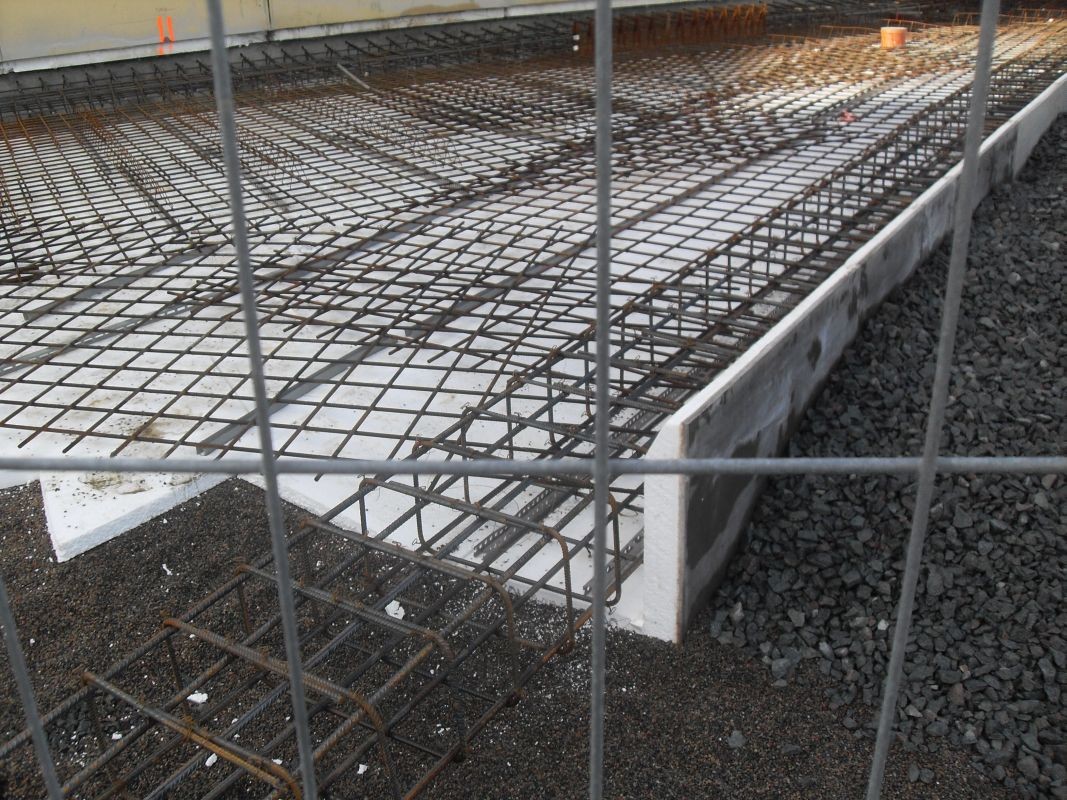
ps What does the picture show? A future bridge? (well, with L-elements ...)
I agree with what you wrote about the cellplast. The most common in villa foundations, however, is EPS, probably due to its sufficiently good properties and being much cheaper.
When it comes to plastic, there are many opinions. Some consider it as a vapor barrier, but it is more common to view it as a radon barrier. And whether the plastic should lie on the gravel or between one of the cellplast layers is also a matter of debate. I personally didn't bother with plastic in our foundation, but instead laid out a radon pipe, since we have a slight radon risk in the ground here.
ps What does the picture show? A future bridge? (well, with L-elements ...)
Hello!
Well, the real question is how to handle the area between the subsoil/gravel and the insulation.
In my opinion, it doesn't hurt to have a foil there, making it vapor-tight/waterproof. Or? At least, it doesn't hurt.
I would say that the plastic should lie on the gravel, so the insulation can't get soaked. For example, construction moisture can't dry out downward, can it? The ground is always moist.
Otherwise, the insulation can partly be considered as protection against moisture problems/moisture migration as well.
But some people think, for example, that the foil breaks down or doesn't hold, etc.
I took the picture in Kållared... I believe it will be a warehouse building. It would be good if the capillary-breaking material were a bit coarser...
Best regards
Well, the real question is how to handle the area between the subsoil/gravel and the insulation.
In my opinion, it doesn't hurt to have a foil there, making it vapor-tight/waterproof. Or? At least, it doesn't hurt.
I would say that the plastic should lie on the gravel, so the insulation can't get soaked. For example, construction moisture can't dry out downward, can it? The ground is always moist.
Otherwise, the insulation can partly be considered as protection against moisture problems/moisture migration as well.
But some people think, for example, that the foil breaks down or doesn't hold, etc.
I took the picture in Kållared... I believe it will be a warehouse building. It would be good if the capillary-breaking material were a bit coarser...
Best regards
Last edited:
The capillary breaking layer is what you see on the outside of the edge elements. The finer "flisen" is only a few centimeters thick and is placed under the polystyrene to create a flat surface for the polystyrene.
Sent from my GT-I9100 using Byggahus
Sent from my GT-I9100 using Byggahus

Is there an explanation for why that's done?Mats said:
What's really thought about the fact that EPS is generally used (instead of XPS)?
When using plastic, you should always be careful. You should avoid trapping moisture. Concrete, etc., should be able to dry, etc.
But having plastic between the gravel and the insulation doesn't seem to be a problem... or?
But having plastic between the gravel and the insulation doesn't seem to be a problem... or?
Reviving the question about plastic. I have a 12 m2 room (bedroom) in a house from '44 that is now excavated. It is DRY everywhere (a mix of stones of various sizes at the bottom, I haven’t had to dig everything out, no soil/clay exposed). I have just added about 4-5 cm of 8/11 untreated crushed stone to even it out. Now I will insulate 250-270 mm in three layers before underfloor heating + reinforcement embedded in about 6-8 cm of concrete. On top of that will be parquet (16 mm). I have understood that the plastic is laid on the concrete, before the felt paper/foam.
1) Do you mean that the plastic should be placed lower?
And,
2) regarding EPS or XPS, I believe I can achieve sufficient insulation value with EPS, and will not load the floor with anything other than a sofa/bed. Is there any reason in my case to use XPS? I have seen that some XPS boards (Styrodur?) are beveled to make it easier to press them together. I haven't seen this with EPS. Is it an advantage worth paying 3 times more for?
and
3) Does anyone have any bad experience with Byggmax's cheap EPS boards?
thankful for answers, planning to shop on Monday.

/U
1) Do you mean that the plastic should be placed lower?
And,
2) regarding EPS or XPS, I believe I can achieve sufficient insulation value with EPS, and will not load the floor with anything other than a sofa/bed. Is there any reason in my case to use XPS? I have seen that some XPS boards (Styrodur?) are beveled to make it easier to press them together. I haven't seen this with EPS. Is it an advantage worth paying 3 times more for?
and
3) Does anyone have any bad experience with Byggmax's cheap EPS boards?
thankful for answers, planning to shop on Monday.
/U
Hello!
I don't know what the others think, but from my side, there are the following points:
1) My point was that the plastic should be placed between the capillary-breaking material and the insulation to protect the insulation from moisture. In any case, I thought it wouldn't be wrong if the plastic is placed there.
2) XPS boards have a different cell structure. I'm used to using XPS in such cases, but maybe EPS also works. XPS usually also has a higher compression strength.
3) I wouldn't say that Byggmax EPS boards are bad. However, you can't retrospectively assess (e.g., after 2 years) if a certain construction works in practice or not. If you have a slab on the ground, you won't be able to access it afterward, and you can't check if the insulation has absorbed moisture or not.
I don't know what the others think, but from my side, there are the following points:
1) My point was that the plastic should be placed between the capillary-breaking material and the insulation to protect the insulation from moisture. In any case, I thought it wouldn't be wrong if the plastic is placed there.
2) XPS boards have a different cell structure. I'm used to using XPS in such cases, but maybe EPS also works. XPS usually also has a higher compression strength.
3) I wouldn't say that Byggmax EPS boards are bad. However, you can't retrospectively assess (e.g., after 2 years) if a certain construction works in practice or not. If you have a slab on the ground, you won't be able to access it afterward, and you can't check if the insulation has absorbed moisture or not.
Last edited:
Ewald,
thank you so much for the quick input. I called LK-systems, whose underfloor heating system my plumber would use. They said that you lay the plastic on the capillary-breaking layer (in my case, crushed stone). Then isolation on top. This is how it is done in new production, and my case can be compared to new production in this regard. (Another thing is, of course, if the concrete is already in place and there is no plastic underneath, then you might want to put plastic on the concrete?). I have also understood that you should never have plastic in two layers. So, it will have to be plastic underneath. EPS should be considered sufficient in my case.
The question, however, is whether grooved/beveled boards are worth paying extra for? Are there EPS boards that are beveled? Otherwise, it might be a trip to Byggmax on Monday.
/U
thank you so much for the quick input. I called LK-systems, whose underfloor heating system my plumber would use. They said that you lay the plastic on the capillary-breaking layer (in my case, crushed stone). Then isolation on top. This is how it is done in new production, and my case can be compared to new production in this regard. (Another thing is, of course, if the concrete is already in place and there is no plastic underneath, then you might want to put plastic on the concrete?). I have also understood that you should never have plastic in two layers. So, it will have to be plastic underneath. EPS should be considered sufficient in my case.
The question, however, is whether grooved/beveled boards are worth paying extra for? Are there EPS boards that are beveled? Otherwise, it might be a trip to Byggmax on Monday.
/U
@ dacolonet
No problem.
You often have to be careful with plastics. You can also trap moisture, etc., if you use plastics in the wrong place.
However, the ground is always moist (100% RH), and drying therefore never occurs downward.
XPS (extruded polystyrene foam) has a closed cell structure as mentioned. The surface is quite moisture-proof, and the material has low vapor permeability.
Yes, if you use EPS (expanded polystyrene foam), it’s not wrong to have a film on the capillary-breaking layer.
Well, EPS is made from small polystyrene beads that expand when heated with water vapor, as far as I remember. The material consists of air-filled cells, thus having an open cell structure.
There are a lot of floor constructions against the ground depending on the properties needed. Concrete that is dense against pressing water (waterproof concrete).
No problem
.You often have to be careful with plastics. You can also trap moisture, etc., if you use plastics in the wrong place.
However, the ground is always moist (100% RH), and drying therefore never occurs downward.
XPS (extruded polystyrene foam) has a closed cell structure as mentioned. The surface is quite moisture-proof, and the material has low vapor permeability.
Yes, if you use EPS (expanded polystyrene foam), it’s not wrong to have a film on the capillary-breaking layer.
Well, EPS is made from small polystyrene beads that expand when heated with water vapor, as far as I remember. The material consists of air-filled cells, thus having an open cell structure.
There are a lot of floor constructions against the ground depending on the properties needed. Concrete that is dense against pressing water (waterproof concrete).
Last edited:
Click here to reply
Similar threads
-
How to insulate around water and sewer pipes in grooves in a slab on grade?
Building Materials and Construction Technology -
Vad är detta för rör? - Dränering platta på mark 60-tals hus
Grund & Markarbeten -
Stolpsko i gjuten betongplatta på mark - hur långt från kant?
Grund & Markarbeten -
70-tals hus, platta på mark, syllar bytt -00 men nu hög fuktkvot igen?
Övrigt husrelaterat -
Vad ska jag välja till villa 190 kvm -74, platta på mark?
Värmepumpar