Hi,
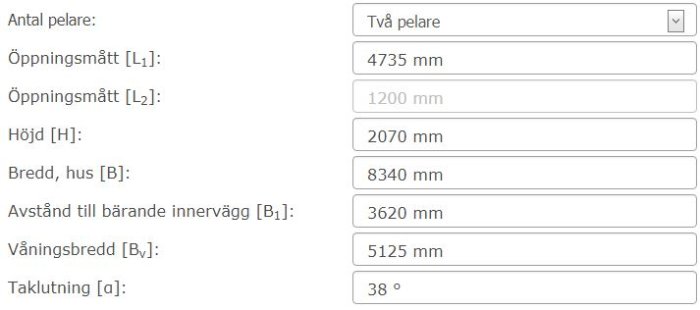
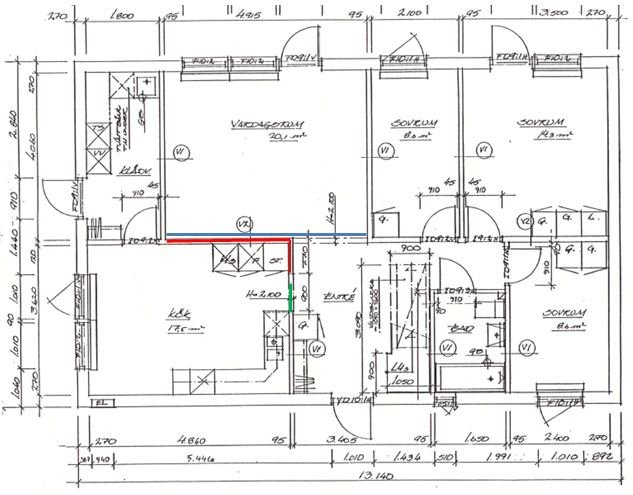
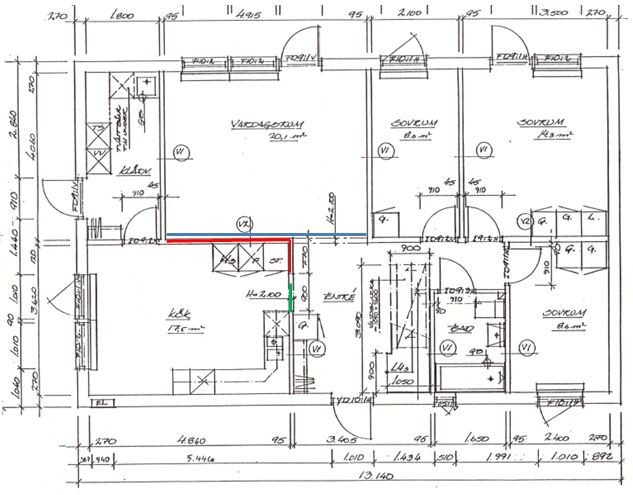
I'm currently in the planning stages of tearing down a load-bearing wall between the kitchen and living room and could use some expert help from you. I plan to open up an existing opening that is currently 1850mm and it should become a total of 4915mm instead. Subtracting the posts that will support the beam, the opening measurement would be 4735mm.
I've calculated it on byggbeskrivningar.se, but it only shows that I'm exceeding the limits of what's approved.
The only approved option would be a glulam beam with dimensions of 115x630. Not feasible.
But after reading various posts on the subject, other dimensions are mentioned that would handle the load for similar openings.
Could I use a smaller dimension, such as 140x270 or 140x315, and it would handle the load?
It's a 1 1/2-story wooden house in Skåne, so the lowest snow zone.
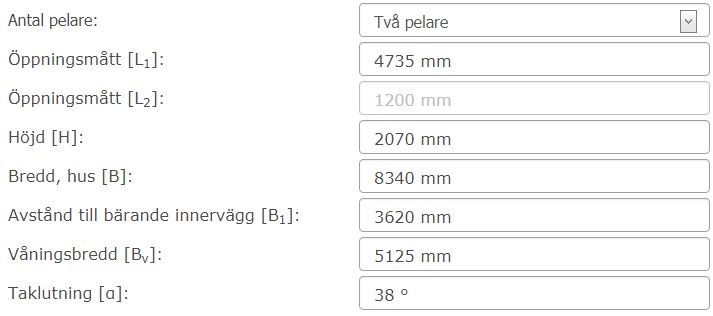
These are the measurements I have and use in the calculation
Grateful for some of your expert knowledge on the subject.
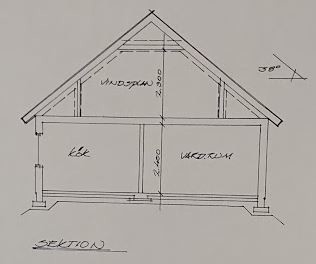
There are two ways to approach the problem. 1) The calculation is correct. In that case, 115x630 exactly corresponds to 215x511. But 215x511 does not exist; the closest standard dimension is 215x540, which is the smallest glulam beam that meets the requirements. 2) The calculation is incorrect. Then I would like to see floor plans and a section before making the calculations. Personally, I believe in 2). Even though it's a considerable span, 115x630 sounds unreasonably large.
I would like to go up a notch in dimension to 115x450. Since the floor joists on the upper floor will rest on this beam, it's important to keep the deflection at a very low level. Instead of 115x450, you can use 140x405 or 190x360.
How do you know it's a load-bearing wall? I can't get the two pictures to match. Shouldn't the labels kitchen and living room swap places on the small picture?
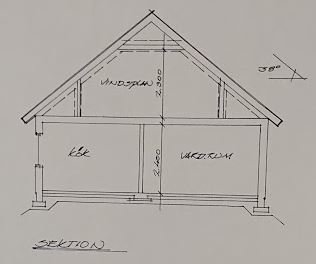
That it is a load-bearing wall is evident from the section. This is a cross-section through the house viewed from right to left in relation to the floor plan.
Clarification—you can see in the section view that the upper floor is based on truss framework.
They need to be supported in the middle, otherwise they bend down or collapse if the spans are too large.
The load-bearing wall running through the house longitudinally is also called a heart wall.
Our house has roughly the same plan and is a 1.5-story villa, so the same solution. We have an opening between the living room and dining room of about 2.5 m where there is an HEA steel beam, probably 120 but maybe 150 mm high.
There is also an opening of 1.7m between the hall and the kitchen, and there it is full ceiling height. Trusses a seem to come c c 1.2 so the question is how it is solved? We'll see when we change the floor on the 2nd floor.
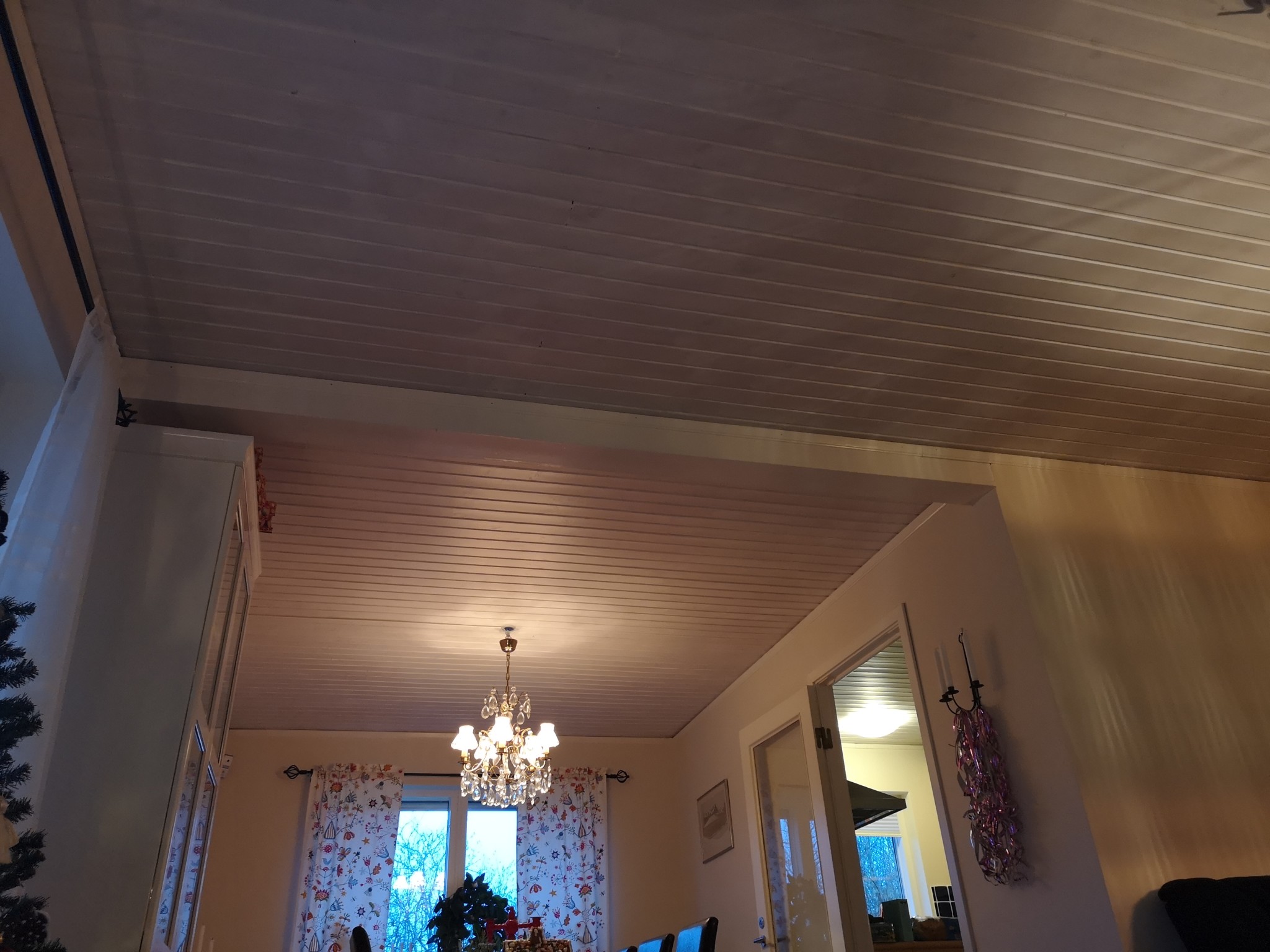
The ceiling height is 2400mm. That's to the inner ceiling, I assume the underside of the rafters is max 50 mm higher.
If you put in a 400 mm high beam, that means only 2000 mm of free height in the passage.
No, it's not worth using a steel beam. Without calculating it, you gain very little.
Using a lower, but wider beam - then it partly rests at the ends on the rise, probably the load-bearing wall. There are limits there too, it's not just sagging that's an issue. Dimension those.
If you could reduce the opening to, say, 3m, it would be a much lower beam.
Alternatively, IF you can consider a supporting column somewhere in the middle. Or a shorter wall section that is left, can, for example, be used as a back wall for a stove?
Right now, we're leaning towards installing a HEA 260.
I've received a quote from a construction company that I believe is quite reasonable.
With a HEA 260, there shouldn't be any issues with deflection.
"Should" in this was to get some opinion from those of you who know a bit more about this than I do.
Right now, I'm just in the process of evaluating quotes. I will receive quotes for different solutions, both with HEA and glulam. The reason I'm leaning towards HEA is due to the implementation. They will fully embed the beam, which means I won't have any visible posts. They will cover the entire beam with plasterboard so it blends in properly. Once I've made up my mind, I will let a structural engineer calculate it. The construction company has made preliminary calculations on HEA260 themselves. But I don't want to spend money on an engineer before I've seen the quotes. Perhaps going about it the wrong way, without an engineer's calculation first and then obtaining quotes based on that. But, oh well...
The advantage I see with HEA is that it adds less to the height. With HEA260 + plasterboard, it will be a maximum of 270. The existing opening today is 330 down from the ceiling. Even though my initial preference was a glulam beam, I've changed my mind. Mainly because the glulam beam would be too high, and I would need an extra post for support.
The quote I've received for HEA seems reasonable to me. 40,000 SEK after ROT. This also includes some other small things.
I can't calculate stuff like this, but when before Christmas I was to replace a load-bearing wall under roughly the same conditions, we got from the structural engineer that either 115x450 or HEA200.
We chose glulam since there was plenty of space.