
Hello. I am renovating a barn measuring 18x10 meters. Part of it will be a garage with a loft above. The size of the loft is 750x880cm with load-bearing walls to lay floor joists on all four walls.
I'm considering the best and cheapest way to solve this. I don't want any interior walls.
My initial idea was to have 3 oversized glulam beams running the 750cm direction evenly distributed along the length, allowing me to lay 45x220 joists perpendicular to these.
Do you think this is a feasible approach? Or should I use glulam directly? (Seems like it would be very expensive).
Or has anyone done something similar and has good suggestions?
Regards
I'm considering the best and cheapest way to solve this. I don't want any interior walls.
My initial idea was to have 3 oversized glulam beams running the 750cm direction evenly distributed along the length, allowing me to lay 45x220 joists perpendicular to these.
Do you think this is a feasible approach? Or should I use glulam directly? (Seems like it would be very expensive).
Or has anyone done something similar and has good suggestions?
Regards

Self-builder
· Stockholm
· 8 775 posts
The dimensioning tables at träguiden indicate that you can manage floor joists in two spans over 880 cm if you go with CC40 and 45x245 C24.J JHLS said:Hello. I'm renovating a barn measuring 18x10 meters. In part of it, I will have a garage with a loft above. The size of the loft is 750x880cm with load-bearing walls to place floor joists on all 4 walls.
I'm contemplating what would be the best and cheapest way to solve this. I don't want any interior walls.
My basic idea was to have 3 oversized glulam beams spanning the 750cm width evenly distributed over the length so that I could place 45x220 joists perpendicular over them.
Do you think this is a viable solution? Or should I go directly with glulam? (Seems like it would be very expensive).
Has anyone done something similar and has good suggestions?
Best regards
220x45 would be borderline with cc40, but if you can live with some sway, it might still work - it probably won't break, and it also depends on what you plan to have in the loft...
https://www.traguiden.se/konstrukti...uktionsvirke-i-tva-fack/?previousState=001000
Thanks for the response!The dimension tables at Träguiden indicate that you can handle floor joists in two spans over 880 cm if you use CC40 and 45x245 C24
220x45 would be on the verge with cc40, but if you can live with some sway, it might still work - it probably won't break, and it also depends on what you will have in the loft...
[link]
My idea is to have glulam as a first layer as a "carrier beam" or whatever you want to call it, and then place 220x45 across these. I'm not worried about the 2-inch studs. It's the dimension needed for the glulam that is the big question.

No response but I would consider replacing at least one of the glulam beams with a HEA/HEB to be able to have such a beam trolley on it and lift things around. Then, of course, you have to size up the beam to take load from below as well, but it might be worth it.
Do the existing walls handle the weight of a floor and what you will have in the loft?
Do the existing walls handle the weight of a floor and what you will have in the loft?
Self-builder
· Stockholm
· 8 775 posts
Ah, there the wood guide has a recommendation for floor joistsJ JHLS said:
750 cm in a bay (i.e., without a column) -> 90 x 360
https://www.traguiden.se/konstrukti...ar-av-limtra-i-ett-fack/?previousState=001000
BUT that's with cc 60. You will be using "cc" 440 cm and not this directly as joists. So, you will have to do some calculations instead, I would say.
But if you don't have high demands on deflection, it probably isn't critical exactly how thick it is, as long as it is "sufficient."
I tried Beijer's tool (below) and chose to calculate on a ridge beam, which should be a similar scenario (it wasn't possible to calculate the support structure you want).
Then I got:
Ridge Beam in Glulam 115x630 GL30c
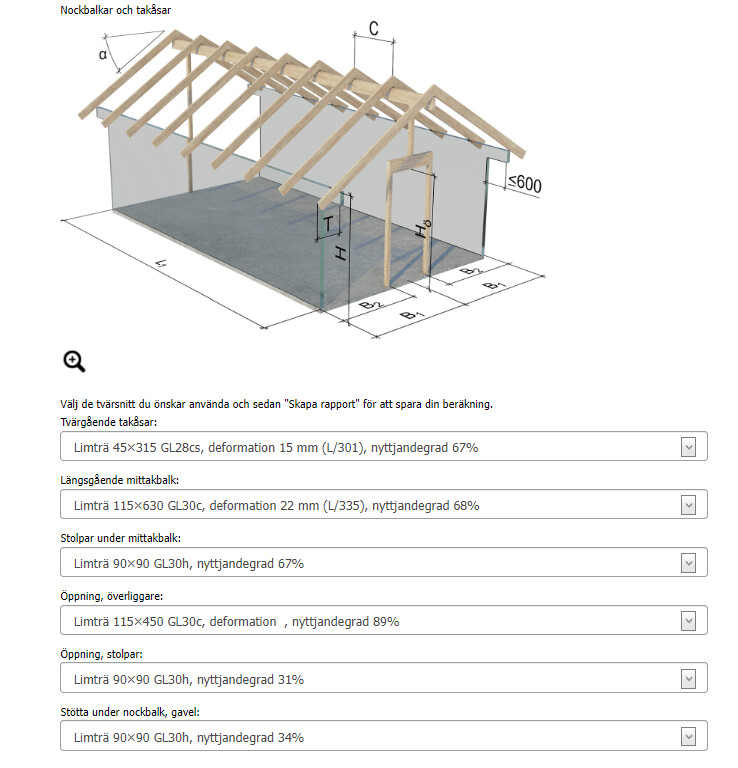
https://www.byggbeskrivningar.se/dimensionering/
https://www.traguiden.se/konstruktion/limtrakonstruktioner/dimensionering-av-limtrakonstruktioner/
https://www.traguiden.se/globalasse...sioneringsexempel/ex01_fritt_upplagd_balk.pdf
I already have a hoist beam with a trolley at the ridge, otherwise, it’s a wise thought that many probably forget. Yes, the walls can handle it. There is an existing floor, albeit with a poorer span, and many tons of hay have been stored in the loft before. The new floor will be around 40 cm above the old one. So I can keep it when I build up the new one.tommib said:
No answer, but I would consider replacing at least one of the glulam beams with an HEA/HEB to be able to have such a beam trolley on it and lift things around. Then you need to dimension the beam to be able to take weight from below as well, but it might be worth it.
Do the existing walls handle the weight of a floor and what you plan to have in the loft?
Click here to reply