
8,135 views ·
10 replies
8k views
10 replies
Should I worry about the choice of screw (C4)?
Didn't want to take over an old thread, so I'm starting a new one with my thoughts.
I was advised at Bauhaus to buy Essve C4 in various formats for the construction I was going to do. Namely:
- Reinforce under the existing decking with more beams/brackets
- Attach the sunroom to the facade
- Attach the sunroom to the decking/beams
- Replace some existing screws
After going to another hardware store to buy more screws, they said it was inappropriate to use C4 given that I live by the sea on the west coast. (Something the others knew as well...)
Here are some pictures of the completed construction. There are 8 8x100 C4 holding the roof at the back fastened into the facade.
Each front post is fastened with 4 8x100 C4 into the beams under the decking.
Then there are beams in brackets underneath, fastened with 6x100 C4.
The question is whether I should be worried that it will fall on my head or if I'm worrying unnecessarily
I was advised at Bauhaus to buy Essve C4 in various formats for the construction I was going to do. Namely:
- Reinforce under the existing decking with more beams/brackets
- Attach the sunroom to the facade
- Attach the sunroom to the decking/beams
- Replace some existing screws
After going to another hardware store to buy more screws, they said it was inappropriate to use C4 given that I live by the sea on the west coast. (Something the others knew as well...)
Here are some pictures of the completed construction. There are 8 8x100 C4 holding the roof at the back fastened into the facade.
Each front post is fastened with 4 8x100 C4 into the beams under the decking.
Then there are beams in brackets underneath, fastened with 6x100 C4.
The question is whether I should be worried that it will fall on my head or if I'm worrying unnecessarily
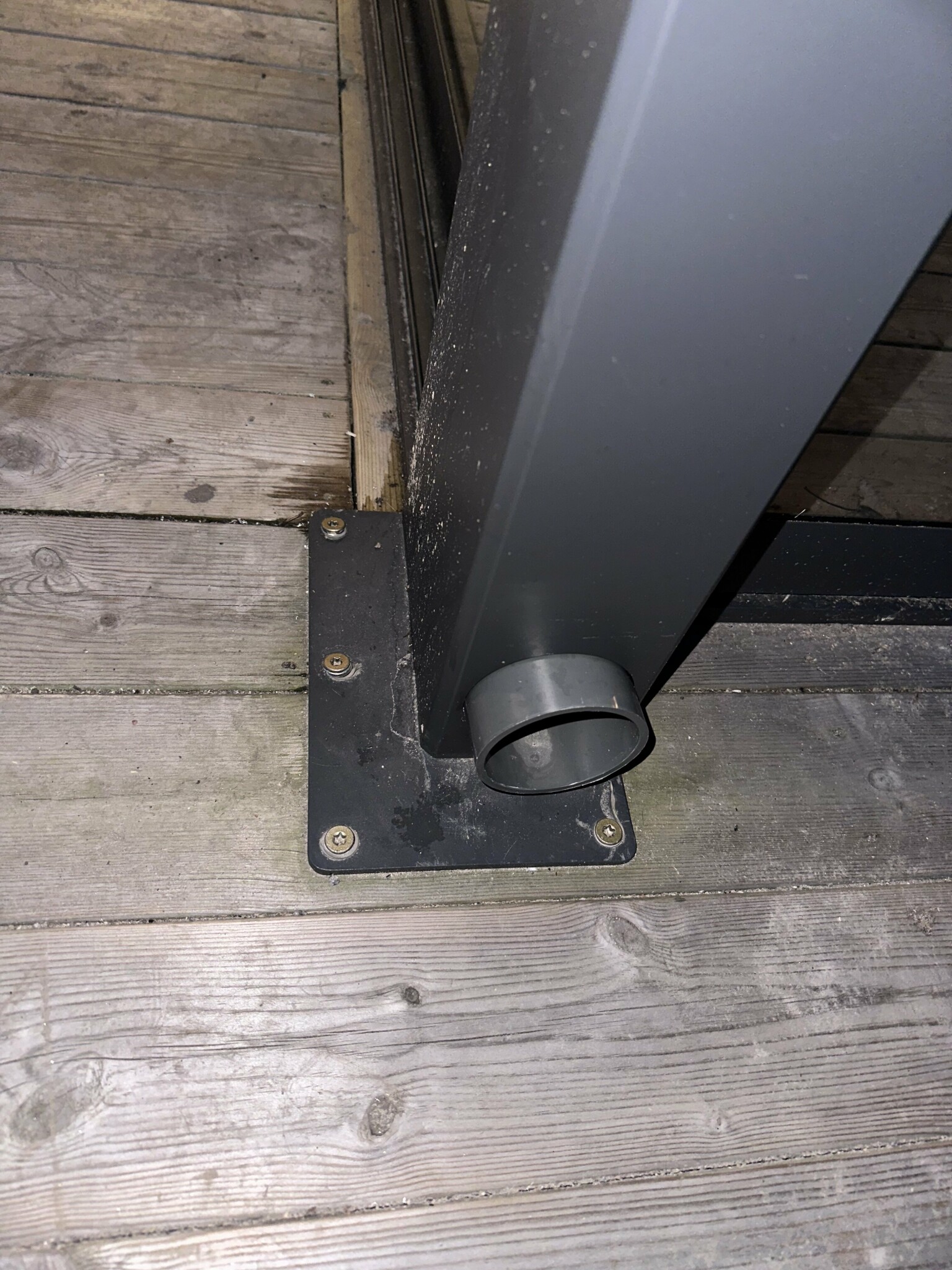
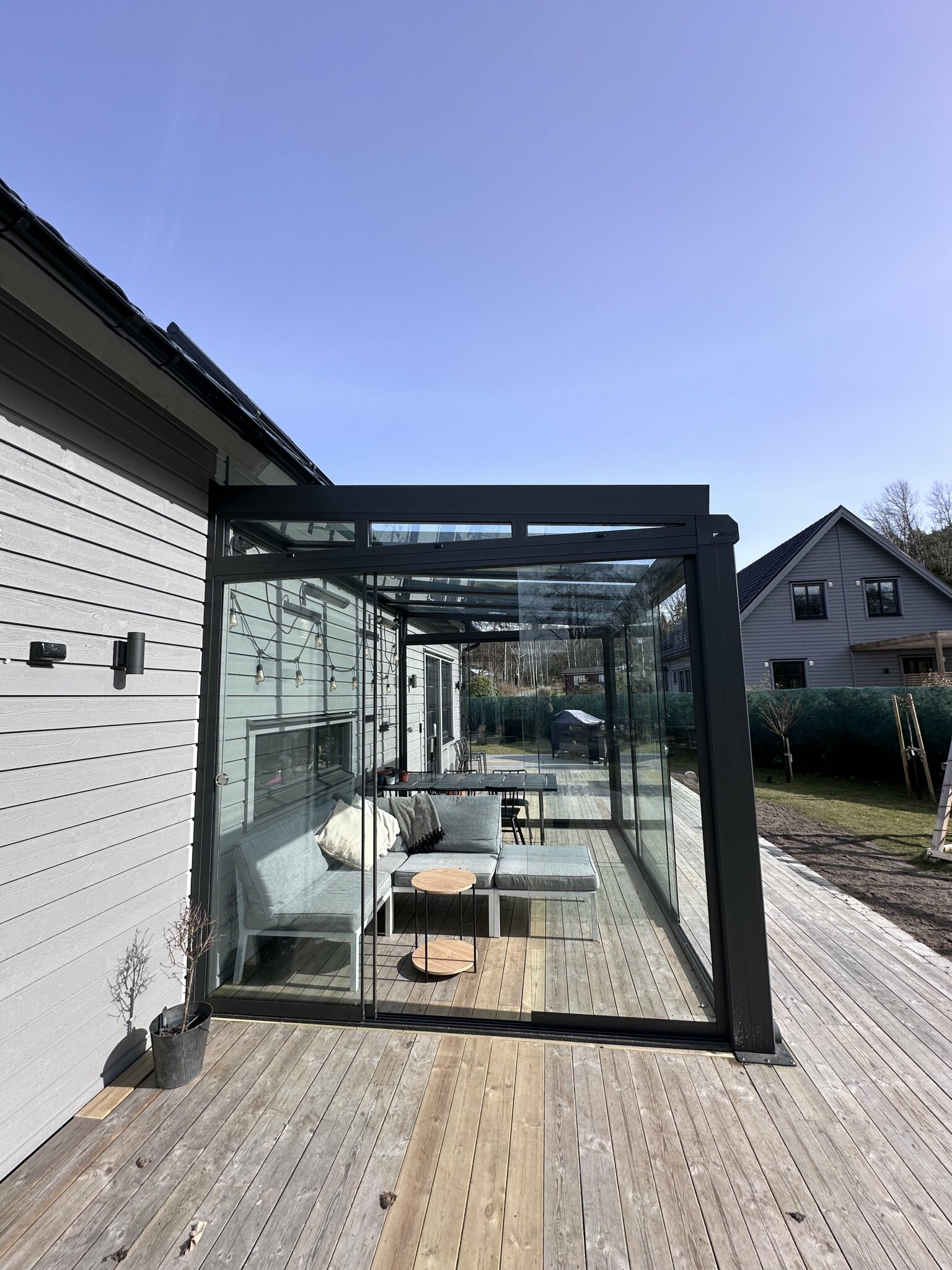
C 4 is intended for coastal outdoor use, as Woody writes
https://hejdes.woody.se/tips-inspiration/rostskyddsklass
We have used C 4 for both decking screws and construction for many years, and have never received any complaints in 20 years.
If we go back say 10-15 years, we nailed all the outdoor constructions, and these still hold up, and galvanized is considered inferior to C4.
C4 – OUTDOORS
Handles high humidity and air with moderate amounts of salt, making C4-classified products suitable for outdoor use and in coastal environments. A common C4 surface treatment is ZiniC-4, which is a mixture of zinc and nickel. It provides a hard, durable surface treatment that also maintains the performance on screw tips and threads. C4 has almost become the standard in Sweden, and products often found in this class are decking screws and wood screws for outdoor use. ZiniC-4 Torx from FAST is a common screw in this class. Stainless steel A2 also falls into this class, even though it is not a surface treatment, but an alloy of steel and chromium, which meets the requirements for the class.https://hejdes.woody.se/tips-inspiration/rostskyddsklass
We have used C 4 for both decking screws and construction for many years, and have never received any complaints in 20 years.
If we go back say 10-15 years, we nailed all the outdoor constructions, and these still hold up, and galvanized is considered inferior to C4.
Last edited by a moderator:
That was reassuring! Thank you for a quick response. I just seemed to find information pointing out how unsuitable it was, which eventually made me a bit blind.Rejäl said:C 4 is intended for coastal outdoor use, as Woody writes
C4 – OUTDOORS
Handles high humidity and air with moderate amounts of salt, making C4-classified products suitable for outdoor use and coastal environments. A common C4 surface treatment is ZiniC-4, which is a mixture of zinc and nickel. It provides a hard, durable surface treatment that also maintains performance on screw tips and threads. C4 has almost become standard in Sweden, and products often found in this class are decking and wood screws for outdoor use. ZiniC-4 Torx from FAST is a common screw in this class. Stainless steel A2 is also in this class, although it is not a surface treatment, but an alloy of steel and chrome that meets the class requirements.
[link]
We have used C 4 for both decking screws and construction for years, never received any complaints in 20 years.
Going back say 10-15 years, we nailed all external constructions and they hold, and galvanized is considered worse than C4.
It's also a bit difficult for a hobbyist to know...
Sorry, but that doesn't say much. If I order a carpentry job and the screws are rusty after 5 years, I find it completely pointless to complain. I don't think any company would admit they chose the wrong screw; instead, there would be a flood of excuses.Rejäl said:
What doesn't say much? You can find faults in everything, like on a car, the rust protection guarantee usually doesn't cover visible rust, only significant rust on load-bearing structures for example.T Thomas_Blekinge said:
To say a C4 screw wouldn't hold up outdoors as it's tested for is just ridiculous...it's the second highest quality that is normally assumed...
Then if you hammer and hit the screw so the coating disappears, it's hardly the manufacturer's responsibility...
I have no opinions on C4's suitability. I just mean that the argument you present "No complaints" says nothing. If you had said: "I have checked 20 constructions after 5 years and not found corroded C4 screws" it would have been different. But the absence of complaints is not an argument.
There has never been a problem with C4 construction screws 6-8 mm for screwing together the frame and attachment.F fekberg said:
I screwed my entire conservatory with
ESSVE construction screw ET-T with Ø8.2 mm intended for joining timber parts, construction timber, glulam, etc., both indoors and outdoors.
The problem is decking screws where the decking moves up to several mm over the year.

Hot-dip galvanized square wire nails. Completely superior. I, who am involved in renovations, have noticed that screws are mostly a problem. After a few years, they have rusted stuck in the wood and cannot be removed. Additionally, they are brittle and if you look at a 10-year-old load-bearing screw joint in wood that moves more with the seasons, it's common for half of the screws to have broken straight off.
Is it then a question of reduced load-bearing capacity or just that it's difficult to remove when replacing planks or the like? What I'm originally worried about is that the screws will snap, and the whole thing will come crashing downH heimlaga said:Hot-dip galvanized square wire nail. Completely superior. I, who am involved in renovations, have noticed that screws are mostly a problem. After a few years, they have rusted in the wood and cannot be removed. Additionally, they are fragile, and when you look at a 10-year-old load-bearing screw joint in wood that moves with the seasons, it's common for half of the screws to have snapped straight off.

You don't need to worry about the load-bearing capacity of that construction. The C4 surface treatment is good enough for your assembly. What could happen over time is that you might get slightly rust-colored screw heads if you live very close to the coast, where salty humid air constantly blows onto the construction. However, the screw itself is mostly screwed into the wood, which means the saltwater doesn't reach it in the same way. If after 7-10 years you find that those holding the feet in the deck start to look too rusty, simply replace them with new ones. Those in the roof construction are mostly covered by the roof and therefore do not get particularly much moisture on them. Corrosion mainly occurs when there is constant moisture exposure, such as a decking screw easily submerged in wood; a vertical assembly prevents much standing moisture. When screws are tested for the C4 corrosion class, no more than 2 out of 10 screws can show any hint of rust after a cycling in a salt spray chamber that simulates 15 years of outdoor use. By hint, it means rust spots, not a weakening of strength or properties.
Click here to reply