I know there are other threads on the topic but I can't find answers to my questions there and would like to take what's mentioned in several of them further into a cohesive discussion.
I'm renovating a log house from the early 1900s that has been affected by house fungus. Everything inside the house is gutted, and I'm in the process of building a new crawl space foundation from scratch. I've decided to go with a solution that includes an inspectable crawl space with a sorption dehumidifier due to the house fungus. Therefore, I need a sealed foundation, as the sorption dehumidifier will otherwise consume unnecessary energy if outside air gets in.
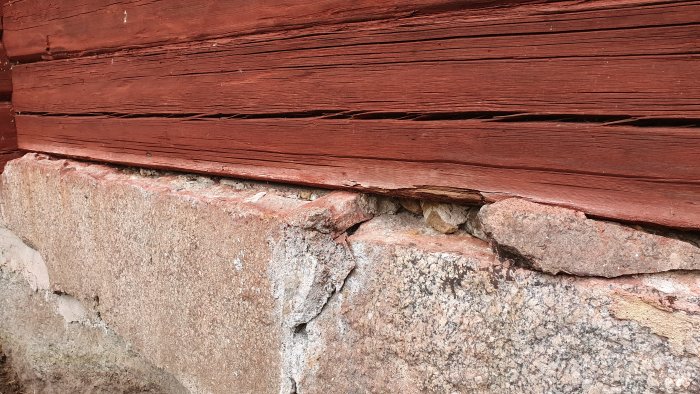
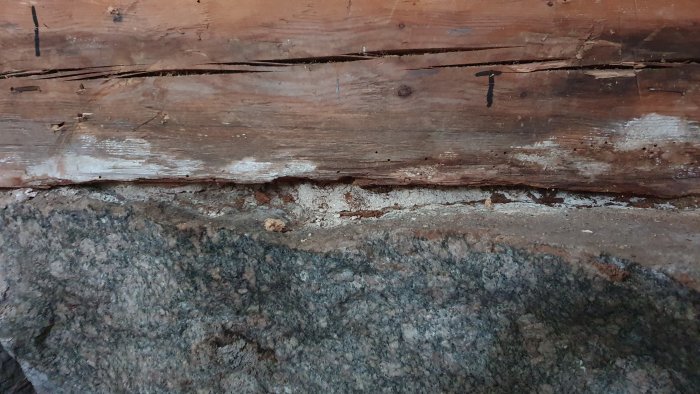
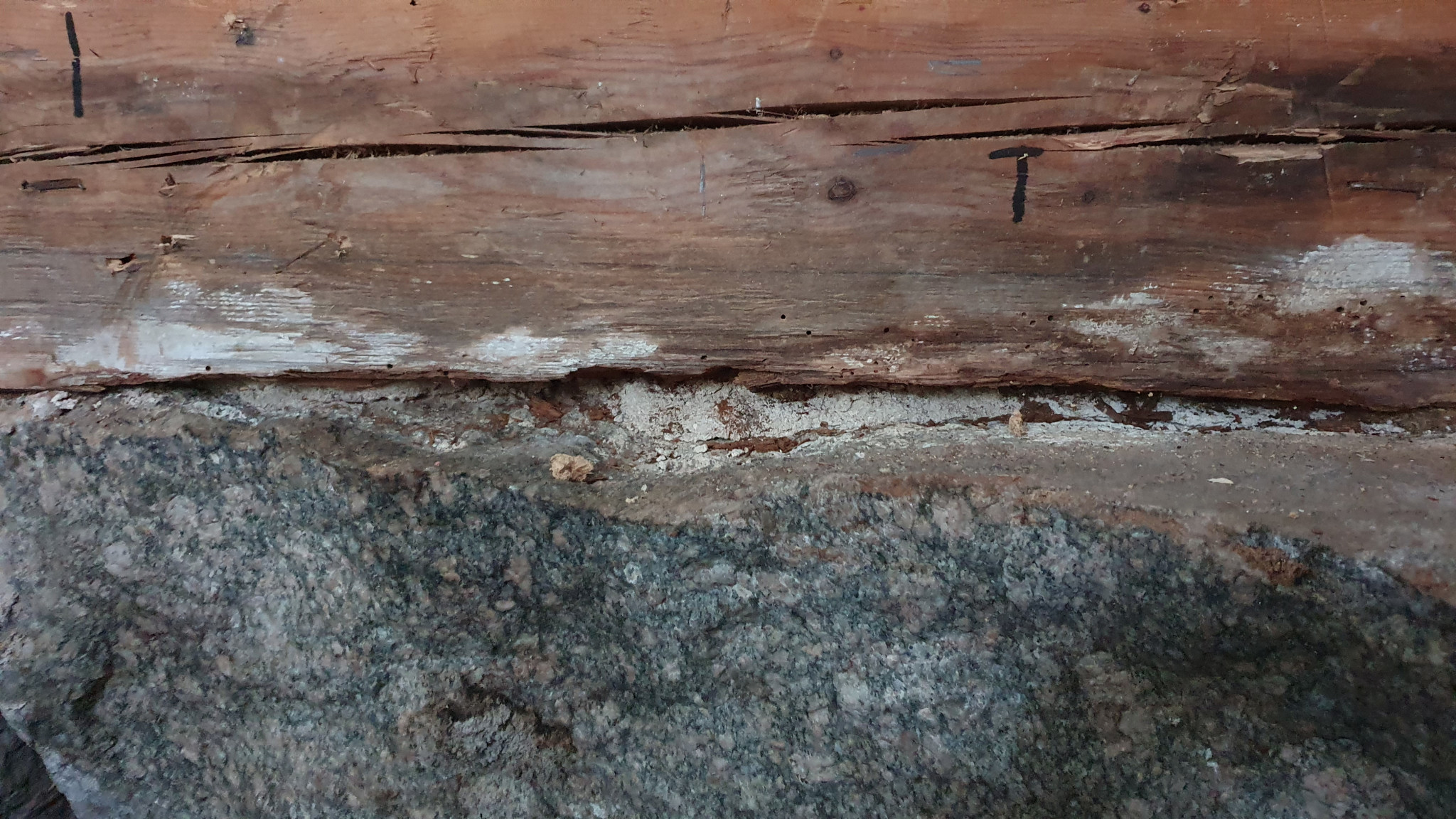
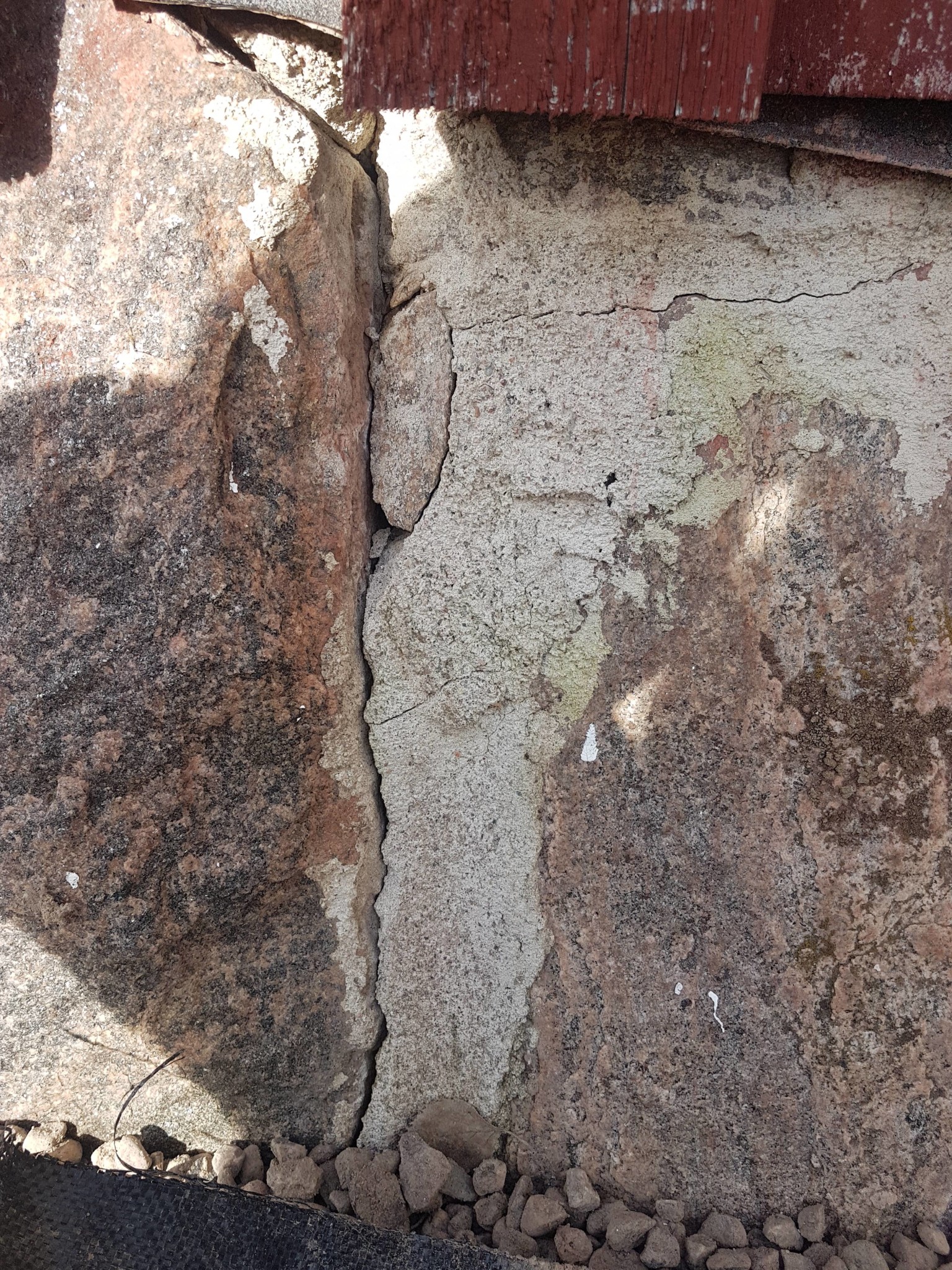
Most of the foundation consists of large natural stones all the way around, with only gaps between the stones and sometimes between the stone and the sill log. The foundation has been sealed before in several stages. The oldest sealing, which partially rests directly against the sill log, is what I believe to be lime mortar and sometimes there's an old sill paper in between. Sealing has been done on both the inside and outside of the sill log.
(in the pictures, I've torn away the outermost part that is completely falling apart, but under the sill log, a layer remains)
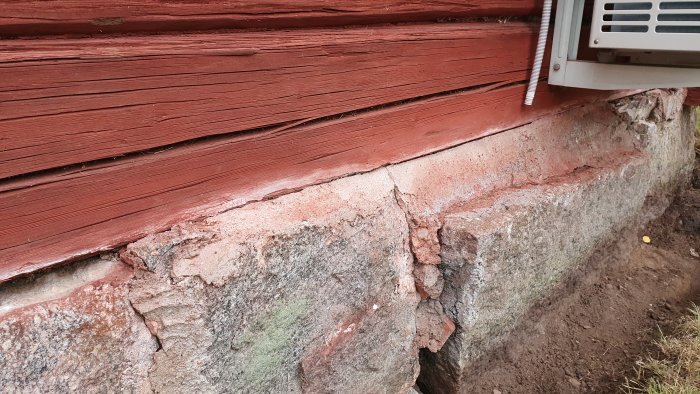
The second sealing is done with concrete/cement mortar and is either a repair or an attempt to slope away from the sill log because some foundation stones protrude outside the log wall. However, both these repairs are now often inadequate and either falling off or have slid away from the sill (creating pockets for moisture).
The sill logs are quite fine, some areas are a bit decayed underneath but mostly superficial (I had a conversation with a carpenter earlier who didn't think it was worth replacing the sill logs, keep them dry and it won't be a problem).
I will seal the holes between the foundation stones with Weber cement mortar A with waterproofing additive. But my question is how to proceed at the top, the sealing between the sill and the natural stone or the sill and the cement mortar?
I know opinions differ regarding house fungus and lime, but I've seen with my own eyes in this house how the fungus has crept along and inside the lime mortar, both in the chimney and under the sill log. It almost looks like it has eaten up the lime mortar. Thankfully, on those parts of the house, they had placed a sill paper between the lime mortar and the sill log, so the fungus hadn't gone up into the wood just there. I am therefore very opposed to using any products with lime
Is it foolish, idiotic, or madness to try to remove all the old lime mortar that remains? I would probably sleep a bit more peacefully at night, but it involves quite a bit of work and it will likely be difficult to remove everything.
In several threads, they suggest lime mortar or clay for sealing. Sometimes they just mention mortar and sometimes they suggest a combination with caulking. Clay is sometimes suggested even without sill paper.
Isn't it true that sill paper is never negative?
If you now lay a sill paper, does it matter in any way if you seal with clay, lime mortar, mortar, or cement mortar? Then you have a capillary-breaking layer, so what's underneath would be irrelevant?
My problem is that it's sometimes difficult to insert a sill paper between the sealing (the one I now choose) as it's very tight. Does anyone have a good idea of how to do this? Is there any capillary-breaking caulking that could be used?
As a complement to the sealing, I had planned to try to mill in a sheet metal in the sill log that protrudes beyond the foundation stone a bit above, so that water can't collect on the foundation stones and flow inward towards the sill log. The alternative that I've seen others do is to chip off the foundation stones so that they always slope away from the sill log. In some places, however, this is practically impossible.
Should one try to keep it as open as possible around the sill log, i.e., not seal evenly with the outside/inside of the sill log? Just make sure it's tight right underneath? All to make it as airy as possible around the sill log.
Does anyone have experiences with flax caulking between the sill log and foundation stones/cement mortar? Should it, in that case, be between the sill paper and sill log or the foundation stone/cement mortar? Will it be airtight enough for the dehumidifier?
Would expanding grout be an option to make it tighter?
Foam sealant is not an option for me as I avoid it as much as possible.
I would be incredibly grateful if someone with experience and/or knowledge in the subject could verify my thoughts or, even better, criticize my ideas and come up with better suggestions
Had hoped for answers here.
I'm also wondering about how dense between Eksell and granite foundation. I'm being recommended to use clay inside and hydraulic lime mortar outside.
Same here. It is a very good question he poses. Many of the problems with getting capillary-breaking layers in are ones I also have. Several people I’ve talked to say it isn't needed between the sill and the foundation. I take their advice with a large grain of salt. At my sill, large amounts of moisture condense, and it's pretty much only there where the timber has become rot-damaged.
I also think many people easily point out that there should be ventilation under the house. I wonder if these people have crawled under a crawl space foundation in the summer and looked at how wet it is on the granite.
At my place, cement-based repairs break away from the granite. Lime mortar and clay daubing are softer and can better follow small movements and can be repaired (clay daubing very easily). In my stone foundation, 100-year-old clay daubing remains on the north side. The south side has been sealed with cement in recent years and everything is cracked. I did a test with clay daubing last fall and mixed it as it seemed to be composed where it is intact. Very rich clay and extremely much sawdust. Now all the clay has washed away (south side) and the clay daubing looks like a chipboard. Considering smearing a bit of pure clay on the outside.
Same here. It's a very good question he poses. Many of the problems with getting in a capillary-breaking layer, I also have. Several people I've talked to say it's not needed between the sill and foundation. I take their advice with a large grain of salt. At my sill, a lot of moisture condenses and it's basically only there that the timber has become rot-damaged.
I also think many people very lightly point out that there should be ventilation under the house. I wonder if these people have crawled under a crawl space in the summer and looked at how wet it is on the granite.
For me, cement-based repairs crack and fall off from the granite. Lime mortar and clay plaster are softer and can follow small movements better, and can be repaired (clay plaster very easily). In my stone foundation, 100-year-old clay plaster remains on the north side. The south side has in recent years been sealed with cement and everything is cracked. I did a test with clay plaster last fall and mixed it as it seemed to be composed where it is intact. Very fat clay and extremely much sawdust. Now all the clay has rained away (south side) and the clay plaster looks like a chipboard. Considering smearing on a bit of clean clay at the outermost.
Hi
I've sealed as best as I can with cement mortar A, I promise to come back later on whether it cracks or not (it surely depends on how well the foundation stones and the timber in the house have settled over the years too, a newer house might be more sensitive?). Then I never really got any good recommendation other than clay, which I actually believe based on everything I've read and heard would be the best. I almost regret not going for it, but I have no experience and don't live where I think it's easy to find and would need to buy the clay. I've also messed a bit with foam sealant, but not against the timber, rather under the sill paper. I've also tried inserting oakum to then see what works and holds.
Regarding ventilation or not, my opinion is that the basic rule is that it should either be properly ventilated or not at all. If there's no ventilation, however, you must either have dry conditions or a dehumidifier. With a dehumidifier, it should be as tight as possible, otherwise, it will be a waste of energy (the dehumidifier tries to dehumidify outdoor air). But then there's nothing right or wrong, everything depends on all the parameters. I have an outbuilding with very little ventilation, damp ground, and the floors are rotting completely. I have a house with little ventilation but which stands dry and there's no problem at all (as far as I know). Then surely the floor construction could affect it. Diffusion-tight floors or has someone laid plastic tiles over the mess?
My problem is that sometimes it's difficult to fit tar paper between the seal (the one I now choose) as it's very tight. Does anyone have a good idea on how to do this? Is there any capillary-breaking caulking that could be used?
I like that you are so detailed in your questions!
Have you considered simply lifting the logs with a jack? Hopefully, then you can both smooth out the holes at the top and then easily place the tar paper.
Hi
I have sealed as best as I can with cement mix A, promise to update in the future on whether it cracks or not
Hmm, I am about to fix exactly the same kind of foundation wall that you have. So, it would be interesting to know if cement mix A has held up well over the winter?
Hmm, I am about to fix exactly the same type of foundation as you have. So, it would be interesting to know if cement mortar A has survived the winter well?
It doesn't last long. It's important that cement mortar doesn't touch wood.
I like that you are so detailed in your questions!
Have you considered simply lifting the logs with a jack? Then you can hopefully both smooth out the hollows on top and then easily lay down the sill paper
Yes , I would have gladly done that if it weren't so complicated to lift 3 of the corners. I have lifted one corner that was relatively easy, replaced a less good sill log, smoothed it out, and placed sill paper underneath as you described, and have also placed sill paper under the existing log on the other side of the corner as far as I could reach. However, I found it difficult to lift enough to pack underneath and lay the new sill log, and an old natural foundation is not entirely even, even if you smooth it out, so I've been forced to pack it afterward anyway, but it's definitely the best result.
I'm wondering if it's possible to saw with a jigsaw or reciprocating saw between the sill and stone to create the gap needed to insert sill paper... I wonder how many seconds of sawing it takes before the blade is completely worn out.
I know there are other threads on the subject, but I can't find answers to my questions there and would like to take what's in several of them forward to a coherent discussion.
I am renovating a timber house from the early 1900s that has been affected by dry rot. Everything inside the house is gutted, and I'm building a new crawl space from scratch. I have chosen to go with a solution with an inspectable crawl space with a sorption dehumidifier due to the dry rot. Therefore, a tight foundation is needed since the sorption dehumidifier will otherwise consume unnecessary energy if outside air enters.
Most of the foundation consists of large natural stones all the way around, with only gaps between the stones and sometimes between the stone and sill beam. The foundation has been sealed several times before. The oldest sealing, which partly lies directly against the sill beam, is what I believe to be lime mortar, and sometimes there is an old sill paper in between. The sealing has been done on both the inside and outside of the sill beam.
[image]
[image]
(in the pictures, I have removed the outermost part that completely crumbles, but under the sill beam, a layer remains)
The second sealing is done with concrete/cement mortar and is either a repair or an attempt to create a slope outwards from the sill beam, as some foundation stones protrude beyond the timber wall. However, both of these repairs are now often substandard and either fall away or have slid out from the sill (creating pockets for moisture).
[image]
The sill beams, however, are quite nice; some areas are a bit rotten at the bottom but mostly superficial (I had a dialogue with a carpenter earlier who didn't think it was worth replacing the sill beams; as long as they're kept dry, there's no problem).
The cavities between the foundation stones I will seal with weber cement mortar A with waterproofing additive. But my question is how to deal with the top, the sealing between sill and natural stone or sill and cement mortar?
I know opinions differ regarding dry rot and lime, but I have seen with my own eyes in this house how the fungus has crept through and inside the lime mortar, both in the chimney and under the sill beam. It almost looks like it has eaten up the lime mortar. Fortunately, on these parts of the house, a sill paper had been placed between the lime mortar and sill beam, so the fungus hadn't gone up into the wood just there. Therefore, I am very opposed to using any products with lime
Is it foolish, idiotic, or madness to try to remove all the old lime mortar that remains? I'd sleep a little easier at night, but it involves a lot of work, and it will probably be difficult to remove everything.
In several threads, lime mortar or clay is suggested for sealing. Sometimes they just say mortar, and other times they suggest a combination with caulking. Sometimes clay is suggested without sill paper.
Isn't it true that a sill paper is never negative?
If you now place a sill paper, does it matter at all if you seal with clay, lime mortar, mortar, or cement mortar? Then you have a capillary-breaking layer, so what's underneath is irrelevant, right?
My problem is that it's sometimes hard to fit a sill paper between the sealing (the one I now choose), as it's very tight. Does anyone have a good idea of how to do this? Is there any capillary-breaking caulking that could be used?
As a complement to the sealing, I was thinking of trying to mill in a metal sheet into the sill beam that extends beyond the foundation stone a bit above, so that water cannot sit on the foundation stones and run in towards the sill beam. The alternative I've seen others do is to chip off the foundation stones so that they always slope out from the sill beam. In some places, however, this is practically impossible.
Should you try to keep as open as possible around the sill beam, not sealing evenly with the outside/inside of the sill beam? Just make sure it's tight right underneath? All to keep it as airy as possible around the sill beam.
Does anyone have experience with flax caulking between sill beam and foundation stones/cement mortar? Should it in that case lie between sill paper and sill beam or foundation stone/cement mortar? Does it really become airtight enough for the dehumidifier?
Would expanding mortar be an option to make it tighter?
Foam sealant is not an option for me as I avoid it as much as possible.
I would be enormously grateful if someone with experience and/or knowledge in the subject could verify my thoughts or, even better, critique my ideas and come up with better suggestions
Very interesting and well-formulated questions! I'm in the same situation and will install a sorption dehumidifier in an overly damp crawl space. How does the result hold up with cement after a few years? I'm planning to seal some gaps from the inside, but initially wanted to find a "reversible" solution in case the measures go wrong, and you want to go the other way and ventilate more instead... I'm considering cutting and attaching foam boards with foam sealant for the larger gaps, which can later be removed if needed. The smaller gaps maybe just foam sealant? I have natural stone throughout my wall, and it's the capillary effect from ground to sill that one wants to avoid, but sporadic spots with foam sealant can't harm either the sill or the stone?
I have done sealing with clay plastering. For a while, I struggled with tar paper, trying to insert it to create a separating layer. But it is practically impossible without lifting the house.
What I did instead was to install a sacrificial board, drip list, or whatever it's called. Then I clay plastered both behind it and between the sill and the granite. I have also sealed as much as possible between the stones with clay plastering. The theory is that concrete is too hard and could contribute to the foundation being pushed apart during frost heave in the ground (poorly drained material around the foundation stones). Clay plastering is softer and can flex a bit. Different clay mixtures can be made for different areas. Lots of reinforcement in the clay makes it softer, more clay makes it resistant to water. Clay plastering costs nothing (usually) and if it rains away after 10 years, you can just smear on new?
On the north side of my house, it's done exactly like this with clay plastering, and it was probably put there in 1902. So that's what I based my approach on.
If you want to create a capillary-breaking layer, you can actually clay plaster on top of foam sealant. It works perfectly. Foam sealant really can’t stand UV light, so the clay protects the foam. In some places, I’ve sealed between big stone blocks in the middle with foam sealant, then clay plastered the exterior. It works great and doesn’t cause a lot of problems as some building conservators claim. Foam sealant should be used with common sense and moderation. Often, house moss and bear moss work better.
Click here to reply
Vi vill skicka notiser för ämnen du bevakar och händelser som berör dig.





Wilmer_T said: