
17,047 views ·
17 replies
17k views
17 replies
Seal between wall and ceiling
Hello! I've done some renovations at home, painted the walls, etc., and I'm also going to replace the floor and ceiling molding. But I'm considering filling the gaps between the wall and the ceiling while I have the moldings removed everywhere. It's not drywall, but some form of board that was used in the 70s, and it didn't go all the way up. The reason I want to seal it is partly because of noise between the rooms, but also to perhaps prevent spiders, etc., from crawling out from the wall and ceiling/attic. The picture shows what it looks like in one spot, but in other places, there are slightly larger gaps.
I'm thinking that this is my chance, as once I've nailed up the ceiling molding, it likely won't come down anytime soon.
What do you recommend I fill the gap with? Regular foam sealant? Or there's that easy filler that you might be able to use to spackle in the gap?
In some places, there's a very small gap, so there you might be able to use regular acrylic sealant?
Thanks!
I'm thinking that this is my chance, as once I've nailed up the ceiling molding, it likely won't come down anytime soon.
What do you recommend I fill the gap with? Regular foam sealant? Or there's that easy filler that you might be able to use to spackle in the gap?
In some places, there's a very small gap, so there you might be able to use regular acrylic sealant?
Thanks!
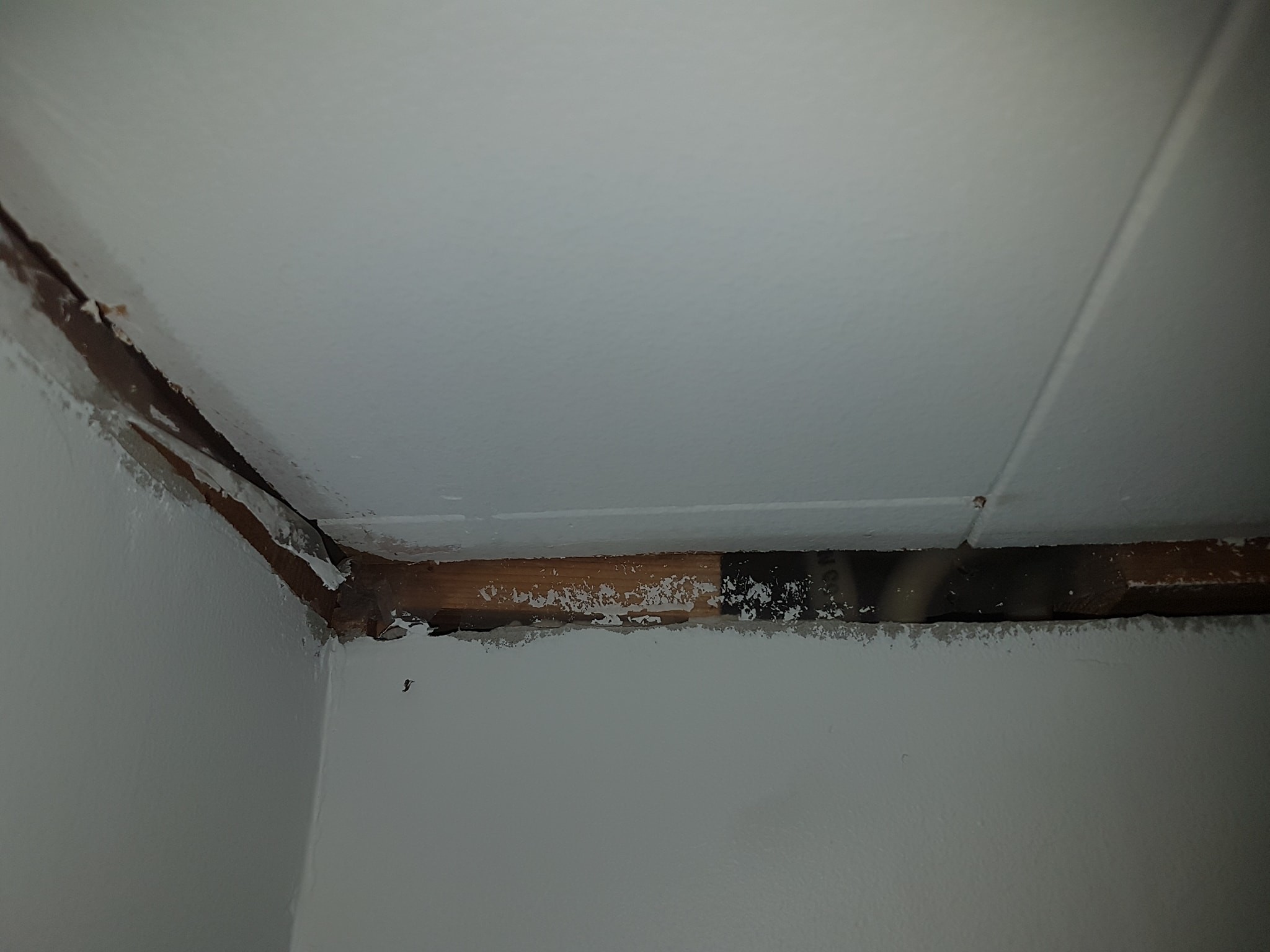

A bit difficult to determine how big the gap really is?
10-15 cm?!
In the gap between the roof and the wall? That doesn't sound likely. 10-15 mm would be more normal.
I think you should forget all about sealant and foam, and use regular drevremsa. It is available in lin, which is much nicer to work with than regular fiberglass. However, it is more expensive.
In the gap between the roof and the wall? That doesn't sound likely. 10-15 mm would be more normal.
I think you should forget all about sealant and foam, and use regular drevremsa. It is available in lin, which is much nicer to work with than regular fiberglass. However, it is more expensive.
Yes, there was a bit of a mistake thereOldboy said:
10-15 cm?!
In the gap between the ceiling and the wall? That doesn't sound likely. 10-15 mm would be more normal.
I think you should forget about all types of sealant and foam, and use regular draft tape. It is available in flax, which is much more pleasant to work with than regular fiberglass. However, it is more expensive.

Ah okay, but yeah that sounds like a good idea, easy to push the insulation/draft tape in there in the gap, so it gets insulated against sound, etc. But another thought I had was to seal against spiders and such, but maybe they still find their way in older houses
I would fill the gap with Biltema's stone glue and use onestrike for filling. It works for everythingG MrGlad8 said:Hello! I've done some renovations at home, painted walls, etc., and I'm also going to change the floor and ceiling moldings. But I'm thinking about whether I should fill the gaps between the wall and ceiling while I still have the moldings off everywhere. It's not drywall, but some type of board they used in the 70s, and it didn't go all the way up. The reason I want to seal it is partly because of the sound between the rooms but also to perhaps prevent spiders, etc., from crawling out from the wall and ceiling/attic. The picture shows how it looks in one place, but in some other places, there's a slightly larger gap.
I think this is my chance, when I've nailed up the ceiling molding, it certainly won't come down in the near future.
What do you recommend I fill the gap with? Regular spray foam? Or there is that easy filler you might use to fill the gap?
In some places, the gap is very small, so maybe you could use regular acrylic sealant there?
Thanks!
https://www.biltema.se/bygg/kemikalier/lim/stenlim-2000029972

Tool enthusiast
· Stockholm
· 1 399 posts
Foam sealant should never be used for soundproofing. Backer rod and non-hardening soft sealant are the best options here. For constructions without movement, gypsum plaster.
Ok thanks for the info! Yes, I will use trim, but it won't be that tight, right? And it feels silly to have such a big opening behind the trim that I might as well close now when I have the chance? Just for sound, insects, etc.?Peter2400 said:
Ah ok! Thanks!
But maybe those "one strike" are good? It seems to remain soft from what I can read and easy to apply from the tub?
But Backer rod is a round foam-like product? Won't it be difficult to put that in place in the gap? Doesn't Drive strip + one strike filler work?
But then maybe a caulking strip in the gap and then some soft putty is a good solution? Like One Strike that Peter suggested?
Tool enthusiast
· Stockholm
· 1 399 posts
I am not familiar with Onrstrike, but if it is a lightweight filler, it is not very effective. It is much better with gypsum plaster. The only function backing rod / tightly packed drev has in soft sealing is to prevent the seal from collapsing over time.