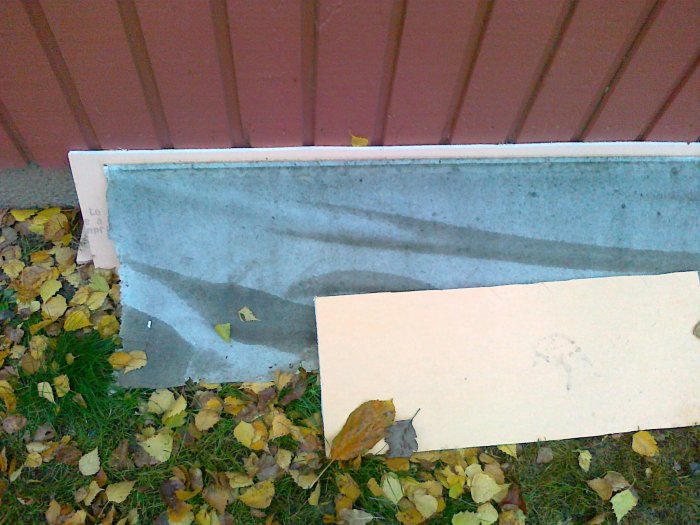
But, if you have plywood, why use fermacell on it? Fermacell argues that it’s okay in bathrooms without plywood, but I would go with plywood and regular gypsum board since fermacell doesn’t really contribute anything on plywood. The fermacell (or are you going for their H2O boards) is not more moisture-resistant than regular gypsum board and molds just as quickly in moisture.
I would probably continue, and will do so in the other bathroom, with moisture-resistant gypsum board with a fiberglass surface instead of paper. I had scraps of both outside over a winter, the regular gypsum board was just powder with black paper, while the moisture-resistant gypsum board looked the same as when I put out the pieces.
Then I'll probably have to buy a new blade first. Not too keen on ruining the blade for my blue Bosch. Will probably stand outside and saw.
A cheap blade from Jula/Biltema should do the job. I sawed indoors, quite okay with a vacuum cleaner but hearing protection was a must. Makes a lot of noise when cutting in Fermacell.
But, if you have plywood, why Fermacell on it? Fermacell argues that it is okay in bathrooms without plywood, but I would go with plywood and regular plasterboard since Fermacell doesn't really contribute anything on plywood. Fermacell (or are you going for their H2O boards) is not more moisture-resistant than regular plasterboard and molds just as quickly if exposed to moisture.
I would probably continue, and will do so in the other bathroom, with moisture-resistant plasterboard with a fiberglass surface instead of paper. I had leftover pieces of both outside over a winter, the regular plasterboard was just powder with black paper while the moisture-resistant plasterboard looked the same as when I put the pieces out.
Moisture-resistant plasterboard is still recommended in zone 1, and Fermacell is included there. I was a bit drawn to the convenient format with 600 mm width. I also like that there is no jointing edge, making it easier both with the waterproofing membrane and the tiling.
It is still recommended to use moisture-resistant gypsum in zone 1, and Fermacell is listed there. I was drawn to the convenient size with a 600 mm width. I also like that there's no jointing edge, making it easier for both the waterproofing membrane and tiling.
600, yes, but the sheets weigh as much as 2000 wide standard gypsum. Straight edges are nice, but you should glue them with Fermacell joint adhesive. If you get to that point, I have 10 tubes left since I had a bit of bad luck when I was thinking...
I don't think they should be glued in wet room installations. Too tired now, will think more tomorrow, but everything is ready for drywall installation so it would be fun to get started.
You're giving me something to think about @TeroM.. I feel I need to reevaluate my choice of records too!
Regarding fermacell, they should not be glued in conjunction with waterproofing. I have been in contact with them and they say it is completely unnecessary when using waterproofing
But, if you have plywood, why fermacell on it? Fermacell argues that it is okay in bathrooms without plywood but I would go with plywood and regular gypsum since fermacell doesn't really add anything on plywood. The fermacell (or are you going for their H2O boards) is not more moisture resistant than regular gypsum and molds just as quickly when wet.
I would probably continue, and will do so in the other bathroom, with wet room gypsum with fiberglass surface instead of paper. I had scrap pieces of both outside over a winter, the regular gypsum board was just powder with black paper while the wet room gypsum looked like when I put out the pieces.
Wet room gypsum with fiberglass surface is probably not absorbing, which I understand can become a problem as the glue for the foil dries too slowly. Looking at the list at GVK https://www.gvk.se/godkanda-produkter/vatrumsskivor/, there aren't many boards that are absorbing, now it's difficult to choose.
Well, I was thinking of going with Kiilto and will probably order from Kakelplattan.se. However, I see it as a disadvantage with recessed long sides because the boards shouldn't be spackled when using foil, and then it becomes more difficult to lay the tiles nicely.
Yes, I was planning to use Kiilto and probably order from Kakelplattan.se
However, I see the recessed long sides as a disadvantage because the boards shouldn't be puttied when using foil and then it becomes harder to set the tile nicely.
I'm actually not sure if it's okay to putty or not... Worth finding out!
@TeroM how would you build a wall then? Plywood and drywall and wet area gypsum in shower/bath?
The last time I remodeled a bathroom, plywood backing wasn't common, so it was cc 30 framed walls and Byggmax moisture-resistant drywall with LIP's membrane system.
I have a bathroom in the pipeline, and the consideration today is plywood, the same board from Byggmax and probably LIP system 27. What I like about LIP is that the membrane adhesive is a two-component type and cures instead of needing to dry. I will also, as last time, use moisture-resistant drywall throughout the room, not just in zone 1. I recall the requirement during the last renovation was moisture-resistant drywall in zone 1 and against exterior walls. In the bathroom I will be doing, most of the walls will be in zone 1 or exterior walls anyway. Regular drywall only in the ceiling.
As for joint filling, it is possible to manage without it with more adhesive under tiles, but it's a small task to apply a layer of cement-based filler (approved for being under tiles) in the joints since it doesn't need to fill out and be completely smooth as with regular interior walls and ceilings where joints should be invisible when painting or wallpapering.
I was thinking a bit about the putty, but can't you instead run a round with fix in the joints after the foil is mounted and let it dry before you set the tiles?
Found the picture I took of normal plasterboard versus Byggmax wet room plasterboard after the boards had been outside for over half a year in all weather conditions. Guess which is which ...
Now you have given me something to think about at least TeroM! I guess I need to sit down and do some calculations... my budget is already going off track, so what does it matter if it goes a little further
Vi vill skicka notiser för ämnen du bevakar och händelser som berör dig.

TeroM said:
But, if you have plywood, why Fermacell on it? Fermacell argues that it is okay in bathrooms without plywood, but I would go with plywood and regular plasterboard since Fermacell doesn't really contribute anything on plywood. Fermacell (or are you going for their H2O boards) is not more moisture-resistant than regular plasterboard and molds just as quickly if exposed to moisture.