
I want to increase the load-bearing capacity of a beam or the theoretical span it can handle. Therefore, I'm thinking of joining two 45×220, C24, NTR-A. The idea is to glue with PU glue, use a number of wood screws, and then clamp together with brackets.
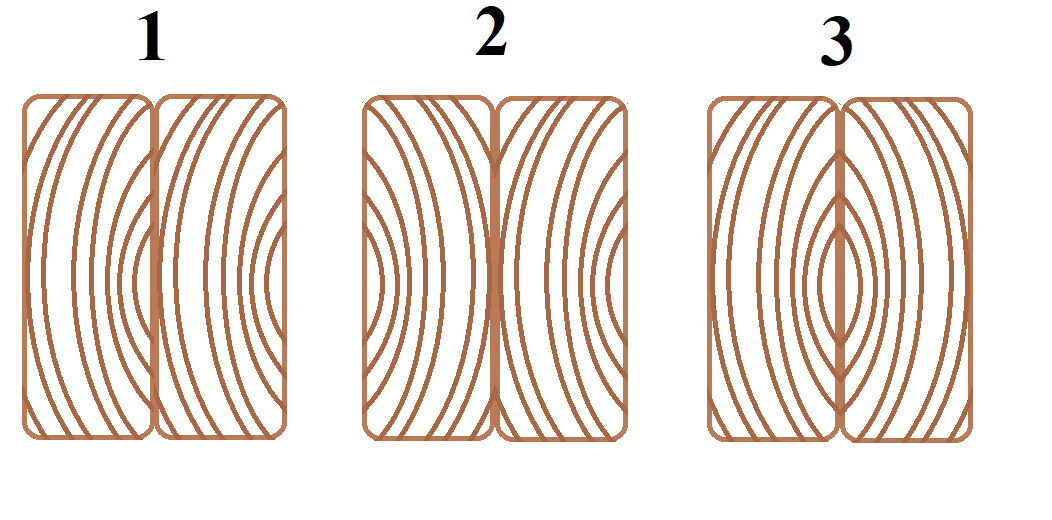
So, the question is: how should the beams be joined? See the diagram below. I'm just interested in what is best, or least bad if you prefer to see it that way. I tried asking ChatGPT. There I got really crazy suggestions. Now I'm relying on you here.
So, the question is: how should the beams be joined? See the diagram below. I'm just interested in what is best, or least bad if you prefer to see it that way. I tried asking ChatGPT. There I got really crazy suggestions. Now I'm relying on you here.
I don't know. But here is my opinion.
Variant 3 will want to break the glue joint with increasing humidity. The same problem exists in variant 1.
With variant 2, the glue joint is compressed and it shouldn't be able to damage anything at all.
If it were indoors with joinery-dry wood, all three would work equally well, but I would choose variant 3 because it is the "nicest".
Variant 3 will want to break the glue joint with increasing humidity. The same problem exists in variant 1.
With variant 2, the glue joint is compressed and it shouldn't be able to damage anything at all.
If it were indoors with joinery-dry wood, all three would work equally well, but I would choose variant 3 because it is the "nicest".
I've been thinking along the same lines but simply don't know which is correct in theory. No one I've asked so far has been able to explain it better than you.L Limpan4all said:I don't know. But this is my opinion.
Variant 3 will want to break the glue joint with increasing humidity. The same problem exists in variant 1.
With variant 2, the glue joint is compressed and it shouldn't be able to damage anything at all.
If it were to be indoors with kiln-dried wood, all three would work equally well, but then I would choose variant 3 because it's the "nicest."
Breaking a glued joint of that type reinforced with screws is not something studs usually handle. Or more precisely, the studs typically do not tear themselves apart in connection with a glued joint of that type.
I'm guessing a bit
To keep the line as straight as possible, 2 or 3, a load-bearing beam is usually fixed at several points so probably no practical difference.
One option is to see if the studs have started twisting and pair them with twists in opposite directions. Same method if they warp.
For the question of load-bearing capacity, I doubt you will see any practical difference regardless of the method.
I'm guessing a bit
To keep the line as straight as possible, 2 or 3, a load-bearing beam is usually fixed at several points so probably no practical difference.
One option is to see if the studs have started twisting and pair them with twists in opposite directions. Same method if they warp.
For the question of load-bearing capacity, I doubt you will see any practical difference regardless of the method.
Thanks for the input!Z z_bumbi said:Breaking a glued joint of that type and reinforced with screws is not something joists usually manage. Or more precisely, the joists typically don't tear themselves apart in connection with a glued joint of that type.
I'm speculating a bit
To keep the line as straight as possible, 2 or 3, a support beam is usually fixed at several points, so probably no practical difference.
One approach is to see if the joists have started to twist and pair them with twists in opposite directions. The same method if they arch.
For the question of load-bearing capacity, I doubt you'll get any practical difference regardless of the method.
But do you mean that it would be completely unnecessary to double? Or that it doesn't make any difference if they are joined? I'm just a layman on the subject, so the question is genuine.
Joining the beams does almost nothing for the deflection, it will not increase in strength.
However, there is a chance that the beam may twist or tip, and in that case, it will help to screw-glue the beams.
However, there is a chance that the beam may twist or tip, and in that case, it will help to screw-glue the beams.
I'm not saying you're wrong, but I've never really understood categorically stating that it doesn't do much/anything for deflection. If you consider the following theoretical example: You are going to cross a waterway that is 100 cm wide. In one spot there is a 45X45, in another place there are two 45x45s that are screwed and glued together. Does this mean that you might as well choose to walk on the single 45x45?
(We assume that balance is not a factor).
(We assume that balance is not a factor).
If you double, you double the forces you can absorb, so if an increase is needed, it's good. A glue joint of 1 mm on a 90 mm wide beam probably makes no noticeable difference, but above all, your different examples of how you turn the studs probably don't affect the load-bearing capacity. But I'm not a structural engineer.M MatsBengtsson89 said:

I guess @Kontoristen7 means the difference between 2 screw-glued studs and 2 loose studs. Given that you have screw-glued them on the "wrong" edge.T TryBran said:
If you lay them on top of each other, it makes a big difference whether they are screw-glued or loose.
S
sinuslinus
Träskalle
· Östergötlands län
· 6 013 posts
sinuslinus
Träskalle
- Östergötlands län
- 6,013 posts
Pretty pointless to glue with PU glue since you won't achieve high pressing pressure or good contact surfaces.
Polyurethane glue requires high pressure and smooth surfaces to become strong. When that's not the case, it gets a low E-modulus. Compare it to the foam that forms, which can be cut with a knife.
Order an impregnated glulam beam instead.
To answer your question, it's customary to have the core side out. Less risk of drying cracks and a larger proportion of heartwood outward.
Polyurethane glue requires high pressure and smooth surfaces to become strong. When that's not the case, it gets a low E-modulus. Compare it to the foam that forms, which can be cut with a knife.
Order an impregnated glulam beam instead.
To answer your question, it's customary to have the core side out. Less risk of drying cracks and a larger proportion of heartwood outward.
S
sinuslinus
Träskalle
· Östergötlands län
· 6 013 posts
sinuslinus
Träskalle
- Östergötlands län
- 6,013 posts
Building rules are not so even that you get an even high pressure even with clamps. Screws don't give that much, and there may even be wood splinters from the screw between the pieces.

Member
· Västerbottens län
· 18 047 posts
Set the studs 5 cm apart and you'll have exactly double the strength, neither more nor less.
Regarding clamping pressure, it's more about how close you should place the clamps. From what I've read, the clamping pressure spreads at a 45-degree angle from the clamp, which would mean 2 clamps every 90 mm, one at the top and one at the bottom. That's a lot of clamps.
Polyurethane glue is expensive, buy something more fun and just use a few screws.
Protte
Regarding clamping pressure, it's more about how close you should place the clamps. From what I've read, the clamping pressure spreads at a 45-degree angle from the clamp, which would mean 2 clamps every 90 mm, one at the top and one at the bottom. That's a lot of clamps.
Polyurethane glue is expensive, buy something more fun and just use a few screws.
Protte
Thanks for all the answers. I still feel like I've become wiser. Or less stupid.
The core side out if I'm going to glue at all. I actually don't think I'm going to do it.
But, where on earth can I find pressure-treated glulam beams? I can't find a thing when I search. Except for those without price information and that can't be ordered.
The core side out if I'm going to glue at all. I actually don't think I'm going to do it.
But, where on earth can I find pressure-treated glulam beams? I can't find a thing when I search. Except for those without price information and that can't be ordered.