
Hello
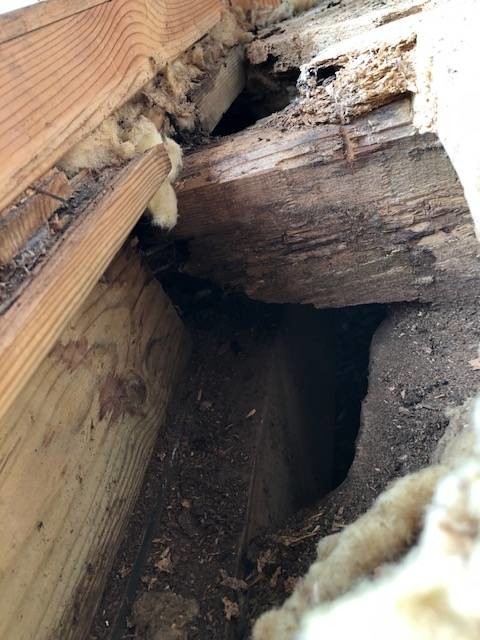
I need some advice regarding a problem we've discovered in our newly purchased summer cottage. We were going to replace the floor and when we removed the old floor, we noticed some moisture damage. When we then cut open the chipboard, we discovered that about 0.5 meters of the wall plate is completely rotten and approximately the same amount of a floor joist.
Now to my question. It is quite obvious that the previous owner renovated this because there is a mix of old and new wood, and boards have been laid to prevent the floor from sagging. It is worth mentioning that nothing is visible from above or below.
I claim that this is a hidden defect or alternatively, the owner should have informed us of the "quick fix"?
I need some advice regarding a problem we've discovered in our newly purchased summer cottage. We were going to replace the floor and when we removed the old floor, we noticed some moisture damage. When we then cut open the chipboard, we discovered that about 0.5 meters of the wall plate is completely rotten and approximately the same amount of a floor joist.
Now to my question. It is quite obvious that the previous owner renovated this because there is a mix of old and new wood, and boards have been laid to prevent the floor from sagging. It is worth mentioning that nothing is visible from above or below.
I claim that this is a hidden defect or alternatively, the owner should have informed us of the "quick fix"?
Last edited by a moderator:
A fault that you are likely to expect regarding the current building. If the summer cottage had been built in 2012 or similar, you should not expect this fault. It is unclear how old the summer cottage is, but the construction suggests that it has been around for a few years.


Swear a little, fix it, and move on with the cottage. Even if the sellers knew about this, you hardly have much to gain there. A dispute is not recommended, there is a risk that you could lose. How much extra work and costs do you estimate for the fix?

Oh, darn, you got me... I thought it would be a construction-related question, but it turned out to be another "does this count as a hidden defect" thread.
For it to be a hidden defect, it must essentially have been impossible to discover without tearing into the building AND the age of the building should not make one expect occasional defects (i.e. practically new construction). In practice, it is very difficult to win a claim for a hidden defect.
From the picture, it looks like it could have been physically possible to see this if one had looked into the crawl space. Thus, the buyer could have seen it when fulfilling their duty of inspection. Not a hidden defect.
Moreover, that is not super expensive to fix, and if nothing else, the cost of the legal proceedings (remember, civil process = you pay for every second of the lawyer's time out of pocket) will be significantly higher, and you can/are likely to lose a legal process.
Think of it this way, a craftsman costs 700 per hour and the headache will be over in about a week, a lawyer costs 2000 SEK per hour and the process takes up space in your life for several months.
For it to be a hidden defect, it must essentially have been impossible to discover without tearing into the building AND the age of the building should not make one expect occasional defects (i.e. practically new construction). In practice, it is very difficult to win a claim for a hidden defect.
From the picture, it looks like it could have been physically possible to see this if one had looked into the crawl space. Thus, the buyer could have seen it when fulfilling their duty of inspection. Not a hidden defect.
Moreover, that is not super expensive to fix, and if nothing else, the cost of the legal proceedings (remember, civil process = you pay for every second of the lawyer's time out of pocket) will be significantly higher, and you can/are likely to lose a legal process.
Think of it this way, a craftsman costs 700 per hour and the headache will be over in about a week, a lawyer costs 2000 SEK per hour and the process takes up space in your life for several months.
That's probably for the best. Unfortunately, you have to expect to find one or two botched jobs and shortcuts, and to be honest, most of us have probably contributed with a few of our own before we really knew what we were doing. It's just a matter of sighing and fixing it, so at least you can feel satisfied knowing you did it better.D Dexter68 said:
Best answer

Now it is difficult to see the damages as a whole. How far in does the rot go? Is it dry or does it draw moisture? Not addressing the syllen does not necessarily mean a mistake has been made. Replacing it requires extensive work, which one would preferably avoid if possible. If only parts need replacing, you can insert shims. Remove damaged parts and add new ones. With the passage of time, one must expect measures that require intervention. If you want to avoid maintenance for a while, you need to invest in new production. In the image you can see, the floor joist is the most affected.
Click here to reply