Hello

I completely agree that he meant the more robust underlay paper, but what I'm worried about is that it might not last for 3 months or however long it takes before the roofer can lay the metal => "apply paper that can withstand being exposed"
And my "low slope".
 
OK, have spoken with the tinsmith
Changing to 2200 or 2500 underlay felt and returning what comes with the cargo ferry tomorrow.

K
 
Sounds good. It could probably work with a tarpaulin while waiting for the outer roof? Preferably a proper one, not a lightweight.

With the low slope, I would recommend the kind of flashing I showed in a previous post.

I had a similar roof installed last week, also a low-slope hipped roof on a veranda. It looks fantastic!
 
  • Like
Sebastian Courel
  • Laddar…
Tarp does not work, the house is on top of a hill in the Gothenburg archipelago (it's windy as heck most of the time).

There is no drip edge on the existing veranda (which will be demolished) or on the "template", a folded drip will have to do...

K
 
I agree with Bernieberg. SEP is an unsuitable cardboard type. I don't think any roofer would want to lay anything on top of it. Your model is a seamed sheet metal roof in aluzink. It cannot be laid without an eaves sheet that is nailed to the raw boards under the cardboard. Therefore, do not fasten the cardboard permanently at the bottom edge. Keep it in place with the help of a wooden batten.
 
be careful so that your roofing felt/underlay doesn't lift off if it lies unprotected on the roof and it's blowing hard
 
hfj

I will nail and glue, no drip edge because it solves MSN through-put fold down the sheet metal.
 
Hi

The "Förlagan" and the existing sheet metal roof lack the mentioned drip edge.

I can't imagine it's needed if the sheet metal is folded over the edge?

K
 
  • Like
RiKr
  • Laddar…
The flashing serves both the function of folding around and thereby securing the roofing, and if you choose the flashing I showed, creating a flange down into the gutter. You likely need the first function, so you probably shouldn't completely forgo flashing (if I understood your plans correctly).

With the low roof pitch, the installation instructions likely state that the underlay should be nailed in a concealed manner so that the lower part of each sheet is only held in place by the adhesive. As mentioned, it might come loose if it gets windy. Perhaps you can nail through both sheets in the overlap and apply asphalt adhesive on the nails, but check the instructions if that's okay.
 
Hi

I plan to clamp the pappen with some läkt, temporarily during the construction period.

The roofer will fold the roof down into the gutter, as he has done in other places on the island.

The existing roof being removed has been in place for 40 years in that way.

K
 
Hello

Ready for the tinsmith, have left the bottom edge unglued. The tinsmith can decide whether he wants a base flashing or not.
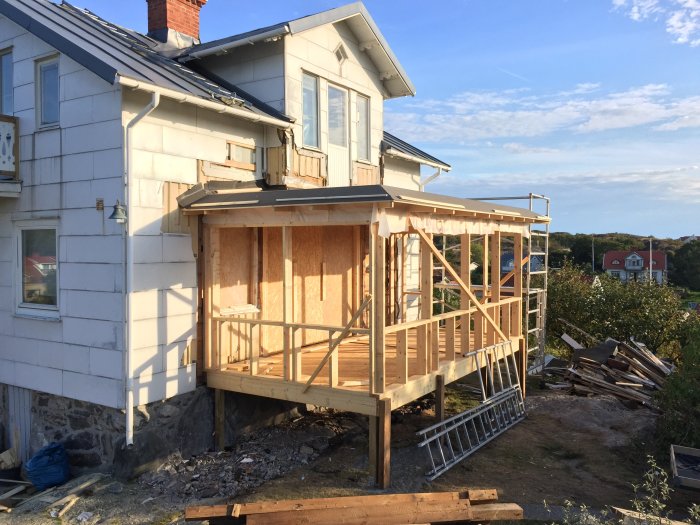
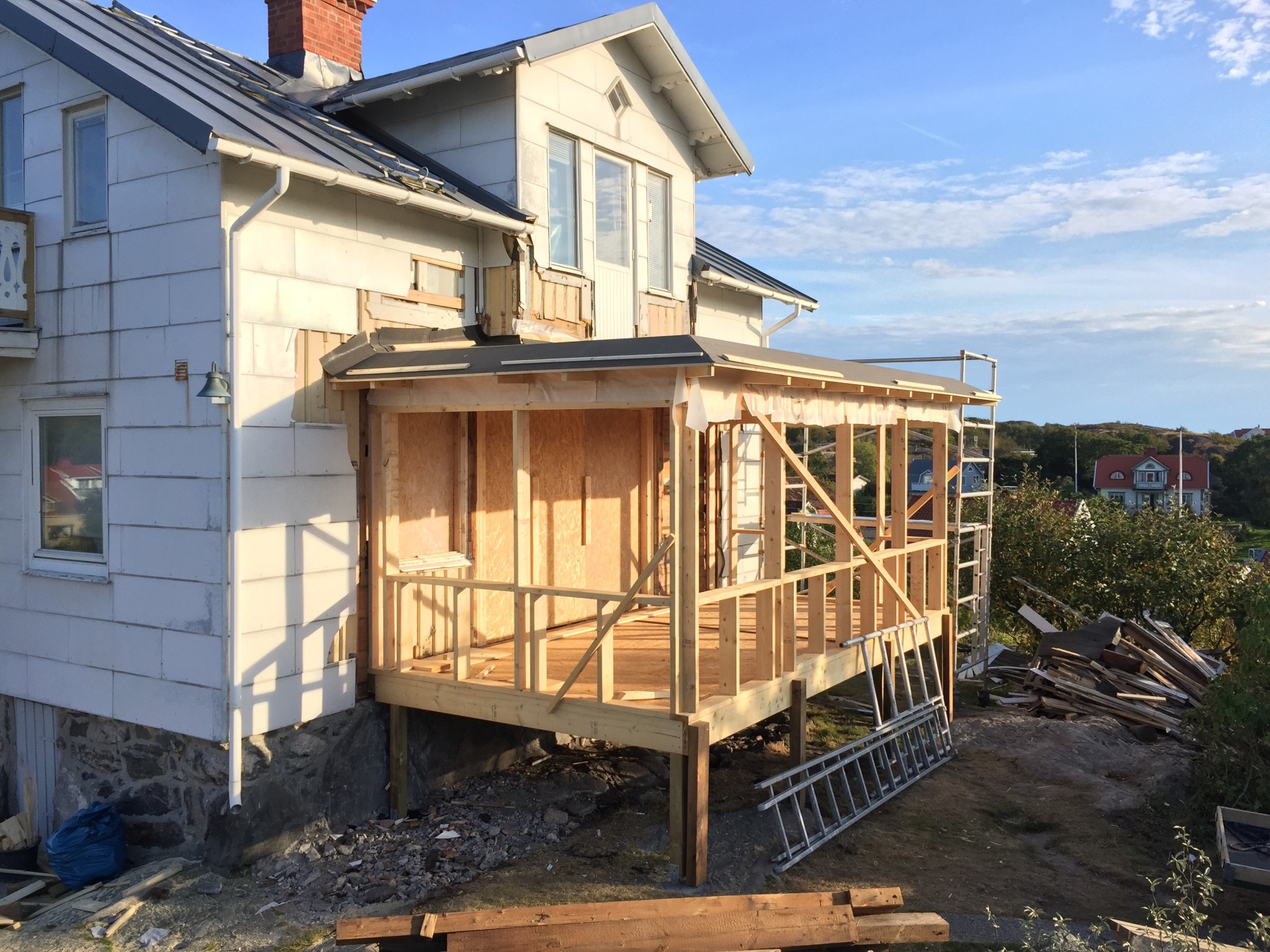
A house extension under construction with wooden frames in place, adjoining an existing building with a ladder leaning against the structure.
K
 
  • Like
Bernieberg
  • Laddar…
NOTE!!! Remember to also place felt under the flashing. The flashing must not lie directly against the roof sheathing. Otherwise, the roof sheathing will deteriorate from condensation. There's a website that shows this.

So double layers of felt at the bottom of the roof so that the tinsmith places the flashing between these.

And no sanded felt. Otherwise, it will rub under the metal when the metal moves.
 
  • Like
Krypstocken
  • Laddar…
"Giving up"
There is sand, albeit fine, on this underlay felt
The tinsmith will "fix" it even if he has to lay another layer of felt on top....

For now, it's reasonably rainproof until he arrives, it'll just have to do for the time being.

PS, when I tore down the existing veranda, there was underlay felt, a base sheet metal, coarse top felt (with sand), and then seamed sheet metal.
 
I had also read about sand before getting a similar roof installation done. According to the metalworker, it only matters on steep roofs because sand can get stuck on the sole of the shoe and cause ugly scratches when walking on the metal. On low-slope roofs, you don't slide when standing on the metal, so it doesn't matter. According to him, wear due to movements in the metal would be completely negligible. Without having experience with metal roofs but having some experience with wear in engineering contexts, I think this sounds very reasonable.
 
Hello

Inclined to agree, there was also coarse surface felt under the old metal.

In any case, I'll bring in the metalworker before the drip strips and any metal are put in place.

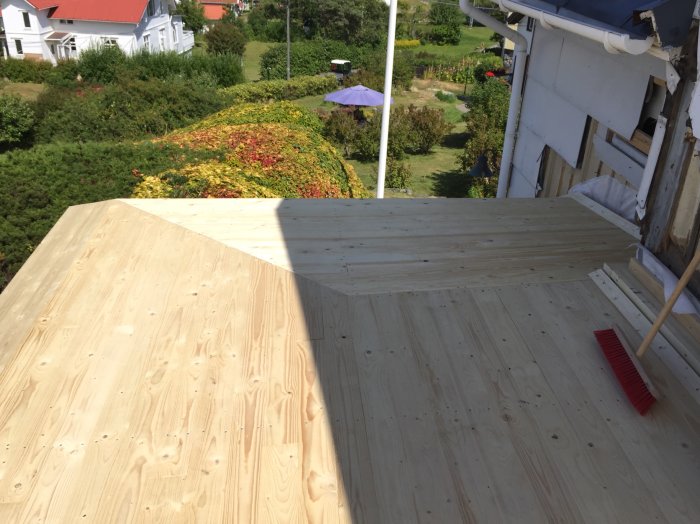
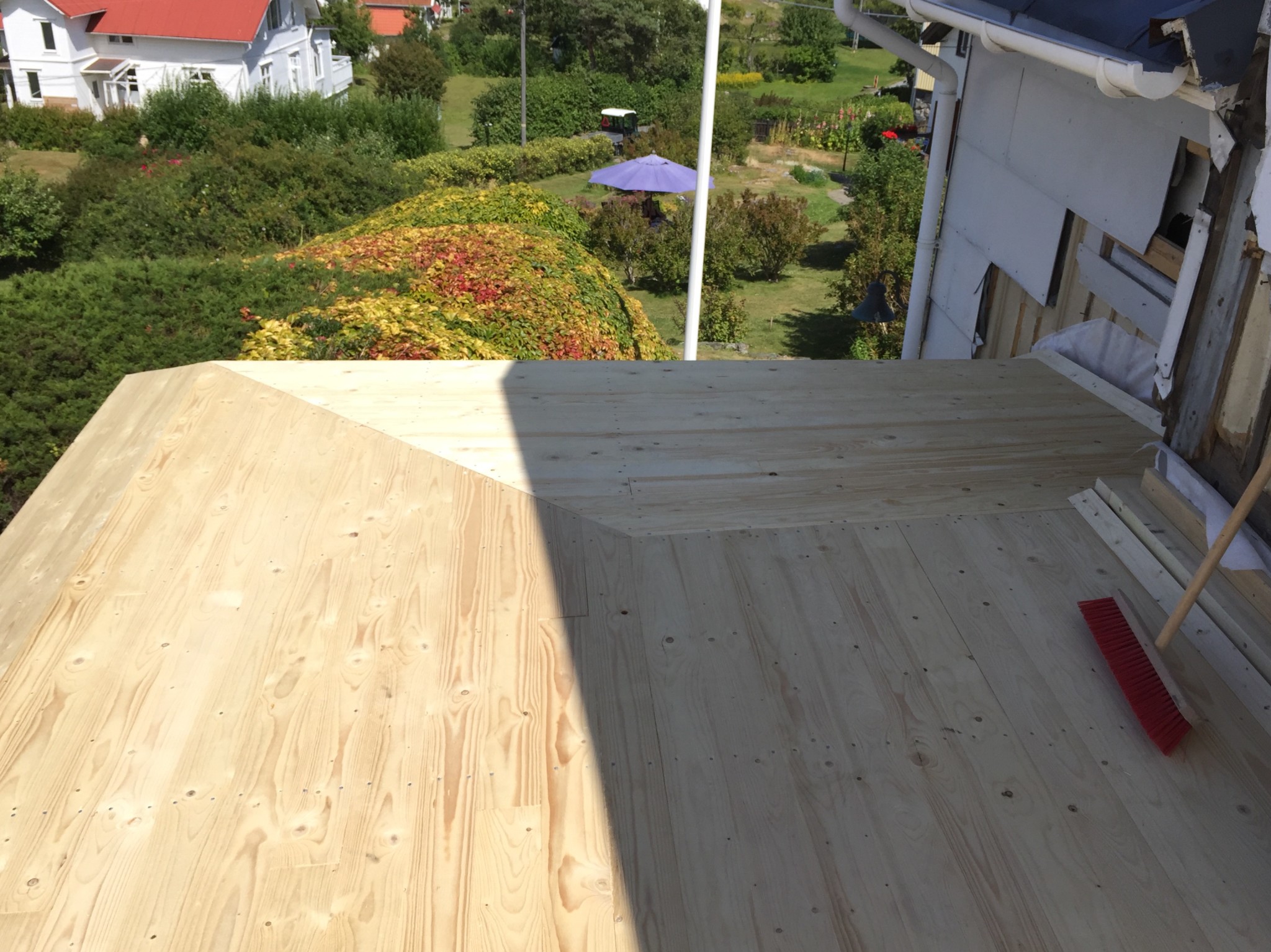
The roof has several breaks, see picture.
Wooden roof with multiple angles under construction, surrounded by greenery and houses, broom visible on the right.

K
 
Vi vill skicka notiser för ämnen du bevakar och händelser som berör dig.