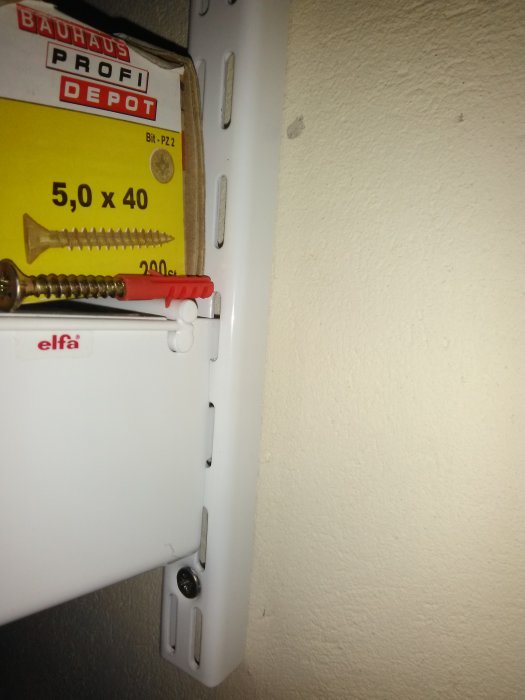
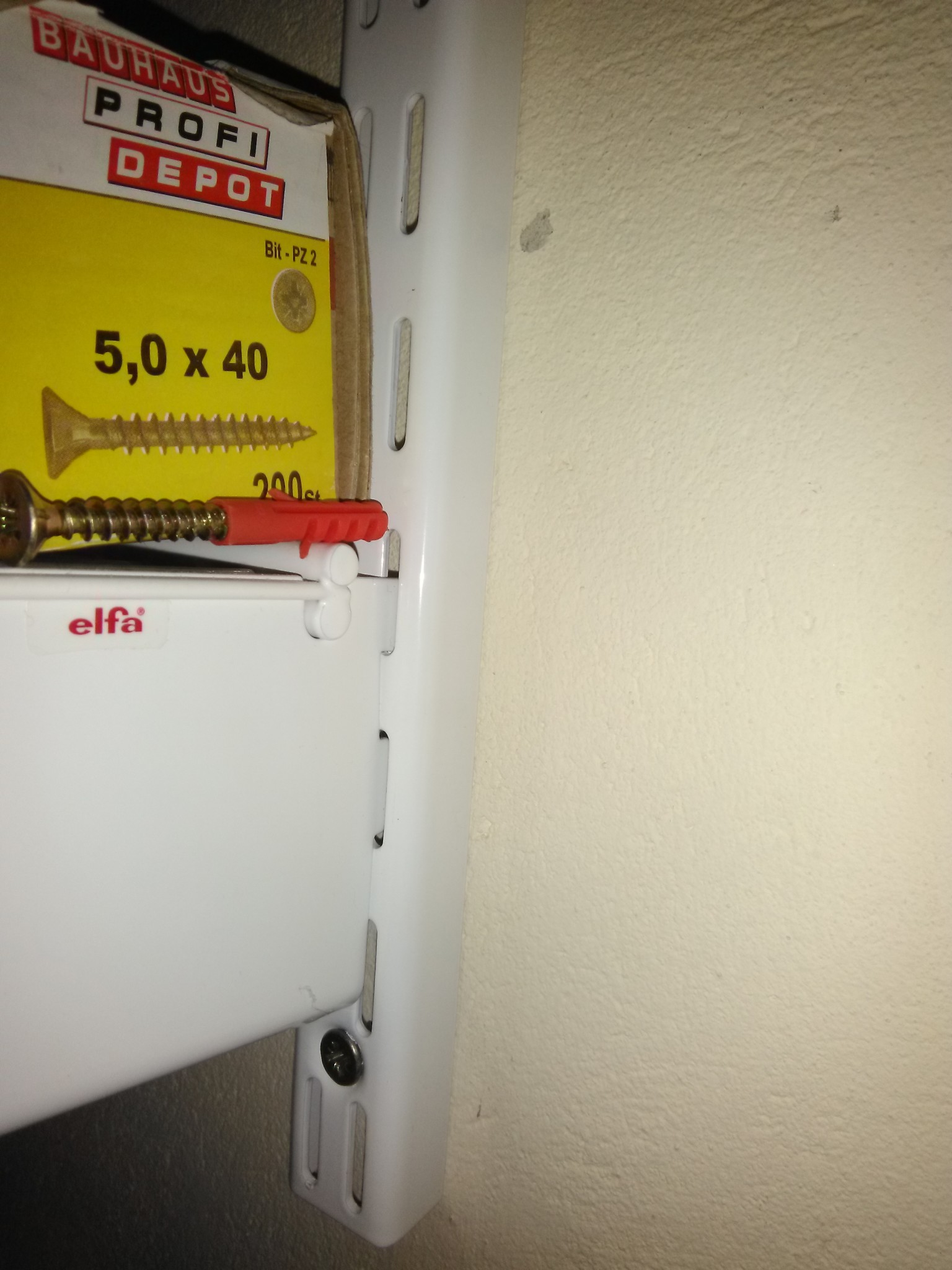
We live in a brick-clad wooden house with a habitable basement made of some kind of hollow block. There are some brackets in the basement that the previous owner screwed in place, and these are now starting to give way, i.e., the screws and plugs are beginning to come out of the walls despite normal load.
I have myself put up both brackets and TVs in the basement since we moved in, and as a hobbyist, I have actually mainly used IKEA's FIXA screws, i.e., 5x60 mm screws with Universal plug 8x51 mm:
The rotary hammer cuts through the hollow block very easily, but despite that, it's not always easy to get the holes exactly as you want them. Most often, you have to drill with a bit one size smaller.
This has held up well so far. But the question is whether you should go for something sharper for the storage shelves? Any suggestions that are relatively easy to get a hold of?
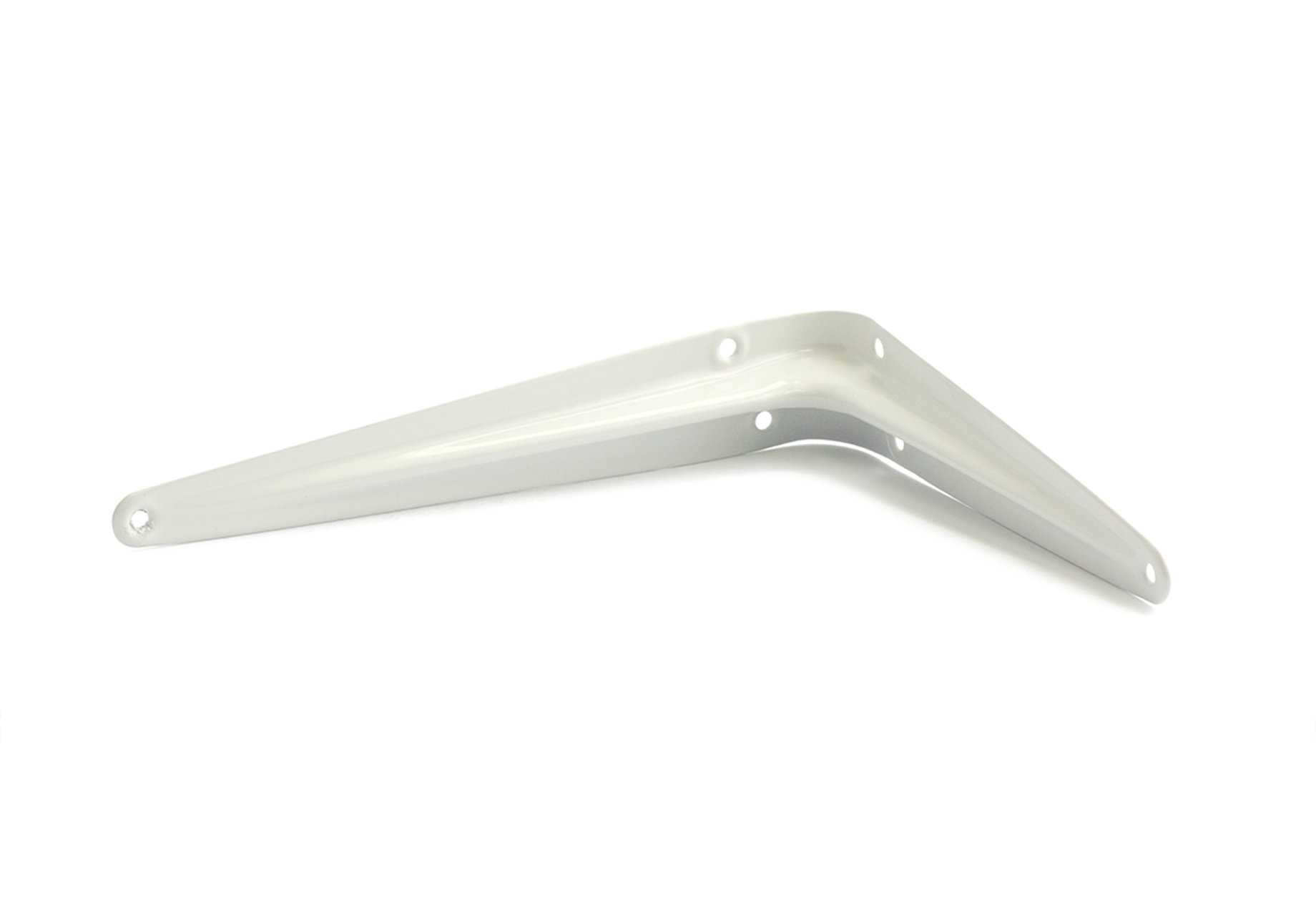
The brackets that are in place look something like this:
Maybe one should take the opportunity to replace them with Elfa? We were thinking of having 1 shelf so the storage space mainly holds larger boxes like banana boxes and product cartons.
I recommend Elfa with rails on the walls, easy to install and significantly stronger than those brackets in the picture.
Yes, maybe I should go with that. The question is whether to use a hanging rail (carrying bar) or wall rails? Probably the hanging rail is much easier to get level?
How does the carrying bar actually work? I've read in several places and I get the impression that it just hangs? You don't fasten it at the bottom at all? So isn't there a risk that it might wobble?
Yes, maybe I'll go with that anyway. The question is whether to use a hanging rail (support rail) or wall rails? Probably, the hanging rail is much easier to level?
How does the support rail actually work? I've read in several places and I get the impression that it's just hanging? You don't attach it at the bottom at all? Isn't there a risk that it will sway?
I usually use a hanging rail and then drill a couple of extra holes that I countersink the screws into to make the shelf rigid. I like the hanging rail because you can easily adjust the placement until you're sure.
Ah, so you attach the rails that hang on the wall near the floor then?
Yes, it varies depending on the wall's strength and the size/use of the shelf. I think it’s best (most stable) with a screw in the middle and at the bottom if the shelf is full height.
Sometimes it feels a bit silly to buy a more expensive hanging shelf and mod in screw holes, but I find it to be the easiest and best. The hanging rail is also easy to level.
I think it's a bit of a shame to drill holes and countersink them in the hanging rails. If you have loose shelves, you can mount the brackets last, in case there's a discrepancy of a few mm. I don't really see why it's so difficult to get standard Elfa wall rails level. Start with a support strip/beam as a spacer from the floor/surface, once the first hole is drilled, you can insert the plug and screw and attach the rail. Subsequent holes are easier to mark and drill correctly by tilting the rail aside.
I did some calculations and the Elfa system ended up being about 2600 kr, which we felt was a bit much for what we were going to use it for. Instead, I think we're aiming for IKEA's Algot, which is very similar but costs half. Of course, I will take a closer look at how much weight and similar they can handle. The downside of IKEA's system is that it might be discontinued after a few years, while the Elfa system will always be available.
But to return to screws and plugs, what do you think should be used here? Do regular plugs, like the ones I linked to in the first post, work? Or should I buy something special?
I don't see any problems using standard plugs for leca/concrete hollow stone. I used these https://www.jula.se/catalog/bygg-oc...g-och-expanders/pluggsatser/pluggsats-002861/ the red size. The important thing is that the screw fits well with the plug and the shelf bracket's countersink. The insertion into the wall for these screws is only 20mm; the plug is 30mm. The load is quite small on this shelf so it has worked excellently, you don't want to over-dimension unnecessarily. But I never use the hammer function as the holes become uncontrollably large, a 5.5mm drill bit works well when using a 6mm plug.



 , but I find it to be the easiest and best. The hanging rail is also easy to level.