
9,078 views ·
19 replies
9k views
19 replies
Replace 45x220 with a steel beam?
An acquaintance has a patio built with 45x220. The outermost is a load-bearing beam of this dimension, to which they have then attached all the rafters using joist hangers. There are only two load-bearing beams, and the width of the patio is about 5 meters. So, there is a load-bearing beam innermost against the house wall, and an outer one as described above.
The problem here is that the patio has begun to sag about 10-15 cm at its worst, as the posts are approximately 3.5-4 meters apart. It can be stated that the person who built it was not very careful with the calculations.
It's a nice patio otherwise, so we would prefer to avoid tearing the whole thing down. It's also built as a carport, where you can park cars under the patio (on a slope). We would like to keep that option.
The thoughts then turn to replacing or reinforcing the outer 45x220 with a steel beam a bit further in, about 2 dm inside on the other side of the posts. Is this feasible? What dimension would be needed in that case? Prefer not to lose any "ceiling height" in the carport, but realize that we have to compromise on this wish in one way or another.
P.S. It seems to stay level otherwise; it's just the outer load-bearing beam that seems too weak.
The problem here is that the patio has begun to sag about 10-15 cm at its worst, as the posts are approximately 3.5-4 meters apart. It can be stated that the person who built it was not very careful with the calculations.
It's a nice patio otherwise, so we would prefer to avoid tearing the whole thing down. It's also built as a carport, where you can park cars under the patio (on a slope). We would like to keep that option.
The thoughts then turn to replacing or reinforcing the outer 45x220 with a steel beam a bit further in, about 2 dm inside on the other side of the posts. Is this feasible? What dimension would be needed in that case? Prefer not to lose any "ceiling height" in the carport, but realize that we have to compromise on this wish in one way or another.
P.S. It seems to stay level otherwise; it's just the outer load-bearing beam that seems too weak.

The smallest HEA beam, HEA 100, has greater bending stiffness than a 45x220 wooden beam. However, the question is what the need is. I would wish for a clearer presentation of how it looks. The construction does not seem completely optimal.
Thanks for the response. Totally agree, the construction is far from optimal. We are trying to address this in the best/simplest way, without having to redo everything since the building is only a few years old.J justusandersson said:
Unfortunately, I don't have a good photo, so I am attaching a simple sketch of the approximate construction.
Red = current 45x220 that is sagging.
Green = my idea for a reinforcing beam
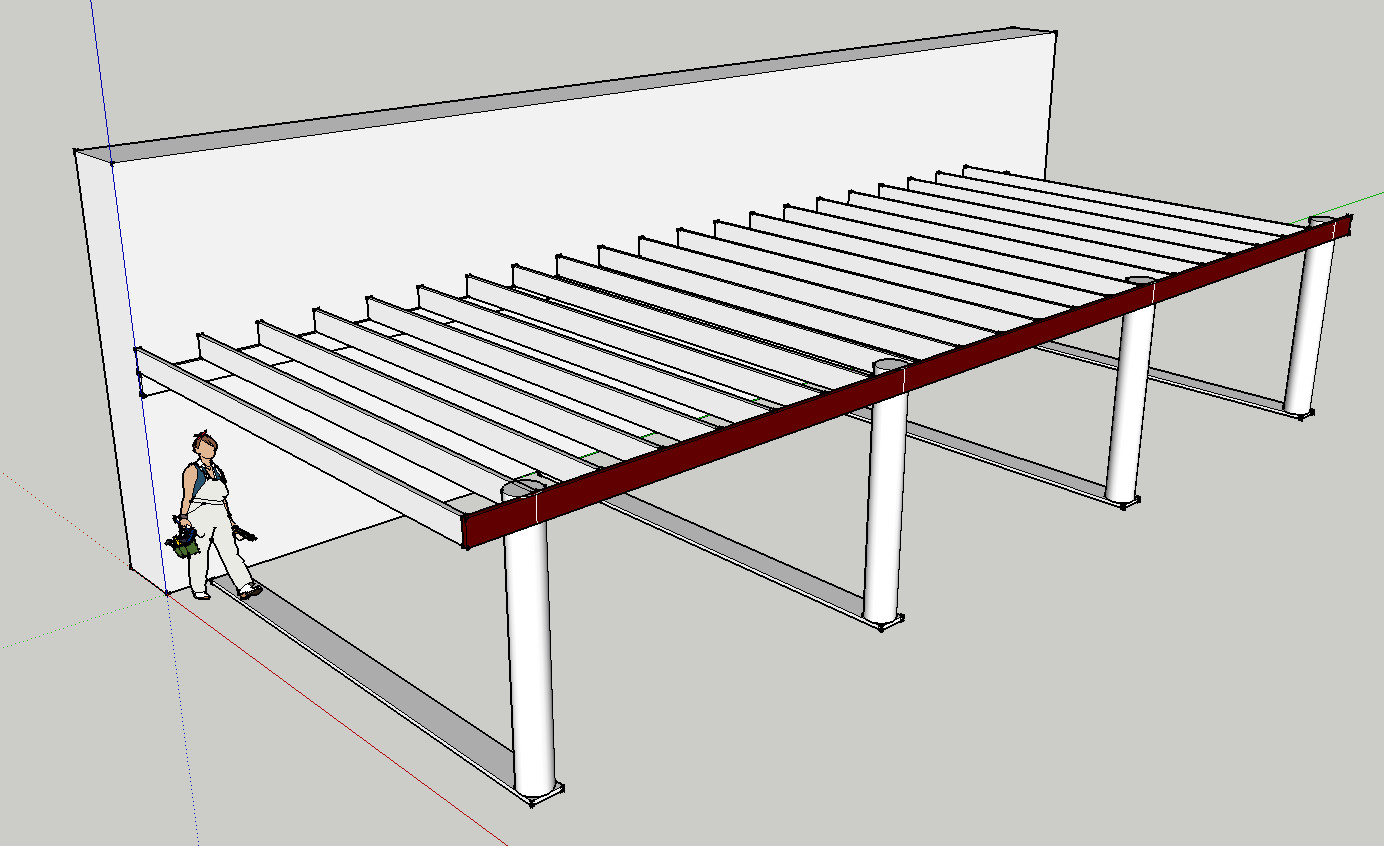
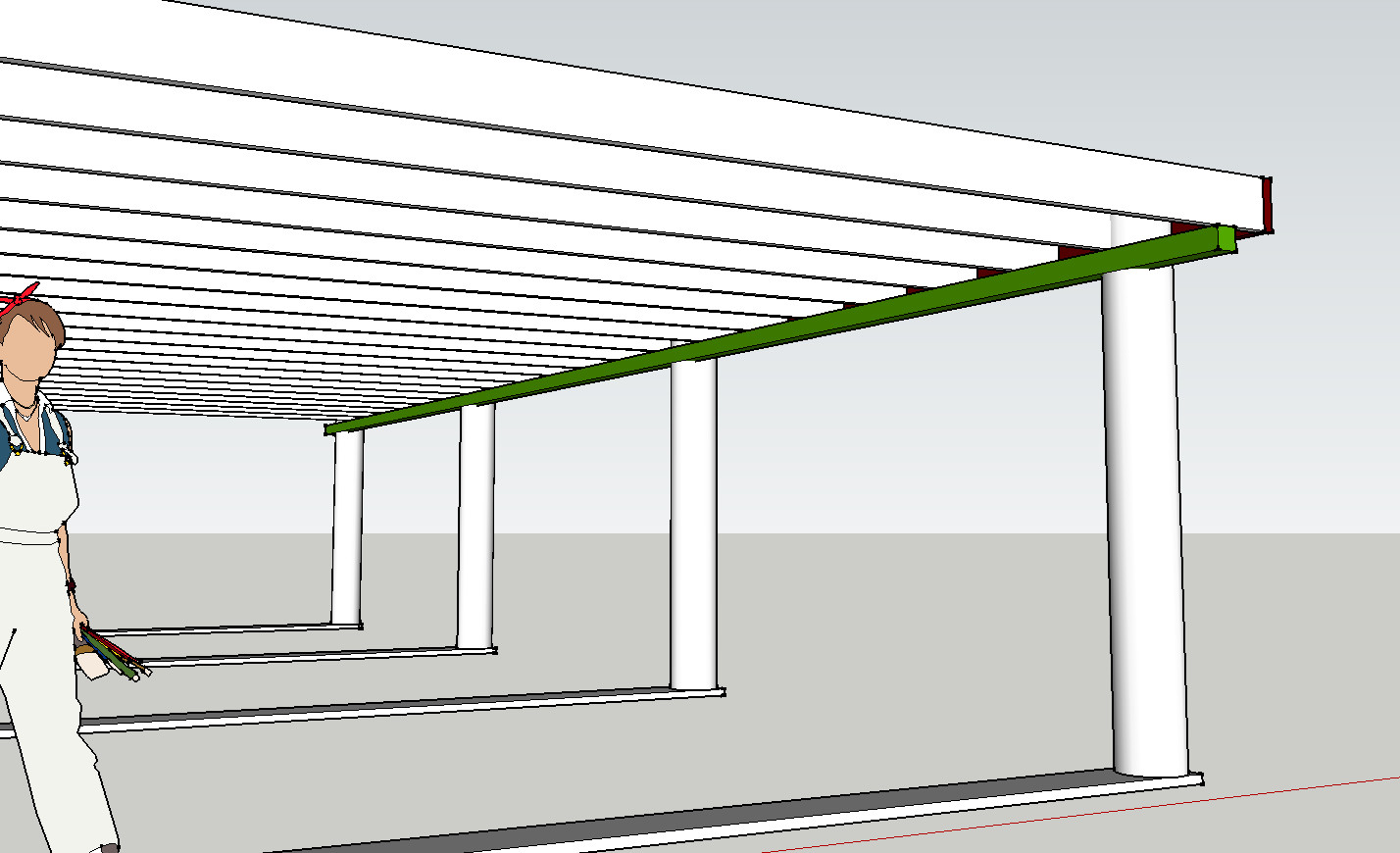
Since none of the rafters are sagging significantly, this should be enough?
Can I embed the beam into the 45x220 rafters to avoid losing ceiling height, which is already quite limited? I assume the risk of cracks in the rafters increases then.
I would feel more comfortable first calculating the beam with the actual loads. Is it used as a deck? What is the spacing of the rafters on center and the distance between the columns?
In general, it is difficult to combine steel and wood. Embedding a steel beam in the ends of the rafters feels like a borderline case for what is possible. I think a better and cheaper solution might be to replace the beam with a glued-laminated beam.
In general, it is difficult to combine steel and wood. Embedding a steel beam in the ends of the rafters feels like a borderline case for what is possible. I think a better and cheaper solution might be to replace the beam with a glued-laminated beam.
I could quite easily add
I also considered glued laminated timber but thought it would require much more downward space to achieve sufficient stiffness compared to a steel beam. What would be a reasonable dimension for glued laminated timber in that case?
Yes, it's used solely as a terrace. The joists are spaced at 60cc, and the posts stand at slightly varying distances, with a total of five posts on that side. Two "bays" are spaced 3.6m apart, the next bay's posts about 4.5m apart, and the last 4m apart. The latter two are, of course, the ones that feel most sagging, but I'm afraid the smaller bays will start sagging soon as well.J justusandersson said:I would be more comfortable first calculating the beam with the actual loads. Is it used as a terrace? What is the spacing between the joists and the distance between the posts?
Generally, it is difficult to combine steel and wood. Embedding a steel beam in the ends of the joists feels like a borderline case of what is possible. I believe that a better and cheaper solution might be to replace the beam with a glued laminated timber beam.
I also considered glued laminated timber but thought it would require much more downward space to achieve sufficient stiffness compared to a steel beam. What would be a reasonable dimension for glued laminated timber in that case?
4.5 meters is much too large a span for 45x220 as a main beam. A rough calculation on the entire deck suggests that the outer main beam should be replaced either with a steel beam, HEA 160, or a glulam beam 190x270. Since the joists are attached with joist hangers, a glulam beam can be allowed to build in height instead. The glulam solution is simpler and cheaper.
If the joists are 5 meters long, the deck itself must be very unsteady to walk on. I don't think it's an acceptable solution, and some form of reinforcement is needed. How to do that depends on what other restrictions exist.
If the joists are 5 meters long, the deck itself must be very unsteady to walk on. I don't think it's an acceptable solution, and some form of reinforcement is needed. How to do that depends on what other restrictions exist.
Yes, I don't understand why they built it so flimsy from the start. I guess it has to do with a lack of competence.J justusandersson said:4.5 meters is way too wide a span for a 45x220 as a support beam. A rough calculation for the whole deck suggests that the outer support beam should be replaced either with a steel beam, HEA 160, or a laminated beam 190x270. Since the rafters are attached with joist hangers, a laminated beam could be allowed to add height instead. The laminated solution is simpler and cheaper.
If the rafters are 5 meters long, the deck itself must be very wobbly to walk on. I don't think it's an acceptable solution, and some form of reinforcement is necessary. How to do this depends on what other restrictions exist.
Is a 190x270 enough in snow zone 5+? If so, it only adds 50 mm more than the current 220. It's completely acceptable, even better than my original idea.
I think the deck feels reasonably solid to walk on anyway, but there is room for improvement. I've experienced worse, but it's not good.
What do you think about replacing the outer support beam with a 190x270, and also installing a 190x270 support beam in the center of the rafters (see attached image)? It's definitely doable, but it would involve quite a few extra hours of work.
P.s. I don't know if it's relevant to the question, but the rafters are lap jointed (cross braces) in two places.
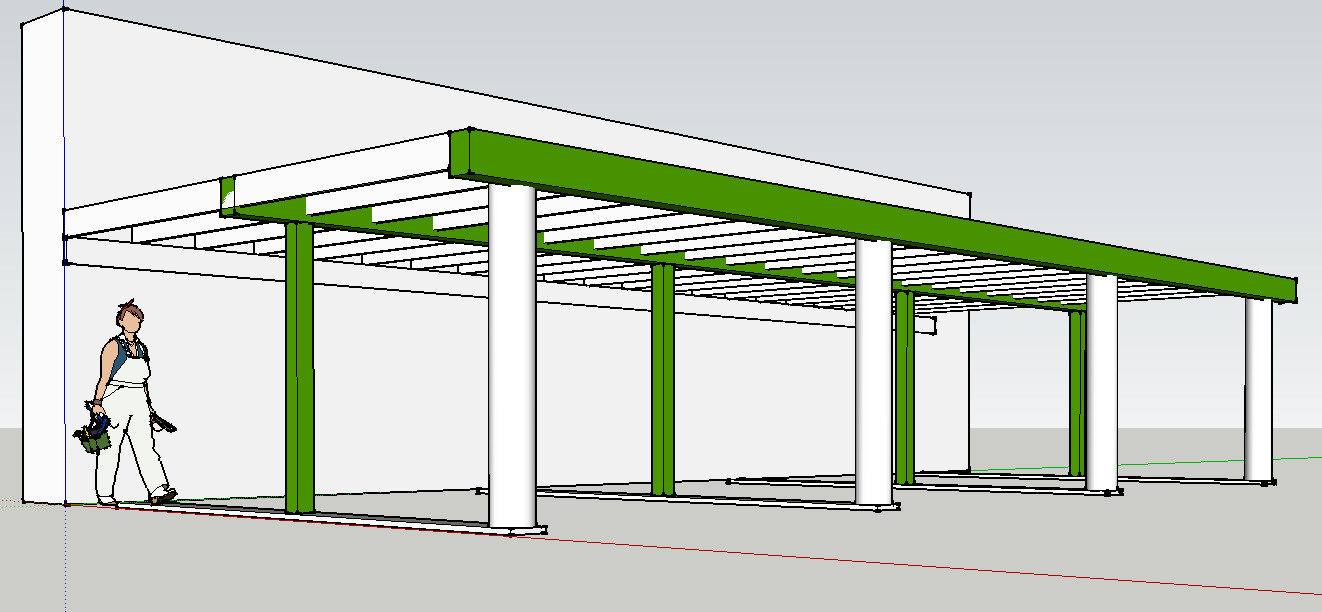
Cross-bracing reduces deflection somewhat but does nothing for sagging. An additional beam in the middle will be a colossal improvement. Before I calculate too much on it, what do you mean by snow zone 5? Is it in the mountains?
It's on the border of the mountains, a few miles from Åre. But snow zone 4 might be more accurate now that I think about it.J justusandersson said:
Embedding a beam in the middle according to the plan involves a lot of work, even though it's the right thing to do... Propping up the entire deck and then cutting all the rafters... Is there a smarter way to do it that doesn't ruin the ceiling height as much as putting a beam under the rafters?
As mentioned, there was over a meter of snow there this year, but the deck was shoveled off when there was 85 cm of snow, as we realized it was about to give up.
I must take this opportunity to thank you for all your help, it's spot-on to get good calculations instead of guesses and interpreting googled tables on my own.
I must take this opportunity to thank you for all your help, it's spot-on to get good calculations instead of guesses and interpreting googled tables on my own.
Snow zone 4.5 is probably correct. I calculated with a useful load of 3.5 kN/sqm, which is the standard requirement for terraces. Snow is not considered simultaneously so I only need to increase by 1 kN/sqm. I will do some calculations on it. With glulam, you can increase the thickness instead. I'll get back to you.
A quick calculation, but with a centrally placed support beam of 215x270, 115x270 on the edge would suffice. The alternative to the central beam is to replace the ridge beams with glulam, possibly in combination with structural timber in the other direction. However, this would be much more extensive and expensive. It is quite a difficult task to design this type of construction. It requires some experience and knowledge.
Well, I came to the same conclusion - that it's too much to think about just to improvise a solution.
But anything would be better than now, and I think reasonably that the proposals you have come up with should make a big difference, considering how stable and good the deck is at the moment (apart from the fact that it has started to sag though).
Thank you so much for your responses, they have been really educational. I will suggest the solution with the glulam beams to my acquaintance and we'll simply start a summer project.
But anything would be better than now, and I think reasonably that the proposals you have come up with should make a big difference, considering how stable and good the deck is at the moment (apart from the fact that it has started to sag though).
Thank you so much for your responses, they have been really educational. I will suggest the solution with the glulam beams to my acquaintance and we'll simply start a summer project.