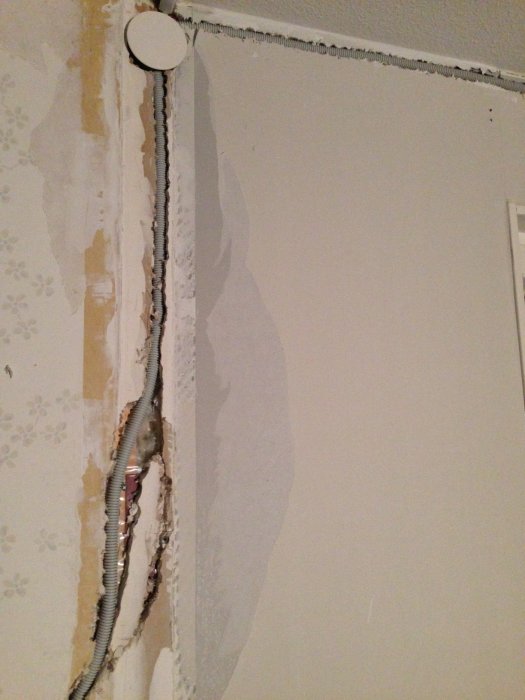
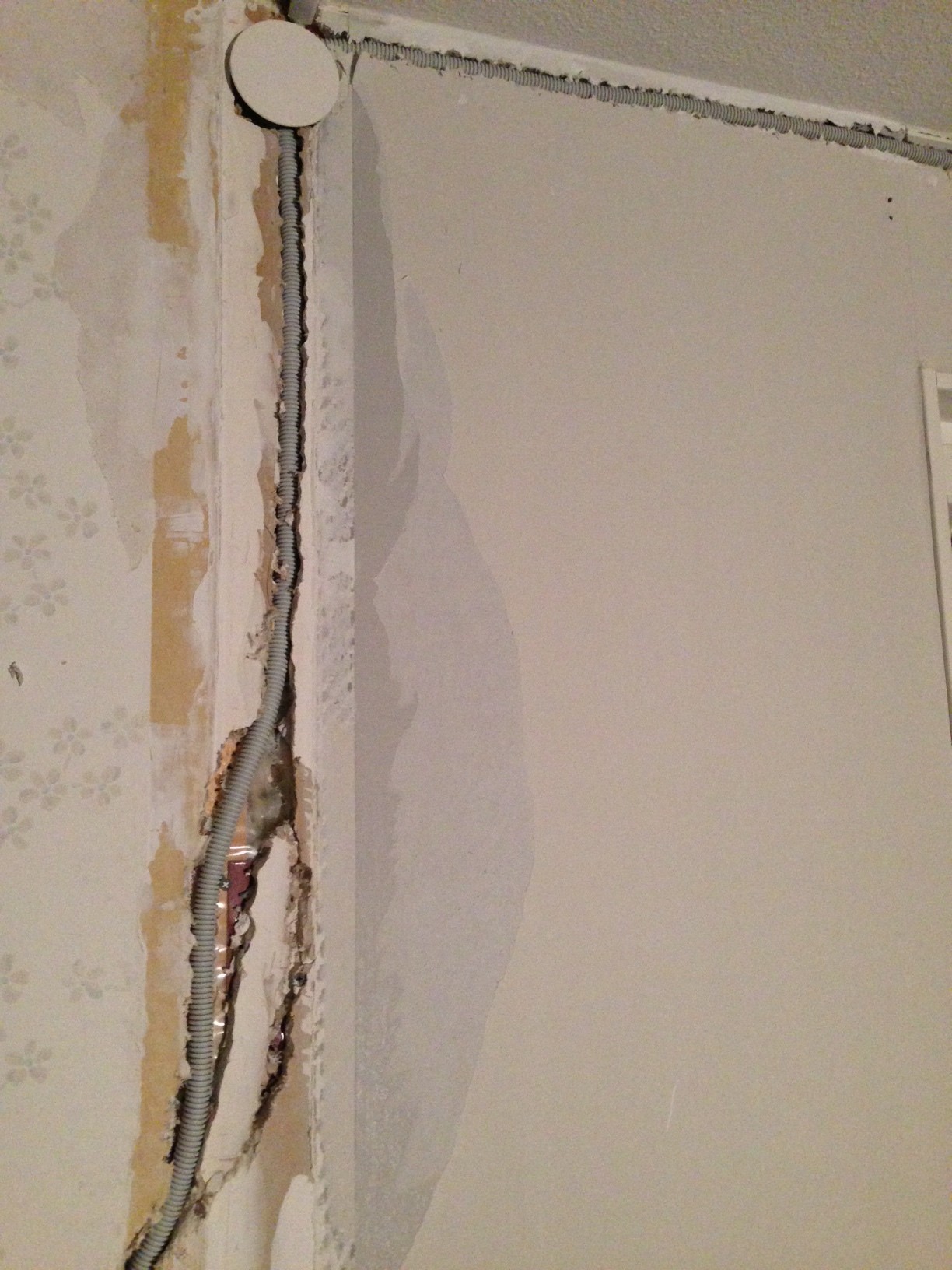
Recently had electricity drilled into the wall (gypsum). The groove is now open as shown in the picture and I'm wondering how I can best fill it. Just using putty feels a bit weak, is there something else I should fill the groove with before puttying? It's an exterior wall so perhaps something insulating is needed?
You mean the plastic as in the vapor barrier? That building technique wasn't invented when tretex was used
It's plastic in the picture and I have plastic behind the tretex at my home. And there are very clear areas of black mold where, for example, a picture has been hung and then removed. You can also see in the pictures that the plastic is completely mishandled.
It's plastic in the picture, and the wall is made of gypsum?
I would probably put renovation gypsum on the wall.
I think it's tretex to the left of, and gypsum to the right of the electrical conduit, right?
SueCia said:
It's plastic in the picture and I have plastic behind the tretex at my house. And there are very clear black mold areas where, for example, a picture has been hung and then removed. You can also see in the pictures that the plastic is completely mishandled.
Yes, there's no doubt there are holes in the plastic. I thought it wasn't a problem with tretex since it's so porous, assumed it breathes. We've torn down five tretex exterior walls without plastic and haven't found anything black. Built in 1959.
Yes, that there are holes in the plastic is no doubt. I thought it wasn't a problem with tretex since it's so porous, assumed it breathes.
It's precisely that it breathes that is the problem. The plastic is not meant to protect the tretex from moisture from the outside, but rather to protect the cold part of the wall from moisture that seeps out from the inside(?)
Then I don't understand why there is black mold behind a painting if the damage occurs on the cold side of the plastic. I am continuing this discussion to learn; plastic in old construction I thought was used like paper, to stop wind and not moisture.
Then I don't understand why there is black mold behind a painting if the damage occurs on the cold side of the plastic.
I am continuing this discussion to learn, I thought plastic in old construction was used like paper, to block wind and not moisture.
It wasn't black mold behind a painting, it was black mold in the insulation, where a nail for a painting had punctured the plastic in the wall. Then, when the painting was removed, moist air came out through there and condensed in the insulation.
Plastic is never used to block wind; that can be a side effect, but never the main purpose of the plastic. If so, you're doing it wrong.
In a construction with fiberglass, plastic should be used, and it should be tight. In older houses, it's rarely tight, but then it ends up looking like my attic too... :S
We brought in an electrician who ran this cable. The plastic, as you said, is damaged in many places along the cable duct, making it difficult to access for taping. Do we need to ask him to come back and remove the cable as well as repair the plastic in all places before we fill it with plaster filler?
edit: I can add that it is a condominium, the building was constructed in the 80s.