Long story short, bought a 70s house with a basement that I'm in the process of renovating and could use some tips and help!
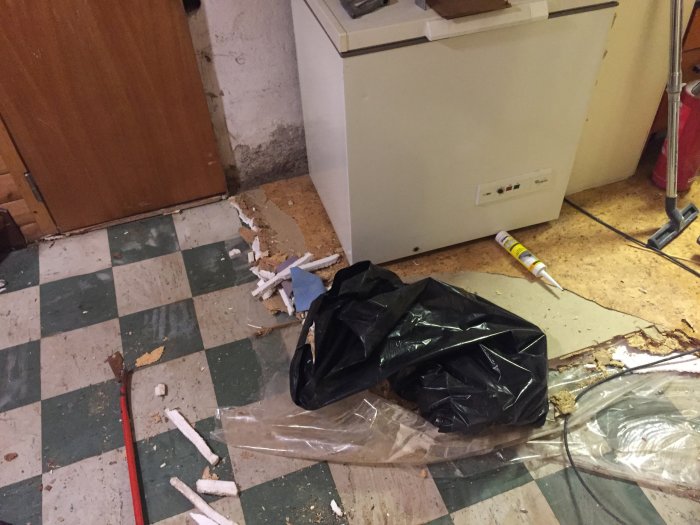
It's about 1 family room and 2 small "bedrooms." They were obviously furnished with wood studs, etc., but all that is removed, and I'm about to start renovating soon. I'm just going to plaster the walls, heard that's best. The problem is the floors; in the adjacent room to the family room, a construction firm renovated, and when we tore it up, we obviously saw how they had done it:
Foam insulation-some kind of plastic foil-cast approximately 5 cm and then a tile floor. Is it okay to build like that?
If so, I'll just do the same in the family room. In the other small rooms, I was thinking of using Bergo tiles and then a needle felt, how does that sound?
In that case, I'll just do the same in the rec room. In the other small rooms, I was thinking of Bergoplattor and then a needle felt, how does that sound?
Do you need to have something like Bergoplatta under the needle felt? It's open, so any moisture can go straight through, right?
Do you need to have something like Bergoplatta under the needle felt? It's open so that any moisture can go straight through, right?
I thought it would be a bit more comfortable to walk on if I did that, read about someone else who tried it. And it is a bit porous and lets moisture through and the needle felt breathes, as you say.
The construction must withstand moisture and allow ground moisture to move upwards.
Assuming you need to raise the floor level since you've torn out the elevated floor?
Either you break up and dig and insulate according to the rules of the art and pour on it, but that's a damn tough job in several ways.
Or you can pour a new floor on top of the old one and level it.
Maybe eps cement can be good to add volume?
The floor construction the construction company has done could create a risk of water under the plastic sheeting.
I've looked at eps cement and then self-leveling it, so that's an option.
Hmm, I'm curious about what the construction company has done if it's now an incorrect construction.. should probably be classified as a hidden defect if so? It was done around 2012, so it's not that old, maybe I should give them a call and ask. I can get a picture of how they've done it so you can see better.
Very grateful for answers, first house and very inexperienced with anything related to construction
Take some pictures and feel free to make a sketch of the basement's layout with doors, windows, vents, and chimney, as there are probably people on the forum who can contribute. I have an older basement myself from 1945. Some parts are renovated, others are older with interior insulation. I won't accept bad odors in the basement, so I've looked at many alternative solutions and make it work well. Despite old drainage and less suitable inherited constructions from previous owners. I'll try to share my experiences if you post material and if you're okay with questions.
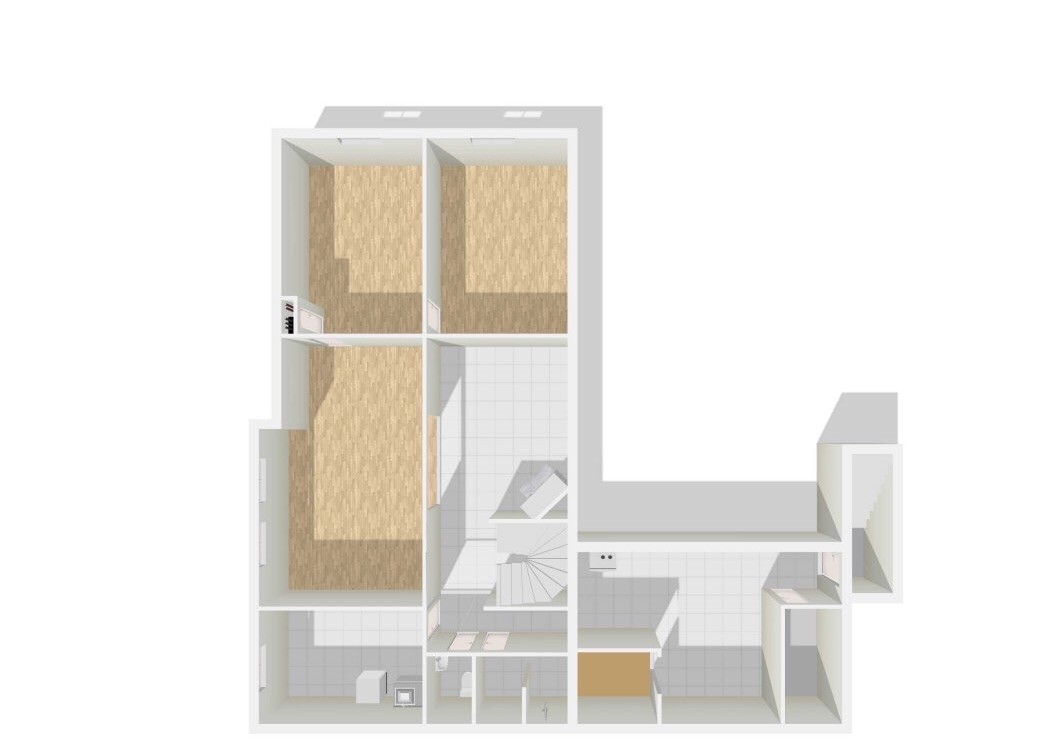
In image 1 you can see how they have laid the floor in the renovated part, and in image 2 there is a sketch of the basement; the rooms with wooden floors are the ones I am going to work on.
The room adjacent to the gillestugan has the floor variant shown in image 1, the rest I believe is laid directly on the poured slab as you don't get the "hollow sound" when you stomp on it.
I don't know if there will be problems with such a construction, but I know from my own experience that it can get wet under the plastic film.
I tore away plastic matting, chipboard, 2 cm foam plastic and plastic film in my basement. Underneath was an old floor that was glued.
It was wet (free water) under the plastic that dried up by the next day.
I doubt that the solution I see in the picture is a "professional" construction on an uninsulated basement floor. By insulated, I mean a modern foundation that is insulated to both be sealed and block incoming ground moisture, as well as provide a warmer floor and save energy.
It is claimed that almost all other types of basement foundations have more or less incoming ground moisture, even if the house has good drainage.
It can work if you have an extremely low moisture level in the ground, otherwise there is, as someone wrote in previous posts, a fairly high probability that it will become very damp between the concrete and the covering above. If the house was inspected when you bought it, I think an inspector would call it a risk construction if he/she saw how the construction was done.
Some may say it doesn't matter if polystyrene gets damp, but EPS polystyrene does absorb some water, meaning damp material requires more energy to keep warm. Additionally, there must be 100% certainty that no organic material remains under the polystyrene, as it can otherwise lead to odor.
Another aspect that I find central: The tighter the floor you lay, the more moisture will find the easiest pathway upward, which can be in the wall. I have a wet room with waterproofing in the basement and chose as open materials as possible on the other side of the walls to let the walls breathe that way. I monitor this with a moisture meter to see that it works. It is clear that the wall has gained more moisture due to the wet room, but so far the solution seems to be working, although we have record low groundwater and have been without rain for a long time, so I follow it regularly to see how it develops. A check takes me less than a minute.
There might be solutions I haven't seen that work. However, the inspection on my house did state risk construction for those rooms where the floor consisted of thin polystyrene, construction plastic, fiberboard, and wall-to-wall carpet.
If I were in your shoes, I would investigate whether the solution in the picture is a professional and approved construction.
If you are going to set up new rooms, my advice is to create a solution that breathes. I have never used EPS cement, but I understand that it's EPS beads in cement that provide both load-bearing capacity and insulation value. If its properties are as vapor-permeable as regular concrete or better, it could be a good alternative as a base for leveling and tiles. If it works, you will likely get a flooring solution that withstands normal incoming ground moisture.
Click here to reply
Vi vill skicka notiser för ämnen du bevakar och händelser som berör dig.