
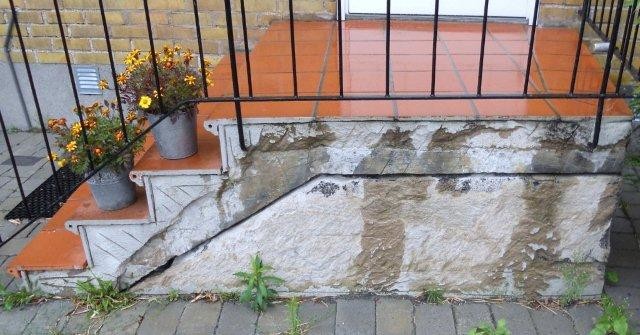
My entrance stairs need a makeover. The stairs are the original concrete from 1959. A previous owner added a wall of LECA blocks under the stairs and plastered the side of the stairs. The LECA wall has shifted due to settling and the plaster has cracked. I've chipped away most of the plaster and plan to apply new mortar C. The remaining plaster is really hard. I've managed to plaster indoor walls myself before, but this might be easier to mess up.
Therefore, I'm looking for good advice to achieve a nice stair side that will last many years. The plaster layer will be thick, several cm in some places.
Should I apply several thin layers, or one thick layer?
Should I use reinforcing mesh, which type?
Should I hope that the LECA wall has stopped moving and plaster the whole side in one piece?
Or should I leave a crack and fill it with something elastic, and if so, what?
Good advice is highly appreciated! I don't have the energy to start until I know how to proceed, and I hope I will have the energy once I get some tips! :S
Therefore, I'm looking for good advice to achieve a nice stair side that will last many years. The plaster layer will be thick, several cm in some places.
Should I apply several thin layers, or one thick layer?
Should I use reinforcing mesh, which type?
Should I hope that the LECA wall has stopped moving and plaster the whole side in one piece?
Or should I leave a crack and fill it with something elastic, and if so, what?
Good advice is highly appreciated! I don't have the energy to start until I know how to proceed, and I hope I will have the energy once I get some tips! :S


Thank you, Stefan! Does anyone else have any good advice to give?
Thank you Helioz! A-bruk it will be!
Do you also think I should leave an anvisning in the crack? A straight and nice gap that I fill with some elastic sealant.
Do you also think I should leave an anvisning in the crack? A straight and nice gap that I fill with some elastic sealant.
Yes, if you want to be completely sure to avoid future cracks there, then do it. Fill the gap with a high-quality outdoor construction sealant that is paintable, then paint everything with a water-based baseboard paint to make it quite invisible. Recommended products are Casco Fasadfog or Bostik Silmax Byggfog. You must prime the surface before sealing, otherwise the sealant won't adhere properly.
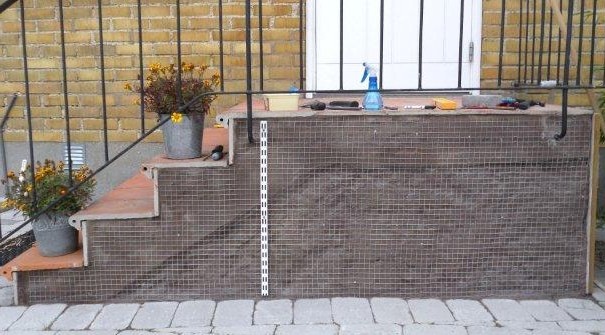
Yes, I'll probably ignore it for now. It should be possible to run a seam with an angle grinder in the future if it starts to crack, or before it cracks if one happens to feel like working. Feel free to give feedback, I haven't mixed the mortar yet!
I don't know exactly how cracking occurs when you've meshed, but the risk as I see it is that the reinforced plaster may cause the cracks to appear irregularly instead of in neat lines at the joint. However, I would have probably tried the same solution as you, hoping to avoid cracks for a while.
An alternative would be to cut the mesh in neat straight lines along the joint and hopefully control any future cracking to some extent.
An alternative would be to cut the mesh in neat straight lines along the joint and hopefully control any future cracking to some extent.
Great, looks perfect! If you skimmed the crack with foam sealant, you can go ahead with the plaster without doing anything more. Smooth out everything and you can see if it holds; there might be a slight void under the crack but the net should keep the plaster in place, so there won't be any visible cracks on the surface. You can definitely create the control joint in the future as well with an angle grinder as you planned. Prime and then fill that joint as I mentioned above.
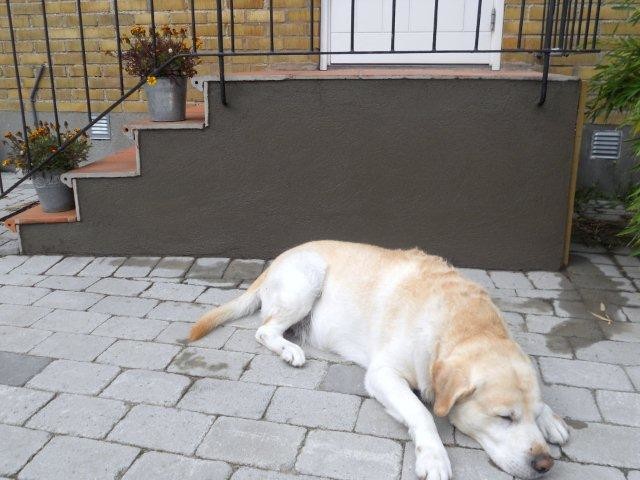
Looks perfect! Water for three days now and wait a couple of weeks until it is completely dry before painting. I would have chosen a regular acrylic baseboard paint instead, it has better durability and results in a more even finish. Since the staircase is freestanding, you have no need for the silicate paint's breathability. Teknos Saku is good in my opinion.
Click here to reply