Yes, if it weren't for that last 1 meter, I would say that the beam is sufficient without a problem. But since you want to extend the span, it becomes more difficult.
2kN/m2 is the same as 200kg/m2, a standard value.
If I understood the beams correctly, that wall supports half of the floor, a quarter on one gable and the last quarter on the other gable.
It was 8.5m long, and the wall then supports 4.25m of floor (4.25 x 4.7) sqm.
Glulam or not doesn't matter if you can't determine whether the roof loads the wall or not. The ridge beam is supported by pillars at the chimney, where does that force go down?
you say the beam is sufficient as it is despite being cut out about 80% where these blocks stand? then I think rather that the beam underneath is the more supporting one, which I plan to remove.
and there's a reason why I intend to bolt quite closely so the beam holds itself together or whatever you want to say
yes, you understood correctly, and I also understand your calculation of the floor area but since the joists go from outer wall to outer wall, I don't think the partition wall is really necessary, but maybe it helps so they don't sag down.
I will cast piers or a footing so the force from the new pillars goes directly into the ground.
addition:
there will be a new isokern chimney where the old one stood, but it is only 40cm wide,
so when I think about it, I might as well place a post 40 cm from the wall so the span only increases by about 60cm instead of 1 meter if it helps to stabilize the whole thing? and you build a wall 40 cm next to the new chimney
As usual with log houses, you have a gabled roof. The weight of the roof is supported by the 3 longitudinal logs; the ridge log and a beam on each side (i.e., from gable to gable), as well as the outer walls. The weight is transferred down via the gable walls and the transverse middle wall. This means that the wall you are considering removing does not at all bear the load of the outer roof.
I'm hijacking this thread which was abruptly ended last time it was up
I think it's great to get help understanding things that I don't understand, so to speak. Sometimes you want so much, and you believe you're talking to knowledgeable craftsmen, etc.
For example, I thought I had checked things out, but the more I read, the more I think I should take this more seriously when it comes to load-bearing walls in timber frames. The craftsmen I've talked to (2 whom I trusted and with good references) have told me that I can pretty much tear down the walls in my timber house as long as the floor joist is not spliced over them or they are load-bearing in another way.
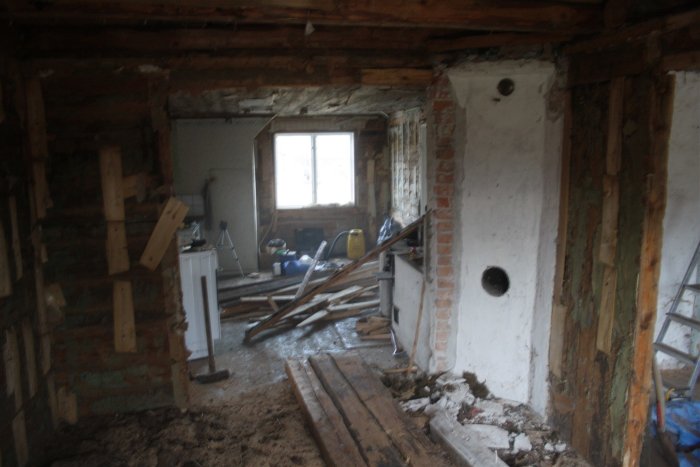
So I did this:
Which I'm beginning to suspect wasn't so smart. However, this is not a transverse wall to the floor joist, and the beam in the floor joist that rests on this wall is not spliced and runs from outer wall to outer wall. So I need advice and suggestions on what I should do now. I had planned to have an open floor plan entirely on the advice of craftsmen but understand that it might be a dream that has to be shattered
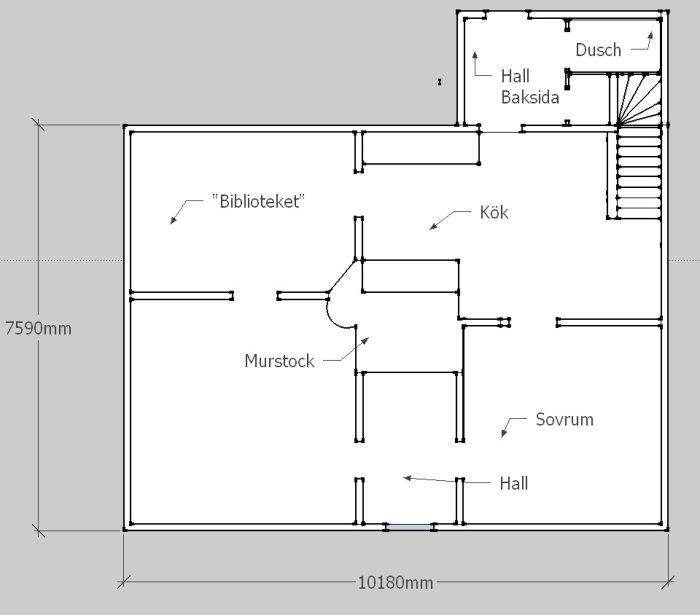
But opening up the doorways should be fine, but how much larger can they be made without affecting the load-bearing capacity riskily? I'm also attaching a floor plan
It’s the wall by the chimney into the kitchen in the library shown in the first image.
Oh well... you won't give up. Your craftsmen are clearly completely ignorant about log houses. You've simply asked the wrong people. It's like asking a furniture maker for advice regarding chimney masonry.
What does it mean to "open up"?
Normally, the logs are pegged 20-50 cm from the notch. If it's absolutely necessary to make the house usable, you can widen a door opening a bit and lose those pegs, but if you start gnawing at the log ends, it usually leads to encountering the pegs when you cut the groove for the new notch, which significantly weakens the wall. Therefore, you shouldn't widen door openings unless it's necessary... and above all, you must install proper connections in all openings. Without the proper connections, it's like a log structure I worked with. On half of the house's length and one gable, the entire upper floor was supported by the window frames and a few planks that were nailed to the log ends instead of proper connections. The logs between the windows had collapsed and carried nothing. Someone had enlarged the window openings and sawed off a lot of pegs without installing any connections. Naturally, the walls had pushed out some logs. They had simply chiseled off the displaced logs and nailed boards on. Do I need to say that the house was unsteady... I had to lift up the upper floor, remove the logs between the window openings, partially re-log, and install connections and pegs.
I advise you to rebuild the wall you just took down. Usually, the roof structure and some partition wall in the attic rest on the transverse partition wall. When you remove parts of it, there is more load on the remaining parts. The full-length timber above the doors is supposed to prevent the long sides from being pushed out. If the long sides get pushed out, the floor beams are pulled out of their attachments, and the upper floor collapses. Otherwise, nothing dramatic happens.
There are no partitions in the attic, and the wall in the picture didn’t even have any swords. It might not make a significant difference, but I think it seems like you're generalizing? I believe that there is quite a bit of variation in how things were built, and one should probably delve more into the construction before making such definitive statements. That's my feeling. Then, of course, it may be that you are right after all.
We'll see, I will consult with some carpenters in the area, to be continued.
I have done something similar where I have removed entire interior walls.
I solved it by adding insulation to the outside with standing 45x95 (95 outwards) on 60cc.
The studs were screwed with 180mm long screws into every third log.
Similar on the inside, screw vertical 45x45
I can't imagine the wall will buckle in the next 50 years

 but since the joists go from outer wall to outer wall, I don't think the partition wall is really necessary, but maybe it helps so they don't sag down.