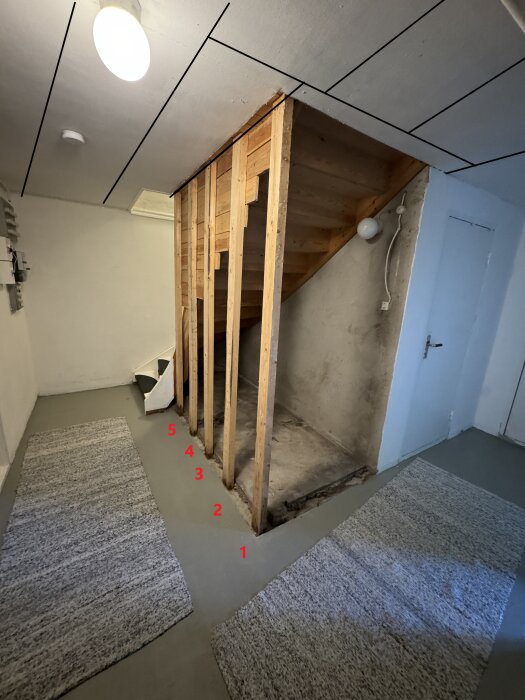
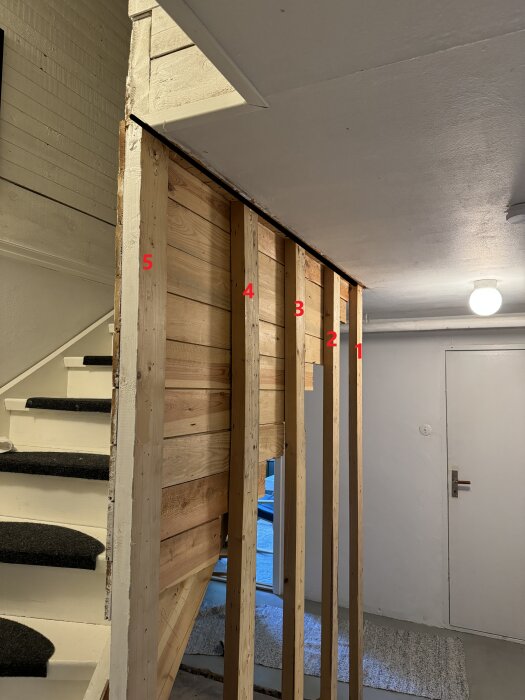
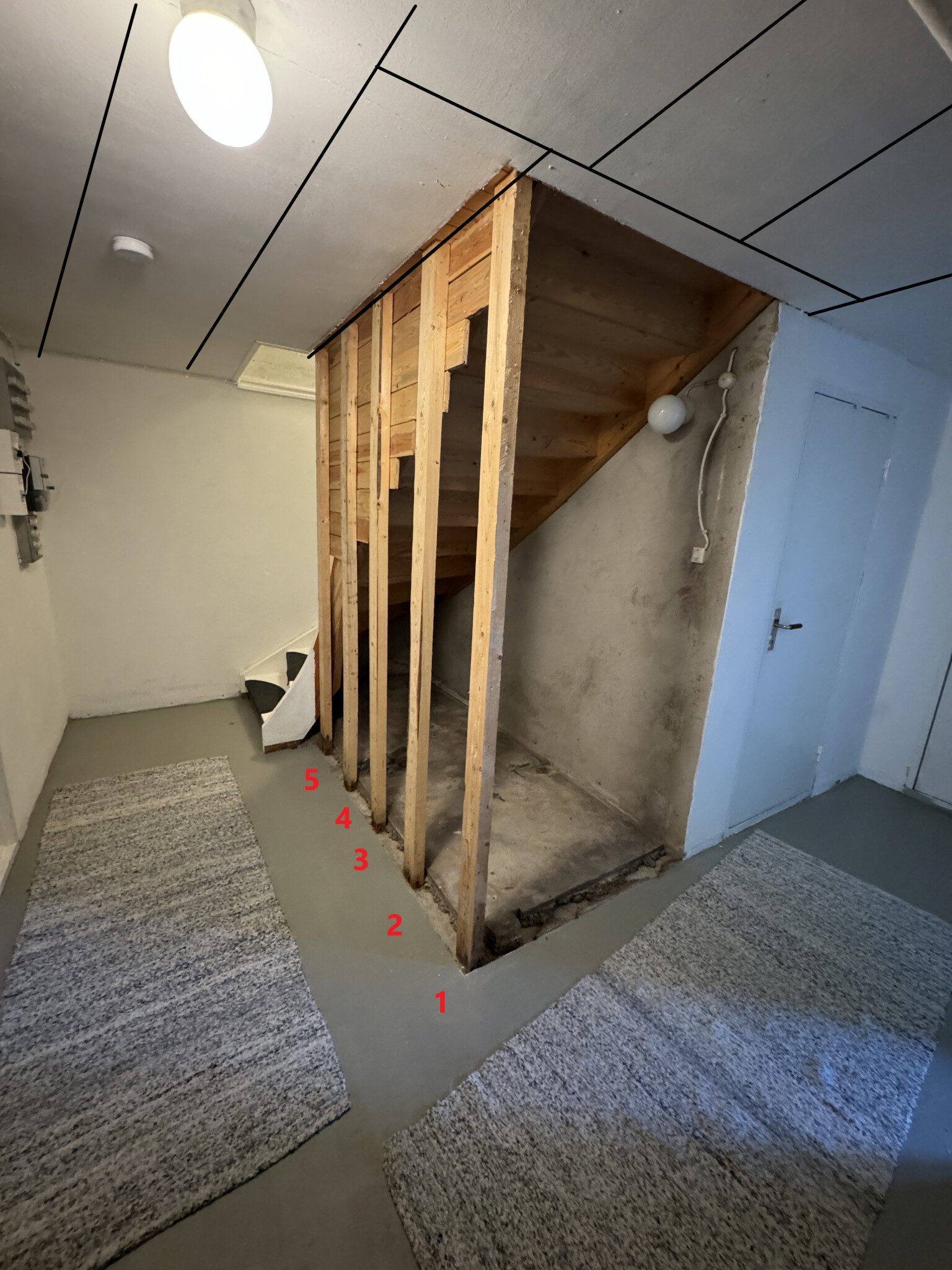
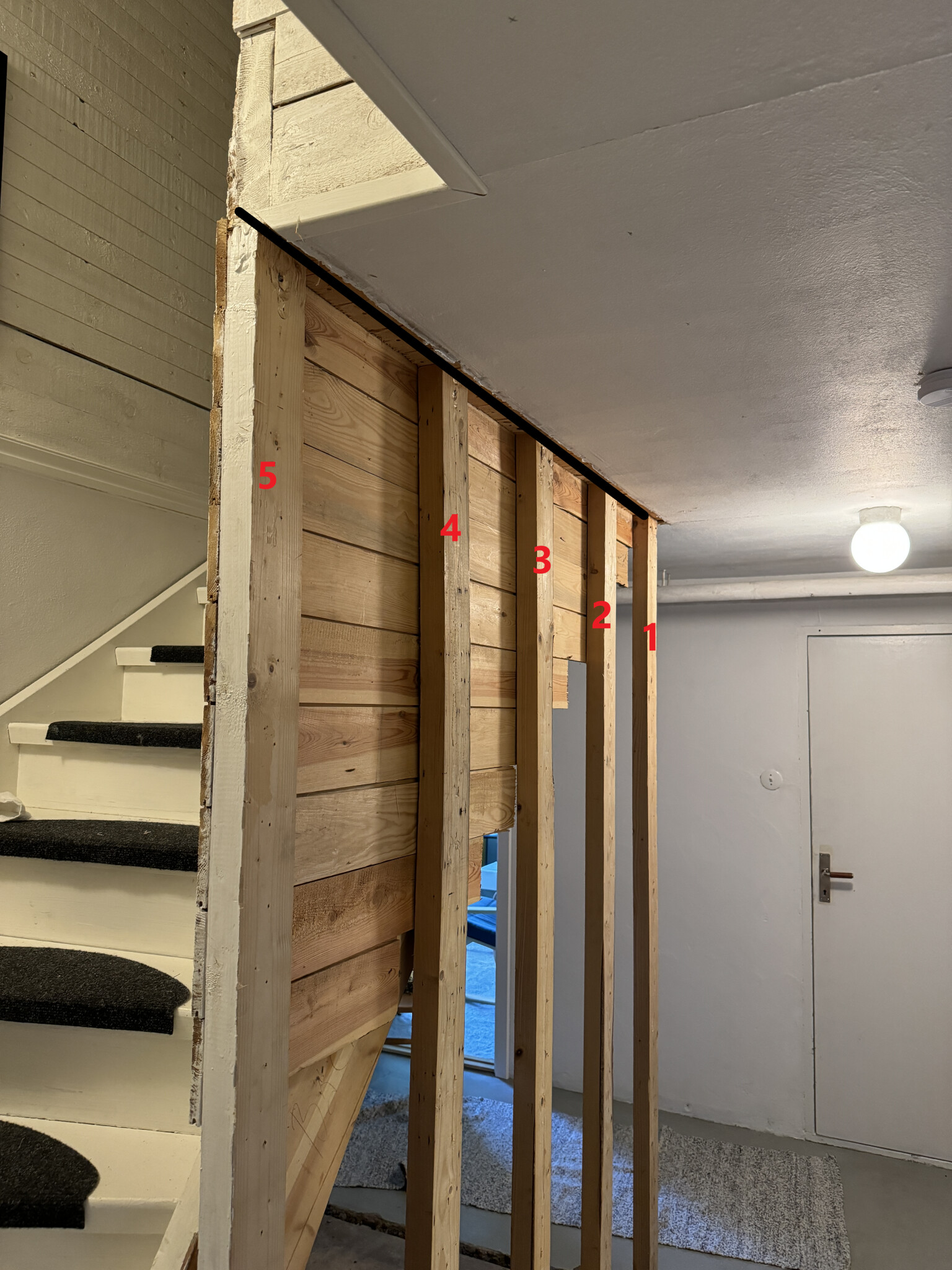
Currently opening up and removing a wall to create a more open space around the basement staircase. I've removed most of the matchboard, gypsum, door, and frame that were previously around it, but now I'm considering how to proceed with 5 studs/joists in which the paneling and gypsum were seated, and what their purpose is.
They are approximately 45x90 in dimension and are in the basement of a house built in 1962. Above these stairs is also the staircase between floors 1 and 2.
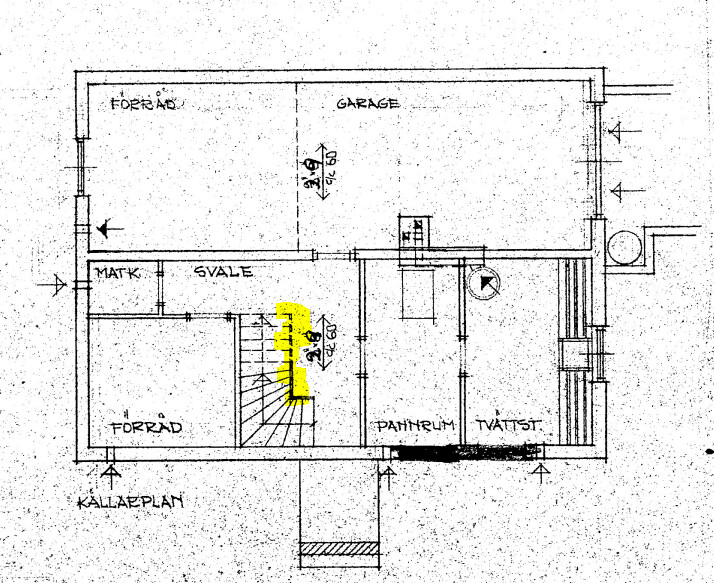
See pictures. The black lines are the joists above, partly guesses, partly based on what I could see, and partly felt with a magnet where the matchboard in the ceiling is nailed up in the joists.
#2, #3, and #4 I was simply thinking of removing, as I don't see what their purpose would be.
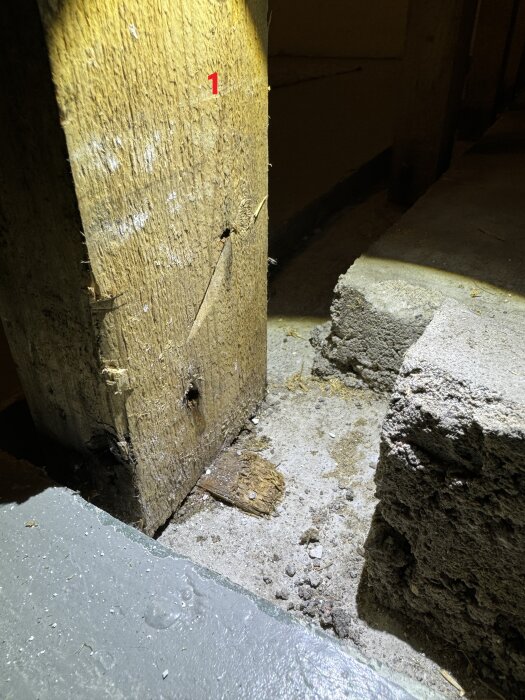
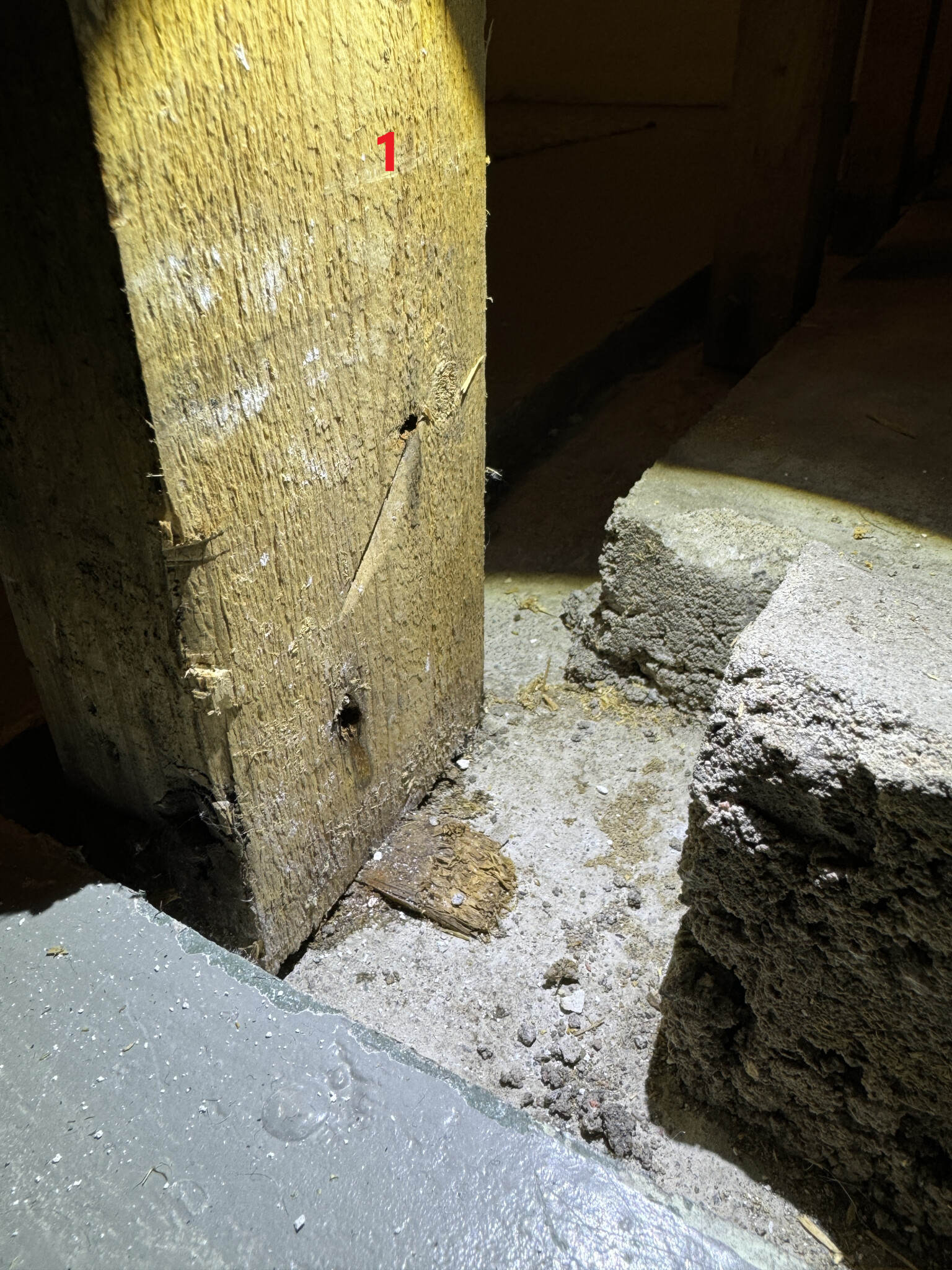
#1 I'm a bit unsure about. I can't see exactly how the joists look above there. But, most likely, there's a header for the stairs according to the picture which means it doesn't carry anything. This is also supported by it only seeming to be placed on a thin piece of wood.
#5 is quite slender, but this one must still be used to at least support one end of the joists above. The idea here was to place a prop, cast a small plinth to get away from the moist floor, and replace it with something like a 95x95 post.
So, to the questions!
Is there any reason why I can't just take down #2, #3, and #4 right away?
What do you think about #1, can I remove it or does it serve any purpose?
Is it reasonable to prop and replace #5 with a 95x95 post?
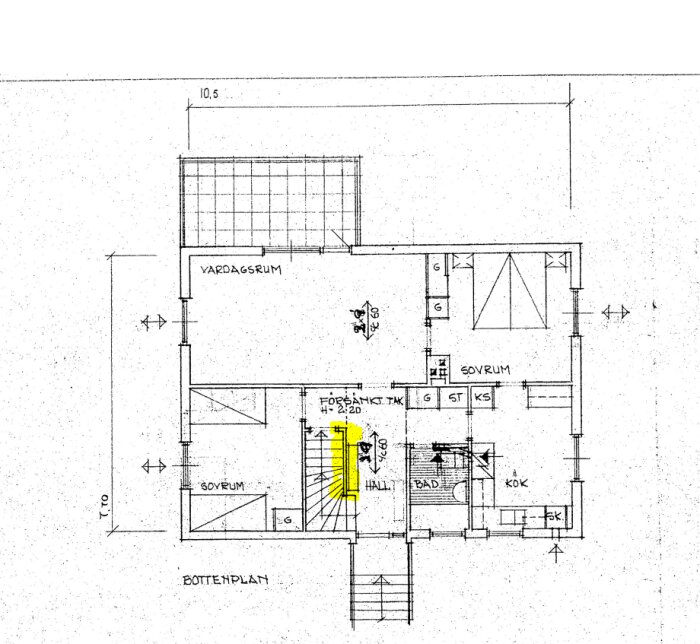
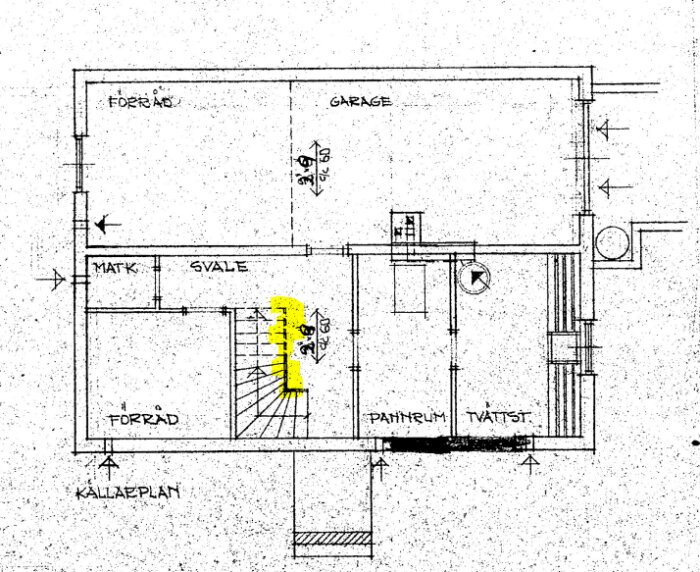
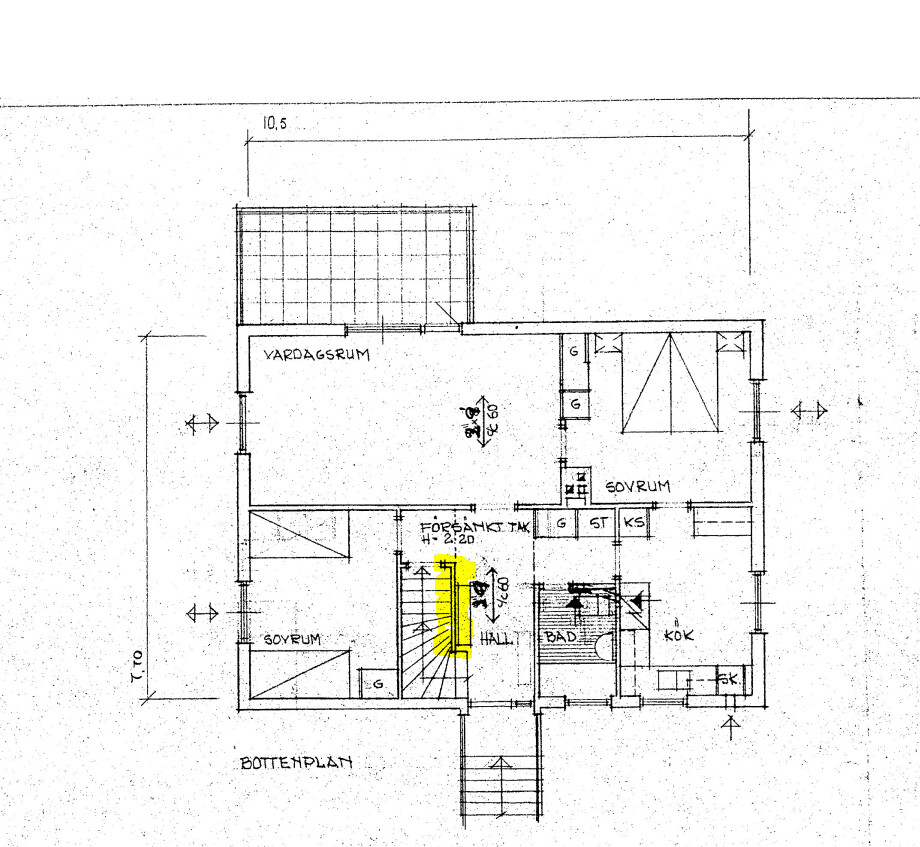
Including floor plan as well, doesn't mean much to me but maybe it can help someone...
Why would you place the 45*90 so close together if not all have a bearing and stabilizing function? I think so, but I'm not an expert.
No, I've also tried to figure out why they are placed so closely, but haven't come up with much more than it's to make it easier to nail the tongue and groove in place.
Nothing is attached to the stringer; instead, the tongue and groove is wedged between the posts and the stringer, and then nailed either from the side above the stairs or the side below the stairs.
Since the stringer is always blocking one post per tongue and groove, it means that you always have an extra post available to fasten the tongue and groove to.
In any case, #2 and #4 are only fastened upwards with a nail and are also far from vertical, so you can wiggle/spin them with a little hand power, so they shouldn't provide much stability.
I have a large, fixed spiral staircase where what you want to remove supports the floor above, but I have a custom-made post that is really sturdy at position 5, and it's 200*100. Your position 1 then rests on a load-bearing wall between the hallway and kitchen (meaning there's a load-bearing wall where you have 1). In between is a regular interior wall that I assess as non-load-bearing. I don't see the beam in the joist between those points but it's probably sturdy since that entire portion of the upper floor is supported by it.
As for what isn’t jammed and might not bear the load now, in the winter when I have 1.5-2 meters of snow on the roof, I can promise you that it starts to creak here and there, and the same, but in the other direction, happens when the snow disappears. But that also depends on the snow zone.
I have a large, fixed spiral staircase at my place where the part you want to remove supports the floor above, but I have a custom-made post which is really sturdy at position 5; it's 200*100. Your position 1 then rests on a load-bearing wall between the hall and kitchen (so there's a load-bearing wall where you have 1). In between there is an ordinary interior wall which I assess as non-load-bearing. I don't see the beam in the floor structure that goes between those points, but it's probably sturdy since the whole portion of the upper floor is supported by it.
As for what isn't currently under pressure and perhaps isn't bearing a load now, in winter when I have 1.5-2 meters of snow on the roof, I can assure you that it starts to creak here and there, and the same, but in the opposite way, happens when the snow disappears. But it also depends on the snow zone.
Of course, just because it's not under pressure now doesn't mean it can't be at another time. In this case, all loads from the roof should already be distributed down into the exterior walls and the load-bearing wall. The only load I see that would affect this area is from the floor on the yellow-marked section of the floor plan for the "Ground Floor" and potentially a bit from the upper staircase depending on how it's anchored at the bottom.
Can update by saying I removed 1-4.
The floor structure was completely stable even when a person was jumping above.
Then I removed #5 and placed a support underneath.
Will put up a column when it suits, for now the house is still standing...
Click here to reply
Vi vill skicka notiser för ämnen du bevakar och händelser som berör dig.

MultiMan said: