
5,431 views ·
9 replies
5k views
9 replies
Reinforcing the floor structure due to tearing down walls
Hello boys and girls, my first post on this page so be nice to me now.
I've been reading a lot on the forum before and found a lot of great help, but this time I can't find the answers to my questions, so I'm trying to write my own thread.
I'm planning a kitchen renovation and want to remove two walls (bearing).
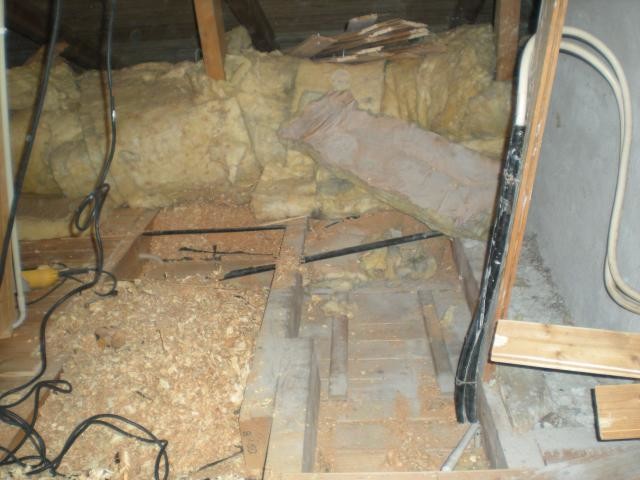
So to my question, above one of these walls, the floor joist is spliced (see picture).
I would prefer not to have any visible beam in the ceiling but a smooth ceiling.
Can the floor joist be reinforced by first attaching a couple of beams edge to edge with the spliced joists and then laying a couple of longer-length beams on top of these, possibly also adding blocking between the joists?
So there will be 4 beams in width in the floor joist but not the entire length of the joist.
I hope you understand my question and that someone can answer it.
The house was built in the 40s, and the walls are made of standing board walls (tongued and grooved).
Above is the floor joist leading to an attic that isn't used for anything.
From outer wall to outer wall, it is 7.2 m.
Center-to-center measurement is about 60 cm between the joists.
About 3 of the joists (if the wall is removed) will hang freely 7.2 m, and about 3 will hang about 4.2 m because there is a wall at the toilet; however, I do not know if this wall can bear this load as it was built by a previous owner.
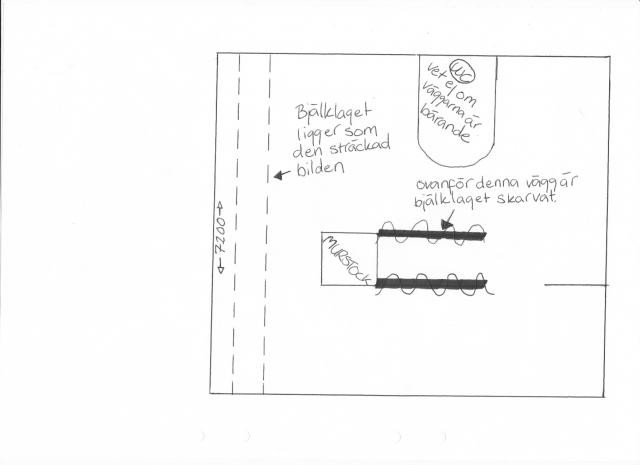
Attached is a picture of the floor joist and a self-drawn picture of the walls to be removed.
The walls to be removed are the ones with the zigzag pattern next to the chimney.
On the other side of the chimney, it is open all the way, but there are L-beams between the joints in the joist, probably done when the house was built.
Thanks in advance, best regards Daniel
I've been reading a lot on the forum before and found a lot of great help, but this time I can't find the answers to my questions, so I'm trying to write my own thread.
I'm planning a kitchen renovation and want to remove two walls (bearing).
So to my question, above one of these walls, the floor joist is spliced (see picture).
I would prefer not to have any visible beam in the ceiling but a smooth ceiling.
Can the floor joist be reinforced by first attaching a couple of beams edge to edge with the spliced joists and then laying a couple of longer-length beams on top of these, possibly also adding blocking between the joists?
So there will be 4 beams in width in the floor joist but not the entire length of the joist.
I hope you understand my question and that someone can answer it.
The house was built in the 40s, and the walls are made of standing board walls (tongued and grooved).
Above is the floor joist leading to an attic that isn't used for anything.
From outer wall to outer wall, it is 7.2 m.
Center-to-center measurement is about 60 cm between the joists.
About 3 of the joists (if the wall is removed) will hang freely 7.2 m, and about 3 will hang about 4.2 m because there is a wall at the toilet; however, I do not know if this wall can bear this load as it was built by a previous owner.
Attached is a picture of the floor joist and a self-drawn picture of the walls to be removed.
The walls to be removed are the ones with the zigzag pattern next to the chimney.
On the other side of the chimney, it is open all the way, but there are L-beams between the joints in the joist, probably done when the house was built.
Thanks in advance, best regards Daniel
It seems like you are considering a kind of "spikbalk" that is more than seven meters long. I personally fixed a masonite-lättbalk at home (rut a groove in a 2x2 beam and wedge in 6.4 mm board) as a load-bearing beam in the ceiling, with a span of over 6 meters, and considering it is in a roof construction with snow load, insulation, etc., it has great strength. But, if you don't feel like crafting a few of those (or buying?!), it might be possible to lay beams across the roof beams in the attic and then let the 7.2m lengths "hang" in them (using spikband) - this assumes you have support for the transverse beams, of course....

In principle, you must involve a structural engineer. Every floor structure is unique.
But having a beam with a 7m span usually doesn't comply with standard sizing rules.
You will most likely need a crossbeam as support under the beams. It is possible to recess this beam into the floor structure so that it is not visible. However, this can involve very extensive alterations to the house to do so.
Then you must also have a structural engineer assess whether there are functioning points of support for the beam, in many cases, you have to go with pillars all the way down to the foundation wall, or in extreme cases, cast a new foundation for the pillar.
Simply put, your floor structure should be able to support a load of 250-300 kg (including its own weight) per square meter. Assuming the beam needs to absorb the load from all 6 beams, with a 7.2 m span, it totals about 6.5 tons. Half of that is absorbed by the beam, the rest by the outer walls. Each point of support receives half of the beam's load. That is, you get about 1.8 tons on each point of support.
This is a very simplified way of calculating; circumstances in your house can greatly affect the calculation, so it's not something you can size according to. But it gives an indication of what needs to be solved.
But having a beam with a 7m span usually doesn't comply with standard sizing rules.
You will most likely need a crossbeam as support under the beams. It is possible to recess this beam into the floor structure so that it is not visible. However, this can involve very extensive alterations to the house to do so.
Then you must also have a structural engineer assess whether there are functioning points of support for the beam, in many cases, you have to go with pillars all the way down to the foundation wall, or in extreme cases, cast a new foundation for the pillar.
Simply put, your floor structure should be able to support a load of 250-300 kg (including its own weight) per square meter. Assuming the beam needs to absorb the load from all 6 beams, with a 7.2 m span, it totals about 6.5 tons. Half of that is absorbed by the beam, the rest by the outer walls. Each point of support receives half of the beam's load. That is, you get about 1.8 tons on each point of support.
This is a very simplified way of calculating; circumstances in your house can greatly affect the calculation, so it's not something you can size according to. But it gives an indication of what needs to be solved.
I didn't realize there was an attic above. In that case, it might work to hang the beams from a beam, and the load doesn’t need to be as large if it’s an unfinished attic. It's still important to secure a good attachment for the beam.
Hey, thanks for the reply. I wasn't quite sure what you meant by how you did with the masonite beam, did you lay it crosswise over the beams or? Do you have any pictures of the operation? Thanks againalen said:So it seems you are considering some kind of "nail beam" that is more than seven meters long. I personally made a masonite light beam at home (milled slots in 2x2 timber and wedged in a 6.4 mm board) as a load-bearing beam in the ceiling, with a span of over 6 meters, and considering it's in a roof structure with snow load, insulation, etc., it has amazing strength. But, if you don’t feel like putting together a few of those (or buying?!), maybe it could be possible to lay crossbeams on top of the roof joists in the attic, and then let the 7.2m lengths "hang" from them (using nail plates) - provided you have support for the cross beams, of course...
Hey, thanks for the reply. Yes, it's an unfinished attic, and the roof structure was originally built for roof tiles, but now there's aluminum sheet instead. I don't know if this makes a difference for the floor structure, but there could be about a 4.5-ton difference in roof weight between the materials. When you say a good attachment for the beam, are we talking about an exterior wall, or would it be enough to extend the beam over a couple of joists on either side of the removed wall?hempularen said:
Absolutely not working.danber said:Hey, thanks for the response.
Yes, it's an unfinished attic and the roof structure was originally built for roof tiles, but now there is aluminum sheet instead. Not sure if this has any significance for the joists, but there should be about 4.5 tons difference in roof weight between the materials.
When you say a good support for the beam, are we talking about an exterior wall, or would it be enough to extend the beam over a couple of joists on either side of the removed wall?
How is the joist supported to the right and left? Where there is 7m free between the exterior walls.
Is there a glulam beam across the floor joists there? What is that beam resting on, if so?
I don't quite understand what you mean by "L-beams between the joints."
Or are the dotted lines in your sketch glulam beams?
Last edited:
Hello. The dashed lines indicate how the flooring is positioned. On one side of the walls that are to be removed, the flooring rests on a wall (not included in the drawing I made), and on the other side, there is an L-iron in the middle of the flooring.Krawk said:Absolutely not working.
How is the flooring supported to the right and left? Where it's 7m free between the outer walls. Is there a glulam beam across the floor joists there? What is that beam resting on then? I don't quite understand what you mean by "L-beams between the joints."
Or are the dashed lines on your sketch glulam beams?
Let me see if I can explain the L-irons. Where the flooring is jointed over a wall, it overlaps by about 30 cm, but where the L-irons are, the joists end about 2 cm from each other, and it is cut out underneath the beams so that the iron is recessed into the beams, making the inner ceiling smooth. Two L-irons are placed edge to edge, forming a shelf that the flooring rests on. It seems the L-irons are anchored into the outer wall and into the chimney breast.
Would just a single glulam beam across, anchored in both gable walls, work? That would be about 11 meters long in such a case.
If you have a load-bearing wall in the continuation of those you are going to demolish, you could use this as a support for a beam. That is, a beam between chimney wall-wall. However, both the chimney and the load-bearing wall need to be checked to ensure they can handle the load. (The support on the chimney must also be done in such a way that the chimney sweep approves it if it is in use.) The supports must take large loads, and looking stable is not enough.
Call a local structural engineer and ask what he would charge to calculate this for you.
Call a local structural engineer and ask what he would charge to calculate this for you.
Click here to reply
Similar threads
-
Vintageförstärkare med rund jordad kontakt
El -
Strengthen beam due to hole drilling?
Building Materials and Construction Technology -
Tearing down a wall - does the joist need reinforcement?
Building Materials and Construction Technology -
Behöver jag förstärka bjälklaget innan badrumsbygget
Golv -
strengthening the intermediate floor
Building Materials and Construction Technology