The house currently has a water-based underfloor heating system that lies above the joists, spaced and then with pipes in metal. It builds up 22mm above the joists, then there is a flooring chipboard on top of that.
I'm trying to figure out a way to "gain back" this height in my new bathroom. Routed flooring chipboard is out of the question as the screed height, as well as the issue of combining with an electric mat, is known to me to create too high a construction height. We want the electric coil to have some drying/comfort heat on the floor during summer.
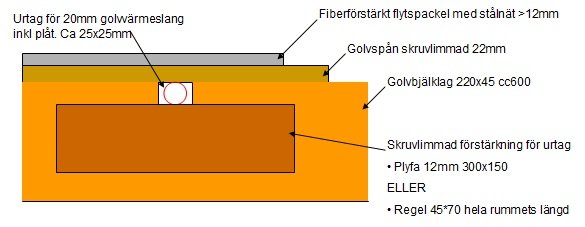
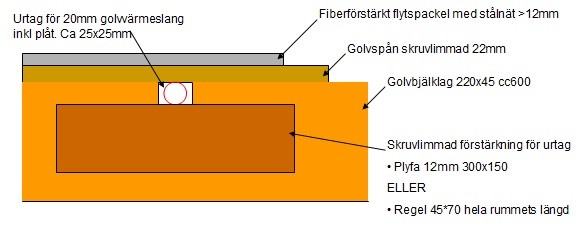
My thought is to make cutouts in the joists with cc30 for the underfloor heating, these cutouts I then reinforce according to the image below. The joists are 220x45 with support at ~1000 and 3600mm. The room has a length in that direction of 2600mm.
This is the constant issue with height that you mention. One wants a step up to the bathroom. I did it like this in my laundry room: I inset a 22 mm floor chipboard between the joists (screwed a 45x70 longitudinally 22 mm below the top edger) then I glued a floor hardboard (about 5 mm thick) with a notched trowel. Reinforced, 12 mm hose, and self-leveling compound. That way, I reduced the height by many cm.
Lay the glesen parallel to the floor joists (at the same height) and notch them at the ends. Place the sheet metal and then the floor particleboard on it and possibly self-leveling compound. That way, you gain 22mm at least.
More than that, I think, is difficult if you want to maintain load-bearing capacity. Then you might have to lower the floor joists, and that could be a lot of work at this stage. That the floor is built up 55mm + tiles is probably something you have to consider.
johel572:
It is those 22mm that I'm after. Unfortunately, it is existing underfloor heating that already runs across the floor joists. Unfortunately, this underfloor heating is shared with other residential areas, so it's difficult to rearrange it in another pattern.
In the proposal I've sketched above, the floor joists are notched every 300mm. In other words, there is ~195mm of functional floor joist left. This rests, as mentioned, on support after 1000mm and then 3600mm from the floor's end support. The reinforcement that I've sketched above should reasonably more than compensate for the 25x25mm notches, right?
I plan to glue and screw the floorboards. I will place the underfloor heating plates with some space between each floor joist.
It's not sensible to glue directly onto the underfloor heating plate
I generally don't think it's a problem to disconnect like that. Just glue-screwed chipboard flooring on top and it'll definitely work in terms of load-bearing capacity.
I'm quite convinced you can skip your "reinforcement" entirely. Since it's in the middle of the beam, the small reinforcement it provides will be virtually negligible.
vectrex: Thanks for the input. My mind works similarly about the reinforcement, but I have seen that there are metal reinforcements available to purchase for the purpose, so I thought it might make some difference after all.
I'll go with notching, with the reinforcement. The latter can then also serve as support for the sparse panel for underfloor heating.
Click here to reply
Vi vill skicka notiser för ämnen du bevakar och händelser som berör dig.