
5,089 views ·
35 replies
5k views
35 replies
Reinforce drywall panels

Hello
I am sketching a "box" (140 x 70 x 110 cm) that I want to build during the holidays. It's the compressor that needs to be "built in" both for soundproofing and also to better utilize the room it's in. I'm of course considering air requirements, heat development, and service-friendliness in the construction itself.
I first thought of building with OSB, but then it struck me that gypsum boards might be the best to use for several reasons. However, the design is made for OSB/plywood and a few places in the construction assume the strength of wood material, something I've figured gypsum doesn't handle as well. Like near edges, etc.
Therefore, I wonder how to reinforce gypsum so it holds up? For example, if a large heavy lined board needs to be unscrewed for regular checks/maintenance and it rests on studs, but is locked with "a couple" of wing screws, or similar, to avoid tools altogether during inspection/service. Is "painter's tape" (fiberglass tape) (and polyester?) enough, or is gypsum simply not the right material for the task?
I understand you might have many follow-up questions from my vague problem description, but the design is far from finalized and I can't scan the papers (drawings) now, hence my somewhat fuzzy question.
I am sketching a "box" (140 x 70 x 110 cm) that I want to build during the holidays. It's the compressor that needs to be "built in" both for soundproofing and also to better utilize the room it's in. I'm of course considering air requirements, heat development, and service-friendliness in the construction itself.
I first thought of building with OSB, but then it struck me that gypsum boards might be the best to use for several reasons. However, the design is made for OSB/plywood and a few places in the construction assume the strength of wood material, something I've figured gypsum doesn't handle as well. Like near edges, etc.
Therefore, I wonder how to reinforce gypsum so it holds up? For example, if a large heavy lined board needs to be unscrewed for regular checks/maintenance and it rests on studs, but is locked with "a couple" of wing screws, or similar, to avoid tools altogether during inspection/service. Is "painter's tape" (fiberglass tape) (and polyester?) enough, or is gypsum simply not the right material for the task?
I understand you might have many follow-up questions from my vague problem description, but the design is far from finalized and I can't scan the papers (drawings) now, hence my somewhat fuzzy question.

I was considering OSB from the start, as a cheaper alternative to plywood. I know that MDF is rigid and heavy, but also expensive (?) and therefore dismissed it as a candidate from the beginning. In this case, I equated OSB and plywood purely from a construction standpoint, not taking into account that plywood is more attractive. Then my friend told me that I should use gypsum, which is both heavy, rigid, and cheap. But then strength became an issue and I now realize, after your feedback, that I should dismiss that idea as well.
BUT...
It might not matter much, as I'm now going to start sketching a new idea that might limit material usage and thereby make the choice of material easier.
Where do you think I should purchase the materials from then? To "get away" cost-wise, I mean. I've been set on buying the boards at Byggmax for that reason, but they might not be the cheapest for board material in particular?
I have a handle on the soundproofing. It will be a combination of materials. I happen to work at Biltema, but working with asphalt mats or similar is hardly an economical solution in this case. Perhaps some of the boards will be reinforced with these.
If I come up with a sketch that I'm satisfied with, I'll try to scan it and post it here, so you can criticize or praise my ideas.
Thanks for the feedback!
BUT...
It might not matter much, as I'm now going to start sketching a new idea that might limit material usage and thereby make the choice of material easier.
Where do you think I should purchase the materials from then? To "get away" cost-wise, I mean. I've been set on buying the boards at Byggmax for that reason, but they might not be the cheapest for board material in particular?
I have a handle on the soundproofing. It will be a combination of materials. I happen to work at Biltema, but working with asphalt mats or similar is hardly an economical solution in this case. Perhaps some of the boards will be reinforced with these.
If I come up with a sketch that I'm satisfied with, I'll try to scan it and post it here, so you can criticize or praise my ideas.
Thanks for the feedback!



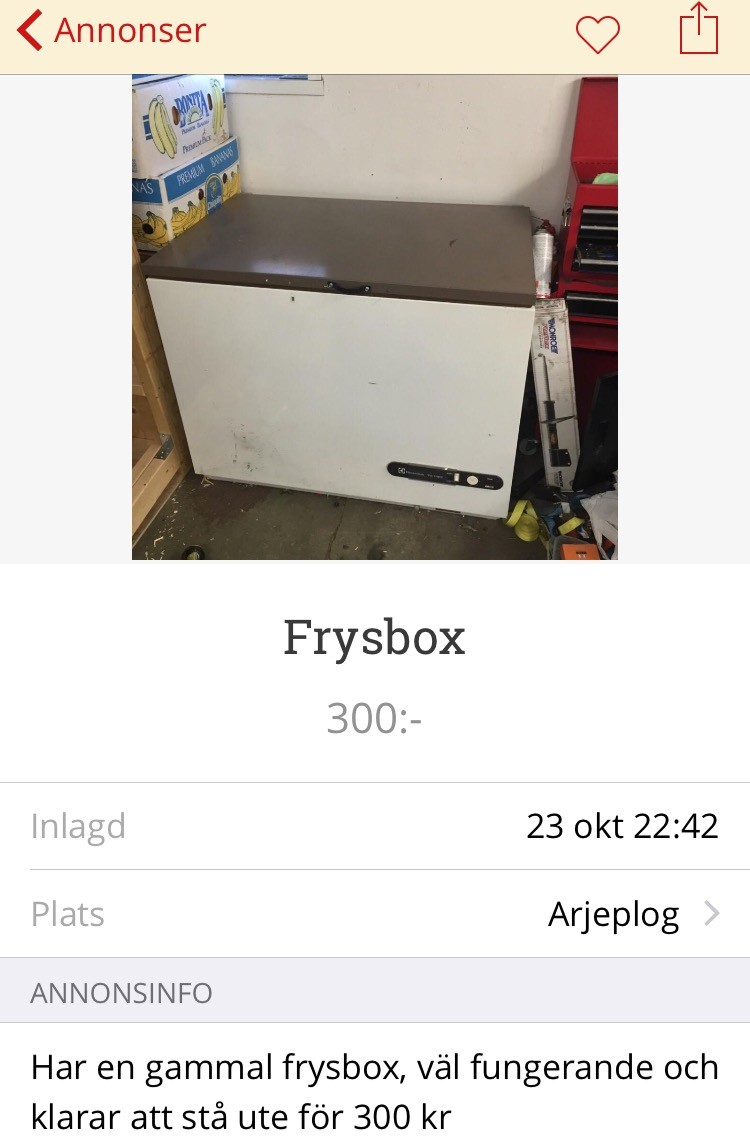
Hmm, the freezer chest was interesting, I have one I'm planning to dispose of (throw away/sell cheaply/donate), but even though mine is the larger model, it's not nearly big enough.
The compressor is at least 50 cm wide, 140 long and just over 100 high, and although a freezer chest is large, a so-called "standard size" is about 85 high (external measurements) and that unfortunately falls flat. Additionally, I want it to be service-friendly and well-ventilated. So in this case, there are probably no shortcuts... Or?
Tips on where to buy boards affordably are gratefully received! Other materials are a minor affair in this context. I should mention that I can pay for myself, but if you're going to buy a few square meters it's convenient to buy it all in one place at a reasonable price. I've mostly "got the impression" that MDF is expensive, but maybe it's still the best choice?
I should mention that I'm planning to acquire some large cheap wooden boards, without remarkable requirements for strength, sound insulation, or appearance for a couple of other projects I plan to do at the same time. Thinner plywood would be perfect for that, but maybe it's not available in large sizes?
The compressor is at least 50 cm wide, 140 long and just over 100 high, and although a freezer chest is large, a so-called "standard size" is about 85 high (external measurements) and that unfortunately falls flat. Additionally, I want it to be service-friendly and well-ventilated. So in this case, there are probably no shortcuts... Or?
Tips on where to buy boards affordably are gratefully received! Other materials are a minor affair in this context. I should mention that I can pay for myself, but if you're going to buy a few square meters it's convenient to buy it all in one place at a reasonable price. I've mostly "got the impression" that MDF is expensive, but maybe it's still the best choice?
I should mention that I'm planning to acquire some large cheap wooden boards, without remarkable requirements for strength, sound insulation, or appearance for a couple of other projects I plan to do at the same time. Thinner plywood would be perfect for that, but maybe it's not available in large sizes?
Another question is whether it is appropriate to build it in at all?
A 5.5kW compressor essentially generates 5.5kW of heat during operation. I read on
maskincentrum that the recommended ventilation is 550l/s and ventilation opening is 40x40cm.
This probably applies to continuous operation, but it is almost impossible to achieve that ventilation in a small
box and simultaneously dampen the sound.
A 5.5kW compressor essentially generates 5.5kW of heat during operation. I read on
maskincentrum that the recommended ventilation is 550l/s and ventilation opening is 40x40cm.
This probably applies to continuous operation, but it is almost impossible to achieve that ventilation in a small
box and simultaneously dampen the sound.
A good question, I think, but that all power would be developed in the form of heat I do not agree with. Even though waste energy in the form of sound eventually becomes heat, vibrations eventually become heat, in addition to the heat directly generated by the electric motor itself and the friction at the pistons, some of the energy is stored in the form of compressed air. The waste heat from the compressed air does come "out" of the box via the pressure line and in the form of friction in the tools, etc. But it would be interesting to have an approximate figure of the total efficiency of a common piston compressor.
One can ponder this endlessly, I am aware that I should monitor the function of the box, and that I will do and modify it as needed. I know that similar constructions have been built before, so it shouldn't be impossible, "the impossible just takes a little longer".
Due to all this, the box will not be "small", even though what is big or small is a relative term...
One can ponder this endlessly, I am aware that I should monitor the function of the box, and that I will do and modify it as needed. I know that similar constructions have been built before, so it shouldn't be impossible, "the impossible just takes a little longer".
Due to all this, the box will not be "small", even though what is big or small is a relative term...

OSB is not exactly "expensive" - Sure, you can get gypsum boards for under a hundred per board, but an OSB shouldn't cost more than about 120-150 bucks per board.
Building a box at half the price of gypsum that doesn't hold up after a few months and takes more time to assemble - THAT, however, is expensive.
I would definitely choose to use K-Plywood, Byggmax charges 189 SEK per board. The choice is simple.
Building a box at half the price of gypsum that doesn't hold up after a few months and takes more time to assemble - THAT, however, is expensive.
I would definitely choose to use K-Plywood, Byggmax charges 189 SEK per board. The choice is simple.

I can't reconcile the combination of well-ventilated and soundproofed. A box made of thin plywood or similar might even amplify certain frequencies. Sure, you can shield some noise, but I wonder if you can really dampen much with the given conditions.
I have my compressor in a small cabinet made of plywood, but it's mostly to make cleaning easier. It's not as dusty in there. The sound has changed somewhat, but it's not dampened.
I have my compressor in a small cabinet made of plywood, but it's mostly to make cleaning easier. It's not as dusty in there. The sound has changed somewhat, but it's not dampened.
Now we probably need to change the attitude in this thread a bit, in my opinion; it's one thing to say "that won't work" and do it with a friendly attitude. I have probably already received the help I was looking for; now it's mostly about "brainstorming further."
WHERE have I written that OSB is expensive? I can't see that anyway. And if you read the thread's development, you can also see that the gypsum alternative has already been abandoned. So that's no longer the question.
I am fully aware that if the construction is done wrong, a wooden structure can amplify sound, as all our acoustic instruments prove, but of course, I don't want to build it that way—it would be impractical. And something well-ventilated and soundproofed? Well, a car engine perhaps? Even if soundproofing and ventilation generally work against each other, that doesn't mean it can't be overcome, right? Light and cold are two other things that rarely go together, but that obstacle can also be overcome if you want to.
The main reason I want to build it is to better "furnish" (use) the room; the soundproofing aspect is a bonus effect that might be worth putting a bit of energy into.
As it stands now, other parameters around the construction will be the main question, so I'm focusing on those now. It's still interesting to get tips on where to buy materials; currently, I'm planning to visit Byggmax for the purpose.
WHERE have I written that OSB is expensive? I can't see that anyway. And if you read the thread's development, you can also see that the gypsum alternative has already been abandoned. So that's no longer the question.
I am fully aware that if the construction is done wrong, a wooden structure can amplify sound, as all our acoustic instruments prove, but of course, I don't want to build it that way—it would be impractical. And something well-ventilated and soundproofed? Well, a car engine perhaps? Even if soundproofing and ventilation generally work against each other, that doesn't mean it can't be overcome, right? Light and cold are two other things that rarely go together, but that obstacle can also be overcome if you want to.
The main reason I want to build it is to better "furnish" (use) the room; the soundproofing aspect is a bonus effect that might be worth putting a bit of energy into.
As it stands now, other parameters around the construction will be the main question, so I'm focusing on those now. It's still interesting to get tips on where to buy materials; currently, I'm planning to visit Byggmax for the purpose.
IF you want to build with plaster, can't you make the frame out of studs that you cover with plaster? Then it will be stable at the edges...
Well, there's nothing wrong with the attitude. Not mine, at least. I have placed my compressor in a plywood box myself. I'm mostly wondering how you will manage it. I'm curious in case I can improve my box.
Regarding car engines and damping. Common measures to increase power are precisely to increase "ventilation." Turbo, compressor, reduced muffling, etc. All these measures result in increased noise...
Regarding car engines and damping. Common measures to increase power are precisely to increase "ventilation." Turbo, compressor, reduced muffling, etc. All these measures result in increased noise...
Minerit board as an alternative to gypsum? Or Cembrit as it might be called now... expensive, but you might not need that much.
http://www.beijerbygg.se/store/privat/byggmaterial/byggskivor/cementbaserade-skivor/cembrit-multiforc-12x1200
http://www.beijerbygg.se/store/privat/byggmaterial/byggskivor/cementbaserade-skivor/cembrit-multiforc-12x1200
Last edited: