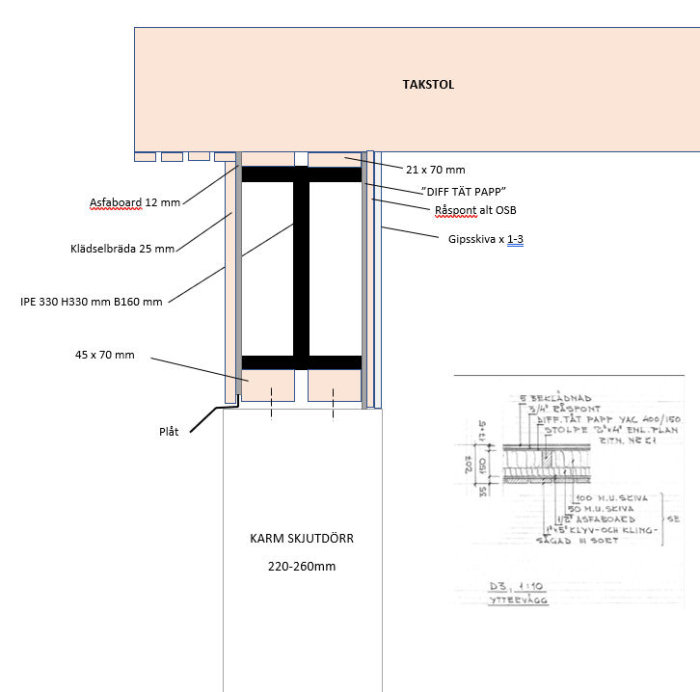
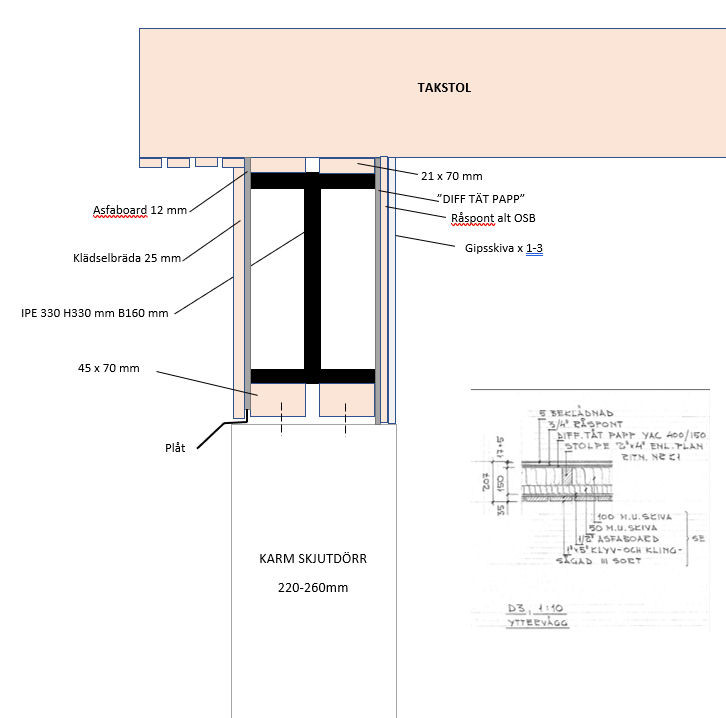
I am going to support a façade with an IPE beam. I'm wondering if I'm missing something in the wall construction. It determines where I should place the beam against the roof truss, i.e., how far in or out I should place the beam.
1. Do I need to rust-proof the beam?
2. Fire-proof the beam?
3. Does it need additional cladding, thermal bridge, etc.?
I would have done as follows.
Painted the beam for rust protection.
Placed the beam so it aligns with the interior wall, as in the picture, and then adjusted the width on the outside if needed.
Insulated in the beam.
Fire painting shouldn't be needed if you have drywall on the inside.
Air gap is a new invention, I don't have an air gap in my house built in 1992.
It will not align on the inside but it will on the outside. The facade is a bit special and it won't look good if the sliding door extends outward.
It doesn't matter if the opening in depth eats a bit into the room's depth. The old wall is only 20.7 but the new one including the frame for the sliding door will be deeper.
These are not the best geometric conditions for performing a good detail. You should break the thermal bridge with an outer layer of insulation outside the beam. This will mean that the façade will be protruded around the mentioned section. This can certainly be solved in an aesthetically pleasing way to form a framing around the section from the outside perspective.
If you choose not to insulate externally, you must place a layer of insulation (if that's even sufficient) between the steel beam and the vapor-tight paper, otherwise, condensation water will drip indoors during the winter.
The best solution would be to place the beam inside the exterior wall. Then you create no problems, except for having an extension around the section indoors.
The IPE profile probably also needs bracing to prevent buckling, check with justus how he's calculated. The beam ends must also be braced laterally.
Two layers of gypsum and a painted beam, and you're covered for fire and rust protection. Check with the blacksmith if they can handle the painting when you order the beam so you can avoid painting.
The origin of the air gap is only slightly older than 1992.
Unfortunately, extending the sliding door part will "ruin" the appearance of the facade. The facade has a "recess" at the top that runs around the entire house. It's hard to explain, but I've tried to compromise with myself without much success.
I can of course add more external insulation, but that means the beam will be pushed even further into the room. Not great, but it's better than having condensation water running in the winter.
The good Justus has helped me to arrive at an IPE330. I will need to bring in a structural engineer for that part with beam dimensioning and construction drawing on the execution. Not because I don't trust Justus but so it can be attached to the building application.
How can I brace the beam against tipping? Shouldn't it be enough to attach the beam to the rafter?
The header on the beam 21x70 (see image) is glued and bolted/screwed to the top of the beam. Then I take an angle iron and attach it to the rafter.
At the ends, I could weld or bolt fast angle iron that I then secure at the start of the continuing wall.
I have realized that I cannot insulate on the outside without changing the facade or moving the beam inward into the room, but then it will end up outside the foundation wall.
I must therefore let the beam lie above the foundation wall and thus I can only insulate inside the beam, towards the room.
But after studying the foundation wall, I realize that it is 20cm, and therefore I should have the opportunity to move the beam towards the room without it ending up inside the foundation wall.
If I want to move it further, I can also reinforce the foundation at the support, i.e., widen the foundation wall just there....
The risk as I see it is that condensation forms on the inside. If you insulate as much as you can on the outside, meaning from the outside flange and outward, then the beam will be warmer. Then you need a thin layer of insulation on the inside of the beam/flanges so that the vapor barrier is not directly against the steel; the vapor barrier will then maintain indoor temperature more or less, preventing condensation. You could skip, for example, the roof decking. I also wouldn't recommend OSB on the inside of the beam as it is a bit sensitive to movement due to varying humidity.
Perhaps the entire beam can be covered in plasterboard as well. This means that even inside the hollow space, the steel is exposed as little as possible inside the wall.