
9,572 views ·
20 replies
10k views
20 replies
raise the floor about 40 cm on a post foundation.

Hello everyone
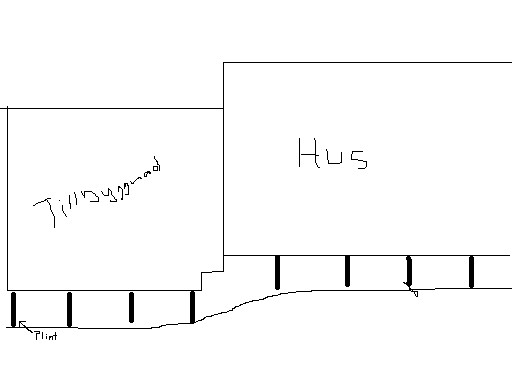
I have a little conundrum... an extension on my house stands on piers about 40 cm lower than the main building according to the picture.
Now I want to raise the floor about 40 cm so that it is the same height.
What is the easiest way to go about it? I really have no desire to make a new foundation :-/
I have a little conundrum... an extension on my house stands on piers about 40 cm lower than the main building according to the picture.
Now I want to raise the floor about 40 cm so that it is the same height.
What is the easiest way to go about it? I really have no desire to make a new foundation :-/
Depends on size and material.
If you have wood - New wooden joist floor on small blocks to reach the correct height, chipboard flooring, and finished floor is one option.
If you have concrete - Leca with gravel in between and new casting is another option.
If you have wood - New wooden joist floor on small blocks to reach the correct height, chipboard flooring, and finished floor is one option.
If you have concrete - Leca with gravel in between and new casting is another option.
Wood joist on plinth, chipboard. The extension is not very big, maybe 12 sqm.sigpl said:
My hope was that you could just build an extra joist at the right height, sort of like a mezzanine that you attach to the frame and with some form of support legs against the old floor. Of course, the ceiling should also be raised accordingly. Am I completely off track?
OK, that was roughly what I meant by building up a new wooden floor structure. But I think I now understand that you want to raise the entire room, i.e., both the floor and the ceiling, to maintain the height. I think anaitis might have an idea with lifting using jacks and building on the pillars. You need to first find the points where the two building sections are attached to each other and loosen these.
Hello again
might take down most of the extension since it is in very poor condition and it needs to be excavated and drained underneath.
How can you build on the posts? Can you cast more mortar on top in some way? Very inexperienced in this but hope for some intelligent answer.
might take down most of the extension since it is in very poor condition and it needs to be excavated and drained underneath.
How can you build on the posts? Can you cast more mortar on top in some way? Very inexperienced in this but hope for some intelligent answer.
If you tell us a bit more about how the plintar look, we can surely come up with a solution!
Material?
Dimensions?
Condition?
Usually not that difficult!
Material?
Dimensions?
Condition?
Usually not that difficult!
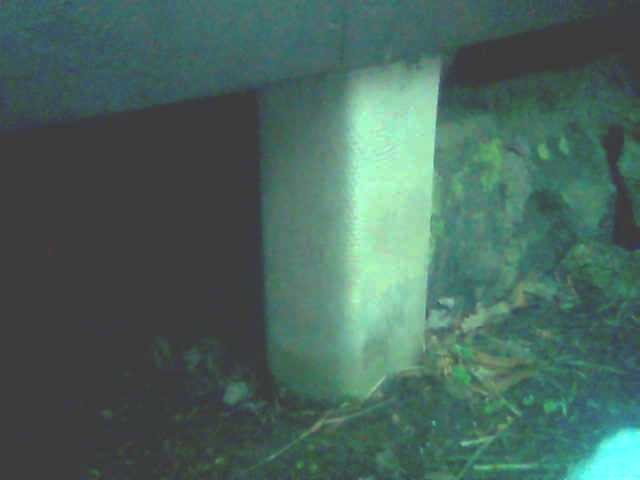
Okay, now I understand the situation.
In this case, I would do it like this:
1. Lift up the part you want to raise with jacks. Lift a little higher than the height you want it to be when finished. Maybe an extra 30 cm.
2. Cast new plinths/pour onto the old ones to the correct height. The new plinths should be in the same place as the old ones. They can even be cast around the old ones, depending a little on how well the old ones are fixed to the foundation if you want to keep them. Check if you can move the plinths when you've detached them from the house. If they are not firmly fixed, remove them and cast new ones. Then you should dowel them into the rock. (I assume here that they stand on bedrock?)
Let the dowels go down about 10 cm into the rock; that should be enough. Then you should reinforce with a rod in each corner, 12 mm. Stirrups c/c 30 cm. Mix and pour!
3. When the concrete has set, lower the house and anchor it to the plinths.
Let me know if the house is not on rock so I can provide new advice!
Good luck!
In this case, I would do it like this:
1. Lift up the part you want to raise with jacks. Lift a little higher than the height you want it to be when finished. Maybe an extra 30 cm.
2. Cast new plinths/pour onto the old ones to the correct height. The new plinths should be in the same place as the old ones. They can even be cast around the old ones, depending a little on how well the old ones are fixed to the foundation if you want to keep them. Check if you can move the plinths when you've detached them from the house. If they are not firmly fixed, remove them and cast new ones. Then you should dowel them into the rock. (I assume here that they stand on bedrock?)
Let the dowels go down about 10 cm into the rock; that should be enough. Then you should reinforce with a rod in each corner, 12 mm. Stirrups c/c 30 cm. Mix and pour!
3. When the concrete has set, lower the house and anchor it to the plinths.
Let me know if the house is not on rock so I can provide new advice!
Good luck!
Unfortunately, I won't be able to use a jack partially because there's not enough space along one long side and also because, now that the snow is melting, I have a nice collection of water beneath, which means I will dismantle the whole mess first and then raise the foundation. Thank you for your help.
If the piers are securely in place, can I just put casting pipes around the old piers and then cast new ones? Do I need to anchor into the pier?
Would it perhaps be simpler to make a crawl space foundation with lecablock when I already have the house down?
Many questions, but you seem to have great knowledge about this.
Thanks again so much
If the piers are securely in place, can I just put casting pipes around the old piers and then cast new ones? Do I need to anchor into the pier?
Would it perhaps be simpler to make a crawl space foundation with lecablock when I already have the house down?
Many questions, but you seem to have great knowledge about this.
Thanks again so much
Your suggestion "Can I, if the plinths are properly secured, just put casting pipes around the old plinths and then cast new ones? Do I then need to dowel into the plinth?" is exactly what I would choose! Or possibly make simple molds that can be moved between the castings. Casting pipes (if they are made of cardboard) usually become very ugly over time, the cardboard partly comes off while it can be difficult to remove completely!
Don't forget to reinforce: Four irons + stirrups. (2 stirrups per plinth are enough)
At the top of the mold, you should have some sort of fitting/flat iron to attach the beams with.
If you are going to compare plinth foundations with crawl space foundations in your case, I think that since you already have plinths, you should continue with this. Much less work to cast on the existing plinths. It's heavy to lay bricks!
If you don't want it to look "open" under the house, I would suggest an open slat arrangement, e.g., 50 x 21 with 25 mm gaps between the slats. A traditional method! You then have full ventilation, i.e., no possibility for moisture problems!
Don't forget to reinforce: Four irons + stirrups. (2 stirrups per plinth are enough)
At the top of the mold, you should have some sort of fitting/flat iron to attach the beams with.
If you are going to compare plinth foundations with crawl space foundations in your case, I think that since you already have plinths, you should continue with this. Much less work to cast on the existing plinths. It's heavy to lay bricks!
If you don't want it to look "open" under the house, I would suggest an open slat arrangement, e.g., 50 x 21 with 25 mm gaps between the slats. A traditional method! You then have full ventilation, i.e., no possibility for moisture problems!