Hello.
My first post on the forum
The previous homeowners removed parts of the wall towards the kitchen to create a more open floor plan. This was apparently done just a couple of years before we bought the house. There used to be an 8x21 or 9x21 frame there. It has now become apparent that the wall was partially load-bearing. It has also been more than 10 years since we bought the house, so we can no longer claim a hidden defect.
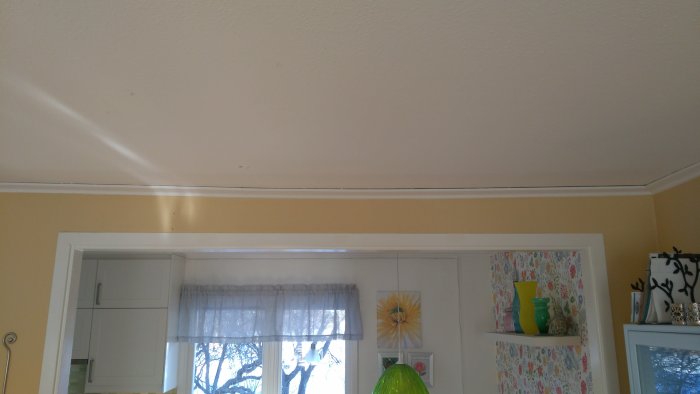
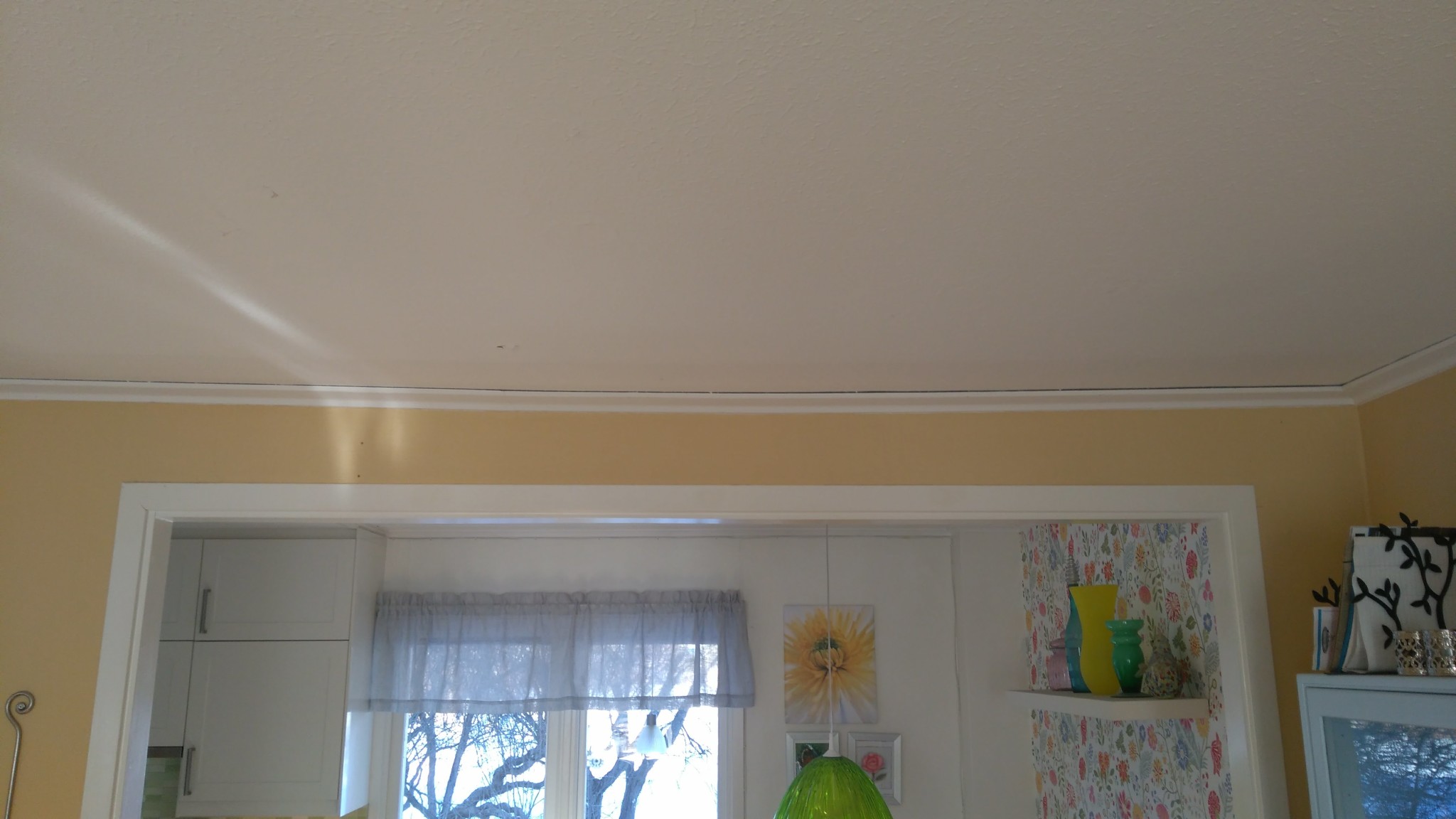
Over time, we've noticed that the floor in the bedroom above has started to sink more and more, but it now seems to have stabilized. I've measured that the sinking is about 2 centimeters, and it is quite noticeable when standing in the living room looking out towards the kitchen. (as shown in the picture). However, it's not as obvious in the picture as it is in reality. Is there a risk that the floor might collapse completely? Anyway, we've realized that we need to address this.
I've spent days online searching for information on how I can fix this afterwards, but I haven't found anything reasonable.
I'm considering a solution which involves jacking up the wall with 2 jacks and placing a steel beam for support. It's not possible to use props due to fabric-stretched ceilings, so I'm wondering if it's possible to place the steel beam directly on the jacks and then press everything up to the desired level and then measure the exact length for new posts to be mounted at each end of the beam? Then the jacks would be removed.
It sounds like a difficult task to me, but is it doable? Maybe it has to be done in a completely different way?
I've read various dimensioning tables but don't understand any of it, so I also need help calculating what size the beam needs to be if that solution is chosen. The opening is now 2160 mm wide and the height is 2220. If I remove the frame, the dimensions will be about 50 mm larger.
The thickness of that wall is only 80 mm, which makes me think of an IPE beam as the only possible choice.
Are 90x90 glulam posts sufficient for this? Then I wouldn't have to expand the thickness of the wall so much.
In that case, the new opening width would be around 2030 mm.
The house is entirely built of wood and is from the 50s. There is an upper floor with bedrooms, and above that, there is an attic. The total floor area on the upper floor is 47 sqm. The roof is tiled. I guess the pitch of the gable roof is about 35 degrees. The house is located in Stockholm municipality.
I gratefully welcome the knowledge that I know exists on the forum to solve this problem.
Hello, and welcome..
The first question in situations like these.. Are there any drawings of the house?
One question is whether the load-bearing capacity of the floor is sufficient to handle the load from the new pillars and the weight..
What's underneath?
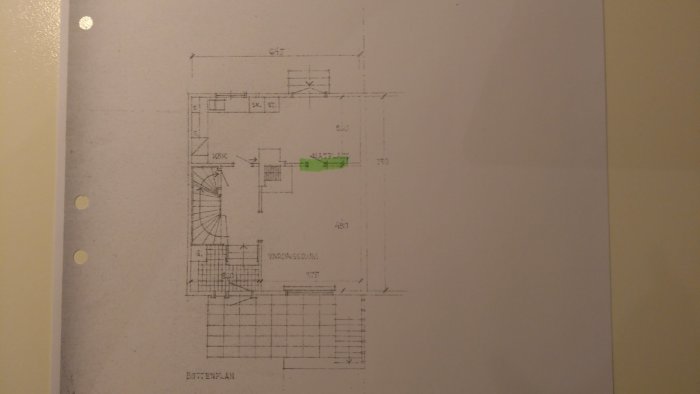
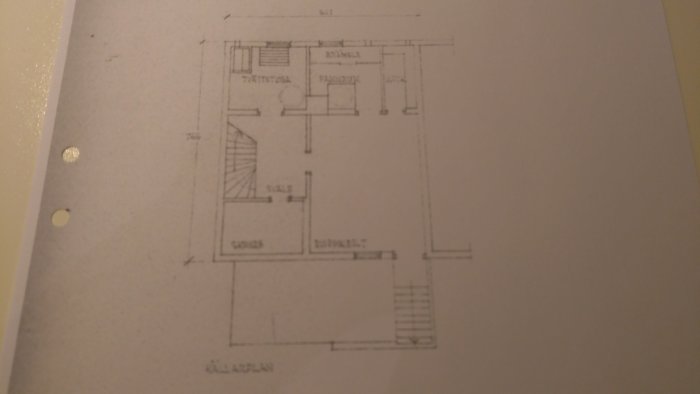
GoForit. Thanks for your response. I found the original drawings of the house. Quite faded and a bit blurry after 70 years but I hope it's visible enough.
There was a wall there before so I guess the load-bearing capacity should suffice. With 2 new posts and a beam, there will of course be more point load compared to earlier when the entire wall except the door rested on the floor structure.
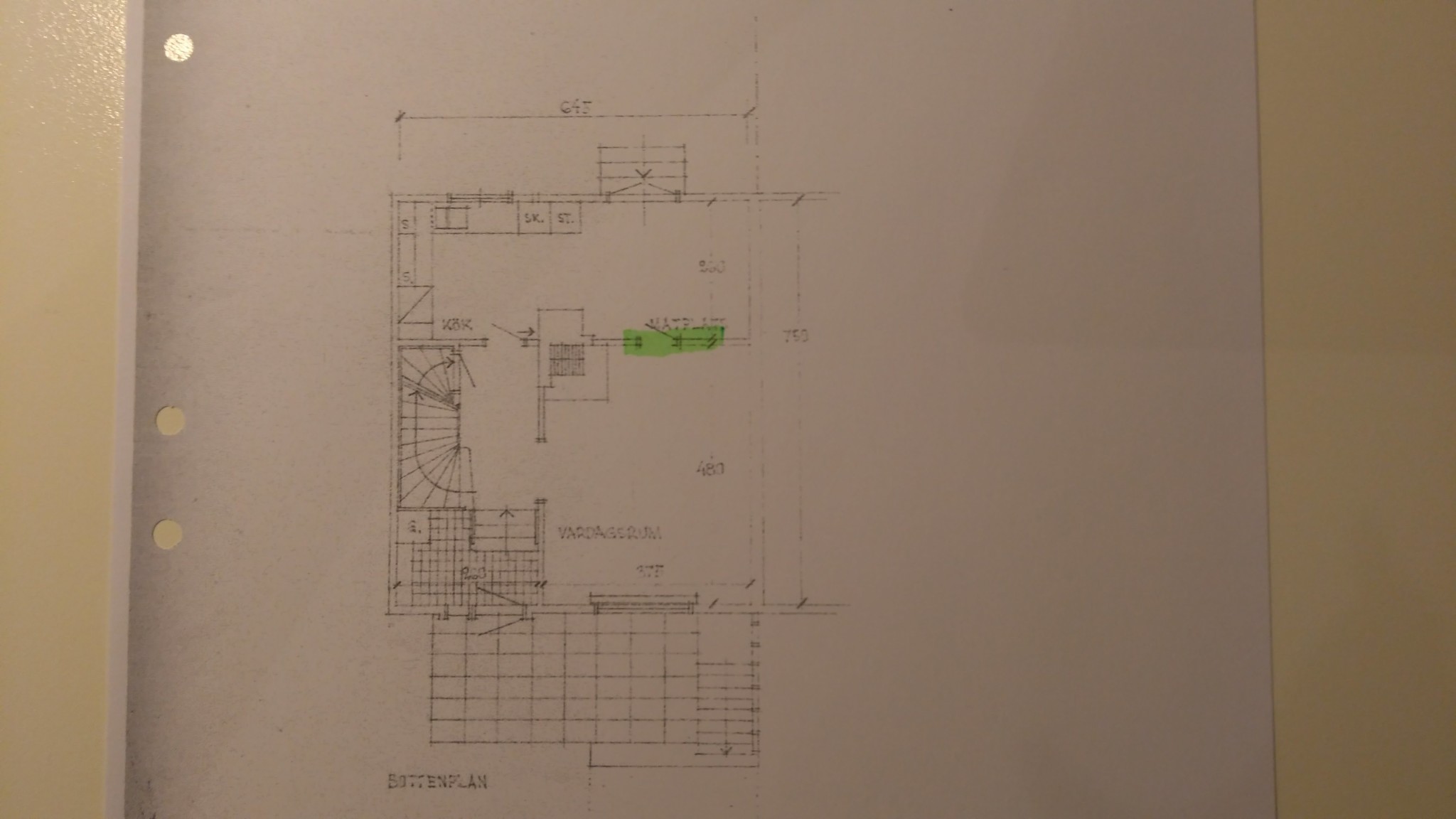
Image 1 shows the ground floor. I have marked the removed wall in green.
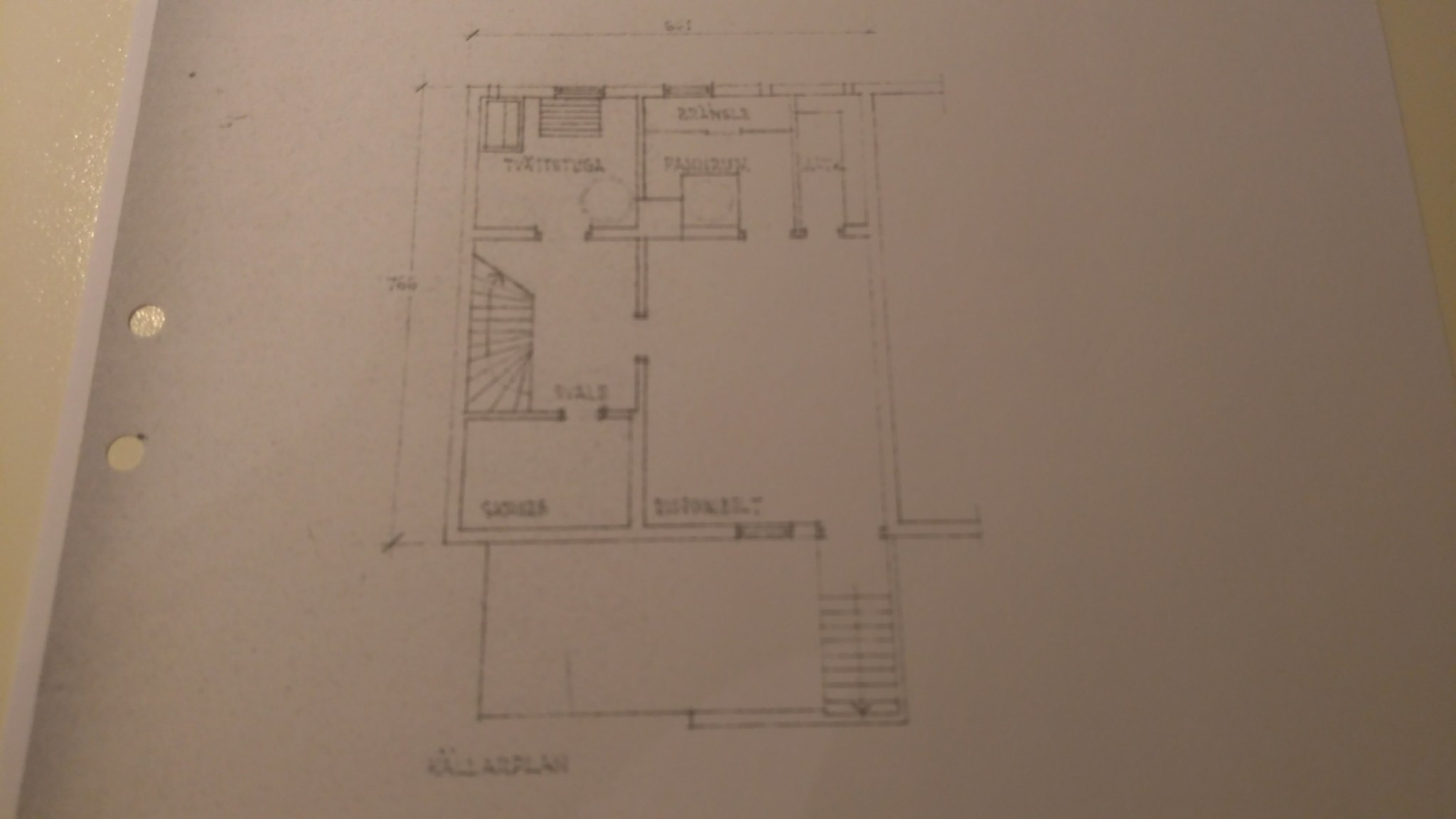
Image 2 shows the basement. There you can see the masonry wall directly under the removed one.
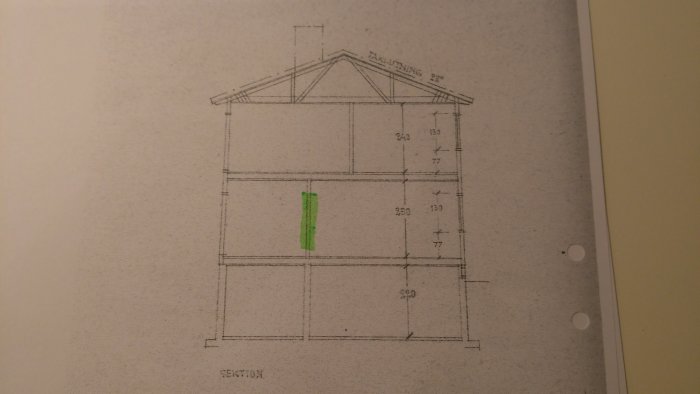
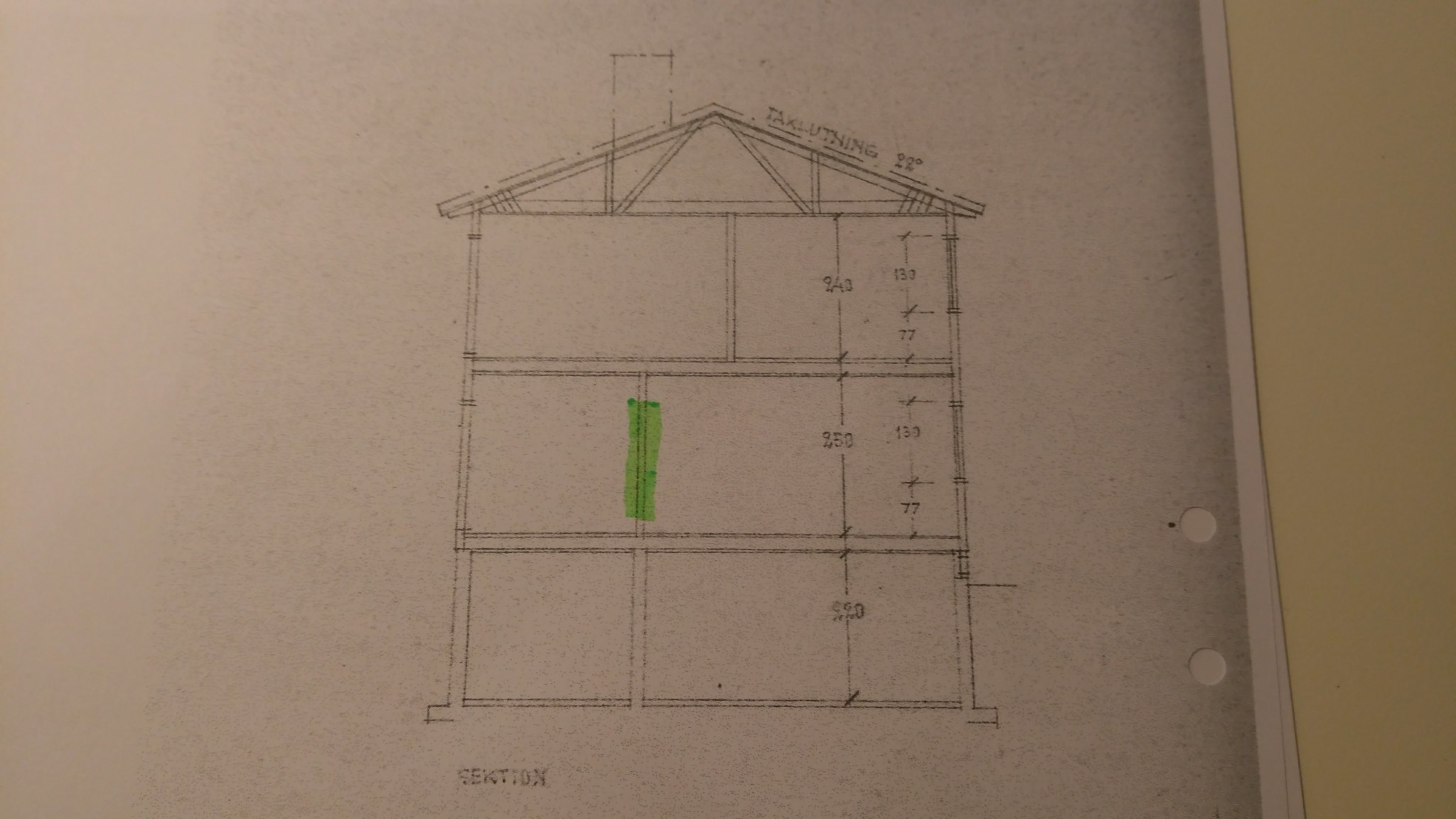
Image 3 shows the section. I have marked the removed wall in green. I also see that I was grossly wrong regarding the roof slope. It is indicated at 22 degrees.
Are these drawings sufficient or would you like to see something else as well?
It looks like the arch is straight. How can it be that only the ceiling has sunk but not the arch?
Thomas. The molding above the casing is almost completely straight. It bows down only a few mm. It seems like the wall has moved behind that molding. I can see that the casing wood has been more pressed down. We have had time to repaint the molding and the casing a couple of times over the years, so the cracking that has occurred between them is not visible.
You have a load over the opening on the order of 10 kN/m, if I’ve read the drawing correctly. Due to the limited width of the opening, you could handle it with a glulam beam of 90x225 mm, if you can get it in place. In this situation, I believe that glulam is better than steel for several reasons. You have space in height (the current material above the opening is of no use), you avoid all other issues with steel in a residence, and it will be cheaper.
Thank you, Justus.
Now we're getting somewhere. Unfortunately, at the moment, I don't have any building height upwards because there are electrical wirings above the ceiling in the kitchen. In some way, it could surely be redirected if it becomes necessary.
I agree with you that glulam is preferable, but the building height doesn't allow for it right now, but the best might be to tear the entire way up to the ceiling with rerouting of the electricity.
It could also be that the part of the wall that remains isn't strong enough to press up the floor structure by 20 mm and has to be demolished to install a proper beam.
Please, forum, I need more concrete answers.
Regarding the building height - is it a crisis if the opening becomes about 100 mm narrower above?
It is not with 100.0% certainty that you can always predict that a solution like this will be feasible to implement, and you must be prepared for other ways to reach the solution.
Thomas. The molding above the trim is almost completely straight. It only bows downward by a few mm. It seems like the wall has shifted behind that molding. The trim wood I can see has been pressed down more. We have had time to repaint the molding and trim a couple of times over the years, so the cracking that has occurred in between is not visible.
Or has the ceiling sunk before someone nailed on the molding?
I had a similar problem when I took down the wall between the kitchen and dining area. I still don't know if the wall was load-bearing or not; in any case, it started to move downward when we were sawing. We quickly propped it up with an interior door that was on hand. We rented a prop that was placed on one side of the opening. We notched out a bit at the top of each remaining wall section and inserted a 6 or 7-inch beam (not glued laminated timber). The span is maybe 3-3.5 m. It's still holding today.
How thick is the wall? Is there enough space for electricity and a 90mm beam?
While you're at it, it's best to do it right. Open above the door and place a beam. Re-route the electricity if you need to. You'll also need support for the beam, so you'll likely need to open up a bit of the wall on the sides.
Click here to reply
Vi vill skicka notiser för ämnen du bevakar och händelser som berör dig.