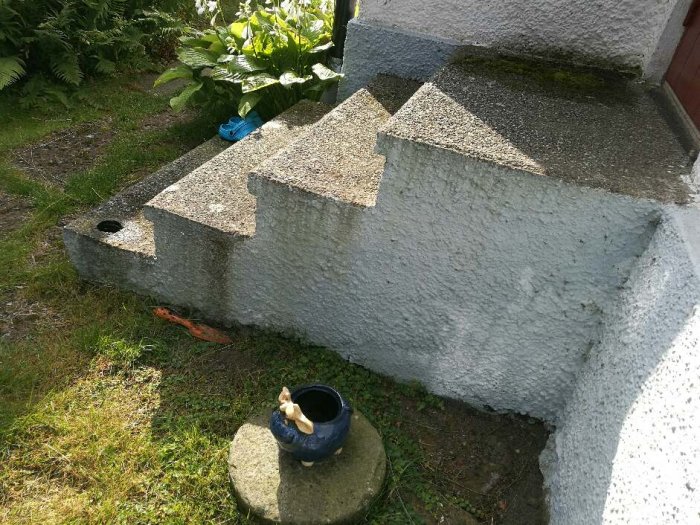
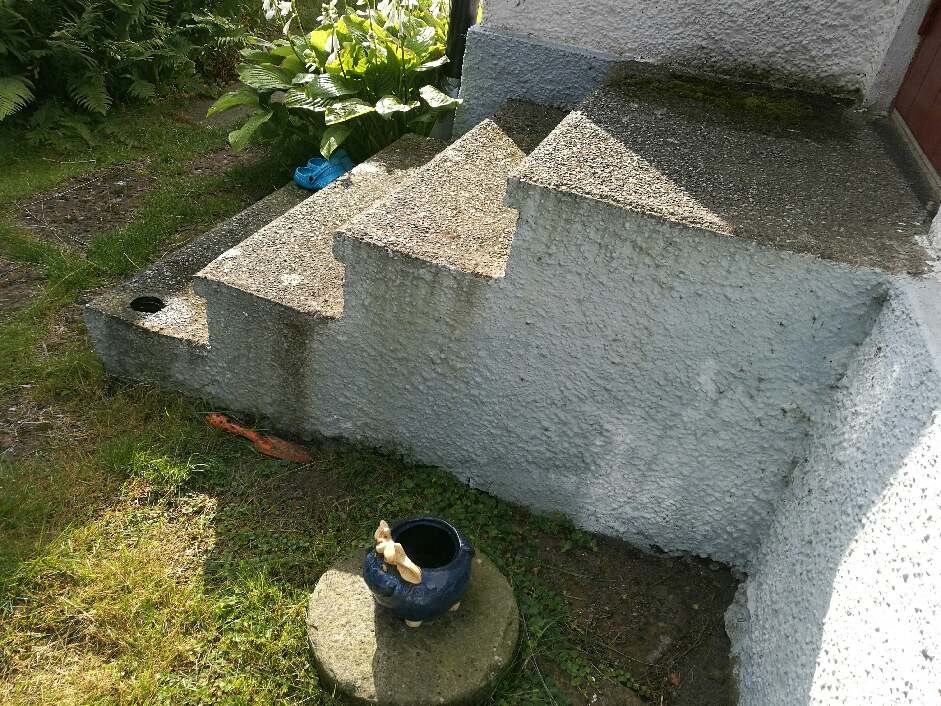
I will try to help my parents with a railing for their stairs. It hasn't had a railing since it was built (40 years ago) but now there is a need. My question is whether it should be iron or rather wood? On the lowest step of the stairs (which is cast), there is a prepared hole 5 cm in diameter and 10 cm deep. There are no holes on the other steps. See picture. The house is also made of stone with a plastered facade. If I order a long pipe that is bent to first rise to railing height and then be anchored to the house, will it really be stable? I haven't measured exactly, but the span will be at least 2 meters from where the railing bends and rises towards the house. Should you then countersink the pipe into the house facade? Drill, chisel, etc. and then cast? Or better to have a plate that you drill and screw on? Or should I rather ignore the pre-drilled hole and simply build a wooden railing?
1 Make an exact to-scale measurement of the staircase profile (including stair nosings and the wall beside the door). 2 Go to a mechanical workshop or a blacksmith and order a railing in bent stainless steel. The height should be 80 cm above the landing and stair nosings. The railing should have welded plates at both ends with holes for three sturdy screws. At the bottom, the attachment should be from the side in the lowest riser. Do not use the existing hole. It will be very sturdy. As one gets a bit older, one can't have too many railings.
Thank you. I'm on board with the stainless steel railing, measurements, and also the plates with screw holes. But why shouldn't I use the pre-drilled hole? If the plate is attached a few centimeters from the end of the pipe, I can drill and attach it to the stairs (around the hole)? and maybe do the same thing up in the house, i.e., let that end of the pipe go a few centimeters through a plate that is then screwed into the house? and thus countersink the end at the house into the house wall as well?
If the hole's diameter had matched the outer diameter of the stainless steel pipe, it would have been a possibility. Now it won't be stiff enough. Additionally, vertical holes outdoors are not advantageous. The main reason is that it becomes stiffer if you follow my suggestion. I have done it a few times, so I feel quite confident about the solution. Using the existing hole also raises the requirement for dimensional accuracy during manufacturing.
Click here to reply
Vi vill skicka notiser för ämnen du bevakar och händelser som berör dig.