
11,648 views ·
9 replies
12k views
9 replies
Possible to determine load-bearing wall from drawing?
I have planned to make two openings in an interior wall in my newly purchased apartment (1 room and kitchen, 38 sqm). The board of the association was previously positive about this change but has now changed its mind and requires:
"A building consultant must certify in writing that the proposed renovation does not negatively affect the property, and that no load-bearing structures are modified (modification of load-bearing structures, even if compensated with beams, etc., is not allowed.)."
Thus, I wonder if anyone here thinks they can determine from the following drawing (before I hire a building consultant) if the wall is load-bearing or not? (wall marked in red)
I received this drawing from the board; is it possible to find better drawings at the City Planning Office, I wonder?
The building was constructed in the 1920s, the wall is of unknown material and approximately 10-15cm thick. My apartment is located at the top under the attic.
Thank you in advance.
"A building consultant must certify in writing that the proposed renovation does not negatively affect the property, and that no load-bearing structures are modified (modification of load-bearing structures, even if compensated with beams, etc., is not allowed.)."
Thus, I wonder if anyone here thinks they can determine from the following drawing (before I hire a building consultant) if the wall is load-bearing or not? (wall marked in red)
I received this drawing from the board; is it possible to find better drawings at the City Planning Office, I wonder?
The building was constructed in the 1920s, the wall is of unknown material and approximately 10-15cm thick. My apartment is located at the top under the attic.
Thank you in advance.
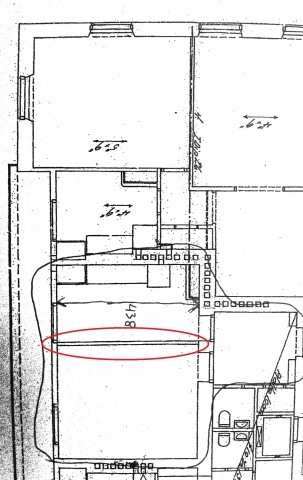

I would guess that it's some form of light concrete with plaster (from what I can see in the picture) in that wall, and then it's usually not load-bearing. The load-bearing structure is typically in the outer walls of older houses.
At the same time, the board requires you to bring in a knowledgeable person to certify it, so really, you just need to bring someone in, then you'll get an answer on whether it is load-bearing or not.
At the same time, the board requires you to bring in a knowledgeable person to certify it, so really, you just need to bring someone in, then you'll get an answer on whether it is load-bearing or not.
Based on the drawing, I would say that it is not load-bearing, so it is definitely worth bringing in the expert.
Load-bearing walls generally run along the house, it's a bit hard to see from the drawing how the house is built. Is the wall parallel or at an angle to the roof ridge?
Load-bearing walls generally run along the house, it's a bit hard to see from the drawing how the house is built. Is the wall parallel or at an angle to the roof ridge?
At an angle to the ridge also suggests that it is not load-bearing, so based on the information available in the drawing and in the thread, I would say that it is not load-bearing.
However, I am not a structural engineer or even close to one, so this is not an expert opinion but as I wrote before, it is certainly worth bringing in someone who can certify this so you can then do whatever you want with the wall.
However, I am not a structural engineer or even close to one, so this is not an expert opinion
but as I wrote before, it is certainly worth bringing in someone who can certify this so you can then do whatever you want with the wall.
The wall is too thin to be load-bearing, and it's in the wrong place to be load-bearing.
A simple check you can perform yourself is to see if there is a corresponding wall in the apartment below you and in the attic, you can check if the wall supports anything (e.g., how the floorboards run).
A simple check you can perform yourself is to see if there is a corresponding wall in the apartment below you and in the attic, you can check if the wall supports anything (e.g., how the floorboards run).
Yes, the corresponding wall exists in the apartment below, where they have made 2 door openings (it doesn't seem like the association required certification at that time).
What I've heard from some contractors is that even if the wall itself isn't load-bearing, openings in walls on multiple floors together can result in a certain reduction in load-bearing capacity?
What I've heard from some contractors is that even if the wall itself isn't load-bearing, openings in walls on multiple floors together can result in a certain reduction in load-bearing capacity?
It may be true if the house needs the wall for wind stability, etc. A non-load-bearing wall can also become 'load-bearing' if there are other heavy non-load-bearing walls on top of this wall. Your house with 40cm thick load-bearing stone walls hardly needs an 11 cm thick interior wall, and your apartment is directly under the attic, so there's not much load on top of the wall.
Bring in a contractor or inspector; they'll likely say it is not load-bearing.
Bring in a contractor or inspector; they'll likely say it is not load-bearing.
Click here to reply