
4,399 views ·
12 replies
4k views
12 replies
Point load on a masonry interior wall

Does anyone have the formula to calculate the point load on the area L200xW200mm that a brick wall with a width of 200 can withstand?



It is an old brick wall from the late 1920s, making it difficult to determine the compressive strength class of the mortar, and it is also hard to assess the strength class of the bricks. There should, in fact, be generally applicable tables for older walls with weathered mortar.
Guesswork on my part is that the brick itself is not something to worry about, but maybe the mortar. How do you find the mortar itself? Does it chip out whole chunks and semi-pulverized mortar if you assault the joints with a screwdriver?
And - how large are the areas for each point load? a square millimeter or a square decimeter? That also matters...
And - how large are the areas for each point load? a square millimeter or a square decimeter? That also matters...
Last edited by a moderator:

The support area was specified as 200x200 mm, but that is not enough to solve the task.
How high is the wall?
What quality is the brick? BABS 67/SBN 67 specifies, for example, 4 different classes for brickwork. The wall is older than that?
The width of the joints also plays a role. Greater or less than 15 mm?
The wall probably withstands the specified loads, but as mycke_nu points out, the risk is that the wall might collapse …
How high is the wall?
What quality is the brick? BABS 67/SBN 67 specifies, for example, 4 different classes for brickwork. The wall is older than that?
The width of the joints also plays a role. Greater or less than 15 mm?
The wall probably withstands the specified loads, but as mycke_nu points out, the risk is that the wall might collapse …
It will be a challenge to find out what type of brick it is, if that's even possible. What I know so far is that the dimension of these is 100x230x65mm. It is at least before the building norm from 1960. The mortar is heavily affected by moisture and can be easily scratched away with fingers and nails. The joints vary between 13-15mm with an average of 14mm. The pictures describe dimensions. It is increasingly leaning toward building a reinforcement of reinforced Leca on each side of the masonry core wall in the basement.fahlis said:


On the right edge, the right side of the load-bearing area is in line with the chimney. However, after removing the plaster, it appears that the chimney and the core wall are not bonded together with interlocking and supporting ties.
Judging by your description, this wall should probably either be renovated or replaced.
Is it your intention to remove the wall and replace it with a beam? In that case, one could consider adding a support pillar and thus completely relieve the wall.
Is it your intention to remove the wall and replace it with a beam? In that case, one could consider adding a support pillar and thus completely relieve the wall.


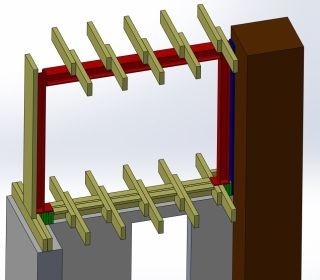
The easiest way is probably to continue with steel down to the floor on either side of the brick wall at the right support. Place a square profile (100 x 25 mm, or so) on each side and weld a base plate to the floor. The profile can then be clad or painted to match the background.
Click here to reply