
7,533 views ·
16 replies
8k views
16 replies
Plasterwall, but need spars?

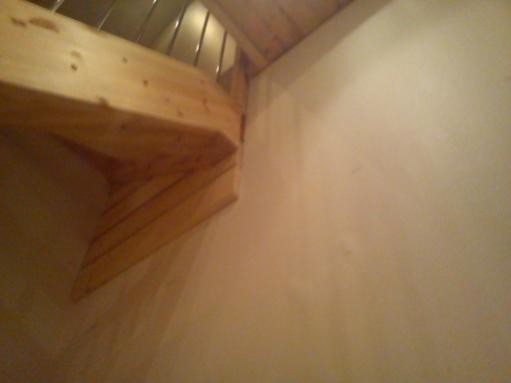
I will plaster a wall after the aftermath of the staircase installation to the sleeping loft. I do not want to box in the horizontal studs like a box, but instead it should be a smooth wall.
I was thinking of installing battens on the wall to reach the same level as the studs, but since the contractors have cut holes in the existing drywall, the studs stick out 45-13 = 32mm and regular battens are 28mm. A 4mm height difference feels a bit much...
Does anyone know of other standard wood that can be used that is 32mm, or should I go through the trouble of screwing a piece of hardboard strips onto regular battens to reach ~31.2mm (28 + 3.2mm)?
If I am to install battens, should I have vertical or horizontal drywall (battens vertical or horizontal)? The wall width is 184cm.
Another reason for extending is also to simplify electrical wiring for various lamps we will have on that wall to illuminate the staircase below.
I was thinking of installing battens on the wall to reach the same level as the studs, but since the contractors have cut holes in the existing drywall, the studs stick out 45-13 = 32mm and regular battens are 28mm. A 4mm height difference feels a bit much...
Does anyone know of other standard wood that can be used that is 32mm, or should I go through the trouble of screwing a piece of hardboard strips onto regular battens to reach ~31.2mm (28 + 3.2mm)?
If I am to install battens, should I have vertical or horizontal drywall (battens vertical or horizontal)? The wall width is 184cm.
Another reason for extending is also to simplify electrical wiring for various lamps we will have on that wall to illuminate the staircase below.


I don't know if there is any standard timber that is 32 mm, at least I've never seen it. But if you don't need much, you can buy 34*70 and then if you have access to a planer, plane it down to 32*70. Another alternative you mentioned is to nail something onto the studs, but then you could, for example, buy 22*145 panel and split it in half and then put a 12 mm plywood or chipboard behind so you have a base to screw into without plugging.

I had torn down the existing gypsum, installed 45x45 horizontal studs, which also provides space for electrical boxes.
Then lay the gypsum boards horizontally to only get horizontal joints.
Then lay the gypsum boards horizontally to only get horizontal joints.
Many thanks for the response!
Ideally, I would have loved to tear down all the existing plasterboard according to pbengtsson's post. Unfortunately, I'm a bit lazy when it comes to this wall.. :s
I wonder if it wouldn't be fastest to throw masonite on the existing studs, space with 34x70 and horizontal boards, that's probably what it will be... But first, check with the small building supplier...
Ideally, I would have loved to tear down all the existing plasterboard according to pbengtsson's post. Unfortunately, I'm a bit lazy when it comes to this wall.. :s
I wonder if it wouldn't be fastest to throw masonite on the existing studs, space with 34x70 and horizontal boards, that's probably what it will be... But first, check with the small building supplier...

I would probably have split down 45x70 studs into 32x70 in my construction/rip saw, as it's not that many meters. Otherwise, I would have gone with 28x70 battens + masonite.
I would have set battens and drywall vertically...
... unless I suspect that the electrical wiring will mostly go horizontally, ... or if I suspect that horizontal battens would facilitate attaching something to the wall (which I already know now). With horizontal battens, there is, of course, the possibility to set cc300 or cc400, but that shouldn't be necessary on a wall.
I would have set battens and drywall vertically...
... unless I suspect that the electrical wiring will mostly go horizontally, ... or if I suspect that horizontal battens would facilitate attaching something to the wall (which I already know now). With horizontal battens, there is, of course, the possibility to set cc300 or cc400, but that shouldn't be necessary on a wall.

Member
· Västerbottens län
· 18 063 posts
I like it when there is something behind the plaster, use 22 mm timber and an OSB + plaster.
Then it's possible to put up the lighting without it falling down.
Protte
Then it's possible to put up the lighting without it falling down.
Protte
Splitting a dozen studs doesn't take more than 15-20 minutes. So, the additional cost from the lumberyard shouldn't be more than 100-200 SEK. If you've bought a lot from them before, it's probably not unlikely they'll do it for free.
However, splitting a 45x70 in the middle to minimize waste is not recommended if it's precision work like on an interior wall. I've done it and they don't turn out equally thick/thin, no matter how well you plan. Instead, split the first one at 32, then you can cut off 0.5-1mm on the next one if the blade is narrow.
However, splitting a 45x70 in the middle to minimize waste is not recommended if it's precision work like on an interior wall. I've done it and they don't turn out equally thick/thin, no matter how well you plan. Instead, split the first one at 32, then you can cut off 0.5-1mm on the next one if the blade is narrow.
Well, attaching drywall at 45 degrees is no fun at all. Haven't had time for the little hardware store today, so I'll have to do it tomorrow, shall check if they can cut something. As mentioned, it's not a lot of money...
The lighting to be installed is small wall-mounted spotlights, drywall anchors or similar should suffice...
The lighting to be installed is small wall-mounted spotlights, drywall anchors or similar should suffice...

Distance to edge 10-15 mm
http://byggsystem.knaufdanogips.se/mounting/m_partitions/boards/skruvavstaand.html
And I'm so bad at aiming ... :blushing:
http://byggsystem.knaufdanogips.se/mounting/m_partitions/boards/skruvavstaand.html
And I'm so bad at aiming ... :blushing: