Hello
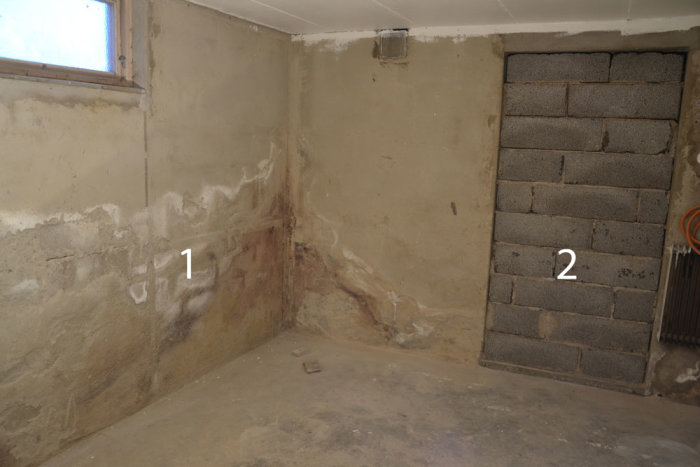
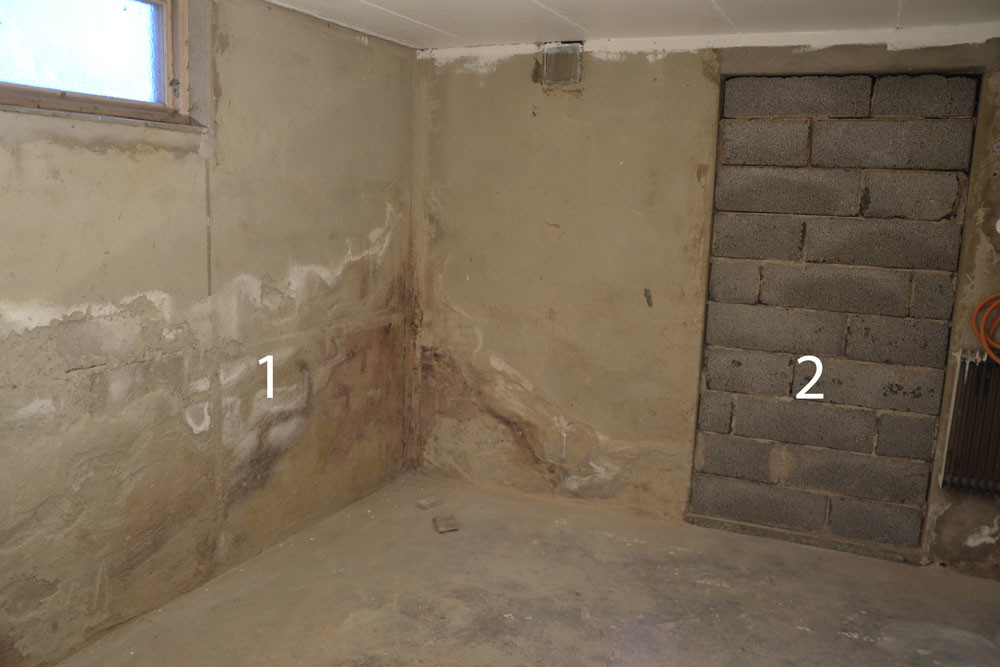
After draining the foundation, it's time to start making the basement a little nicer. I intend to plaster the walls in this room and have some considerations. How would you deal with the old door? It's Leca that I've built up and plastered on the outside. What makes it a bit more complicated inside is that it's about 4 cm to the wall surrounding the door, which results in a very thick layer of plaster. What can be used as a "spacer" to ensure you achieve an ideal plaster thickness?
(marked as 2 in the picture)
Then to the wall on the left (marked as 1 in the picture). Here the wall is very uneven and heavily affected by moisture at the bottom and pretty unaffected at the top. How do I make the wall vertical or even with the upper part in a good way? When plastering new, you set up guides (I believe that's what they're called) that you can use a straight board with, etc. Do you just go "by feel," or is there something smart you can do to make it vertical and nice?
I probably would have meshed the lecaväggen and plastered it 2 times, the old walls seem to need some cleaning with a brush and knock off loose plaster. If the walls are not straight, you can cut wooden wedges to pull the plaster against, you level the wedges/leaders with a spirit level. If they need adjustment, you can place plastic shims or similar in between.
Ok, thanks for your response. I'll have to explore the possibilities of making wedges if needed.
I'm thinking about the door... Could it be more economical to find a board in some good material that you attach to the lecan and adjust the board so that you get a plaster coat of about 1 cm.
Is it just a more complicated solution?
We plastered up about 3 cm and used plaster mesh fastened with nails and plastic spacers, a bit fiddly but the result turned out well.
We didn't put up strips when bricking up a door; instead, we dragged the plank along the plaster on both sides of the door, which evens out any slight height difference by itself (provided the difference isn't too much).
OK.
Well, at the door it goes without saying, no battens (leaders) are needed there; that's not where I'm worried about it being vertical, but on the other wall marked as 1 in the picture.
In the picture, it looks like there are smaller areas where the plaster has come off, like spots.
We knocked the spots clean as best as we could and then used a sufficiently large trowel to get it somewhat level with the surrounding plaster that was still in place. If you don't knock everything down, you have to consider that if you have a completely smooth wall otherwise, it looks strange with completely even sections.
You could fill in bruk in the places it's missing and just scrub/skim the wall, I did that in my basement. It results in a slightly rougher surface but still quite nice and much simpler. Weber putsbruk C hand, worked great.
Click here to reply
Vi vill skicka notiser för ämnen du bevakar och händelser som berör dig.