
10,710 views ·
7 replies
11k views
7 replies
Plaster lightweight concrete wall with cement crown + B mortar plaster
Hello
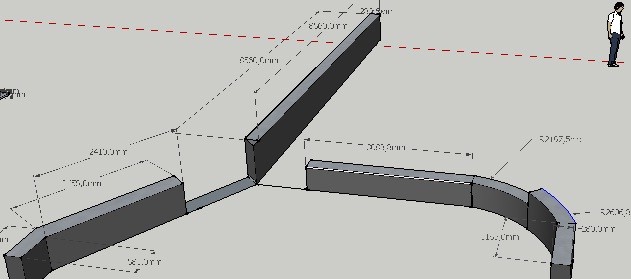
We have built a wall of Leca blocks in the garden, part of it is rounded. See the attached figure.
It is plastered with mortar B and was supposed to have a metal capping, but winter came and we applied a layer of cement on the wall top, which I understand should be able to seal adequately as the top layer before painting??
Now it turns out that a metal capping requires a lot of craftsmanship to solder the metal together at the rounded section. We are not going to go with that solution.
QUESTION: The joint that currently exists between the cement and the B-mortar (really just cosmetic, the Leca blocks are covered 100%); can I use a suitable type of mortar to "blend" these two layers together?
So, something that adheres to both cement and B-mortar?
The wall will then be painted with plaster paint (or whatever it may be called). We think the cement capping is nice and don't want to place stone blocks on top, which is otherwise customary.
What can I use? What is important/wrong with this solution?
Thank you for your response, Patrik
We have built a wall of Leca blocks in the garden, part of it is rounded. See the attached figure.
It is plastered with mortar B and was supposed to have a metal capping, but winter came and we applied a layer of cement on the wall top, which I understand should be able to seal adequately as the top layer before painting??
Now it turns out that a metal capping requires a lot of craftsmanship to solder the metal together at the rounded section. We are not going to go with that solution.
QUESTION: The joint that currently exists between the cement and the B-mortar (really just cosmetic, the Leca blocks are covered 100%); can I use a suitable type of mortar to "blend" these two layers together?
So, something that adheres to both cement and B-mortar?
The wall will then be painted with plaster paint (or whatever it may be called). We think the cement capping is nice and don't want to place stone blocks on top, which is otherwise customary.
What can I use? What is important/wrong with this solution?
Thank you for your response, Patrik
A great use for these types of mixed-use repairs is called Repair Mortar and comes in 25 kg bags from, among others, Finja.
http://www.finja.se/App_Resource/Product/PDF/PB/5529805-1.pdf
I think it's a really good product because you can fill small holes with it since the grain size is so small. Mix the mortar exactly as stated on the packaging but only make small batches as it dries quickly. Pre-wet and post-wet for 3 days as usual. The mortar usually cannot be taken with a scraper but has to be floated out, which gives a very fine surface.
The surface may feel too fine if the rest of the wall is roughly plastered, and in that case, I recommend instead using regular B-bruk but with a 1 mm stone fraction as it is better for filling and repairs, and is also cheaper compared to repair mortar. Cement mortar A 0-3 mm also works if you want even coarser and harder mortar to match the concrete on the top.
http://www.finja.se/App_Resource/Product/PDF/PB/5529805-1.pdf
I think it's a really good product because you can fill small holes with it since the grain size is so small. Mix the mortar exactly as stated on the packaging but only make small batches as it dries quickly. Pre-wet and post-wet for 3 days as usual. The mortar usually cannot be taken with a scraper but has to be floated out, which gives a very fine surface.
The surface may feel too fine if the rest of the wall is roughly plastered, and in that case, I recommend instead using regular B-bruk but with a 1 mm stone fraction as it is better for filling and repairs, and is also cheaper compared to repair mortar. Cement mortar A 0-3 mm also works if you want even coarser and harder mortar to match the concrete on the top.
Thank you for your answer Helioz!
Do you think that cement/concrete edge + paint is enough for moisture protection? I am aware that there could potentially be a problem with runoff on the sides, but I reason that we can deal with it then and consider another solution/repaint.
Do you think that cement/concrete edge + paint is enough for moisture protection? I am aware that there could potentially be a problem with runoff on the sides, but I reason that we can deal with it then and consider another solution/repaint.

Unfortunately, you will probably see your wall destroyed by frost heave unless you revert to plan A and provide it with a tight roof. Even laying stone/tiles with a slight slope helps considerably. But even that will eventually break down due to freezing.
Ok, you're bringing up one of my concerns. But I read somewhere (which I considered reliable) that concrete/real cement would suffice as a sealing layer, especially after it is painted.Ardexsmitten said:
Isn't cement dense enough for a leca wall? I should add that the wall stood with this unpainted provisional plaster+cement covering throughout this extremely cold winter without problems (15-20 degrees below zero for several nights in a row).
Are you suggesting that a sloping and/or completely sealed layer like metal or stone (which have joints!) is needed to prevent moisture from penetrating?
There are different guidelines everywhere about this, I can't figure out what's right. But we don't want to use stone/roof tiles, and metal would be expensive and time-consuming due to the curve.
More opinions!
I can't say 100% that a thin layer of cement mortar + paint will prevent your wall from freezing and breaking. It might work. But I have seen many walls with better conditions than paint and cement mortar that have frozen and broken. The problem occurs when it thaws and freezes repeatedly, creating significant stress in the material. Then time is always an interesting factor, how many years do you think the wall should last, and how much maintenance do you want/will you do on it? If you make sure the paint stays there, and is sealed, maybe it will hold up just fine. I don't want to be negative, just saying what I know and what I've seen. Hope it works out!
Ardex; It's good to have input even if it indicates that I need to do more work, thank you for your opinions!
I know that it's sometimes flagged that you MUST cover with metal/stone/roof tiles, etc. to protect the wall. On the other hand, LECA blocks are described as moisture-resistant in themselves and cement/concrete as dense materials.
I simply have to take a chance, but I'd like to see more opinions on the matter here, it probably won't be plastered for a month or two.
I know that it's sometimes flagged that you MUST cover with metal/stone/roof tiles, etc. to protect the wall. On the other hand, LECA blocks are described as moisture-resistant in themselves and cement/concrete as dense materials.
I simply have to take a chance, but I'd like to see more opinions on the matter here, it probably won't be plastered for a month or two.
Last edited:
I live in Skåne and have several walls like yours in different places around the house and haven't had any issues with frost damage despite these two harsh winters with -10 degrees down here (the walls are considerably older). If the plastering is done correctly, it should last at least 10 years, I would guess. If you've gone all out and red-primed first, and applied mesh before the final plastering, it will probably last even longer. A bigger problem (at least in Skåne) is that horizontal plastered surfaces (in my case, completely without slope because I was young and naive) are very prone to get green mold due to standing water, but this is also partly because I have used lime, as green mold attaches to all lime-coated surfaces.
My tip for you is therefore not to paint with a completely diffusion-open paint (lime, silicate, some plaster paints) because this type of construction doesn't need to breathe like a house. Instead, I can recommend a paint I've used a lot and like, which is Saku Sockelfärg from Teknos. It's an acrylic paint (plastic) with a certain degree of diffusion openness, yet water runs off, perfect for your wall, and you avoid green mold. Additionally, it's really durable and easy to paint with (water-based).
My tip for you is therefore not to paint with a completely diffusion-open paint (lime, silicate, some plaster paints) because this type of construction doesn't need to breathe like a house. Instead, I can recommend a paint I've used a lot and like, which is Saku Sockelfärg from Teknos. It's an acrylic paint (plastic) with a certain degree of diffusion openness, yet water runs off, perfect for your wall, and you avoid green mold. Additionally, it's really durable and easy to paint with (water-based).
Last edited:
Click here to reply