The outer walls of my house from the early 1900s are currently constructed as follows (from inside to out):
1. Treetex
2. 4" plank frame
3. Tar paper of this type
4. Old worn panel
5. Current panel
No air gap.
The outermost panel is in poor condition and needs replacing. While doing that, I plan to install new tar paper (directly against the planks), install horizontal 45mm battens, add 45mm additional insulation, add another layer of tar paper, minimal furring strips (10-12mm), and then new paneling. I want it to build out as little as possible so as not to mess with the house's proportions. My plan is to later redo the interior walls and add an additional at least 45mm of insulation on the inside.
My questions:
1. Is my plan sensible?
2. Is the first layer of tar paper (directly against the planks) unnecessary? Otherwise, can I place the insulation directly against the planks?
3. I am considering using either some cellulose insulation, like iCell, or some cheaper mineral wool. How significant is the choice of insulation really?
Ideally, the old panel should also come down. Its insulation capability is marginal, and there is a high risk that cold air can find its way between the boards, rendering the outer (new) insulation less effective. Additionally, this reduces the thickness of the wall so that the proportions are less affected.
If you want the house to look good, you need to move the windows and doors out in line with the new facade.
I don't think interior insulation is a good idea. It's better to either add more thickness on the outside or to use more high-insulating insulation (better lambda value), such as a Västkustskiva.
In principle, there can't be too many layers of wind barrier. The more, the better/denser/better wind protection/more robust against damage. Wind barrier is a fragile material.
Ideally, the old panel should also come down. Its insulation capability is marginal, but there is a high risk that cold air can find its way between the boards, diminishing the effectiveness of the outer (new) insulation. Additionally, it reduces the thickness of the wall, so the proportions are less affected.
If you want the house to look good, you'll have to move out windows and doors flush with the new facade.
I don't think additional insulation should be done on the inside. It's better to either add more on the outside or use higher-insulating insulation (better lambda-value), such as a west coast board.
In principle, you can't have too many layers of wind barrier. The more, the better/tighter/better wind protection/more robust against damage. Wind barrier is a fragile material.
Mineral wool can be used.
Oldboy said:
Ideally, the old panel should also come down. Its insulation capability is marginal, but there is a high risk that cold air can find its way between the boards, diminishing the effectiveness of the outer (new) insulation. Additionally, it reduces the thickness of the wall, so the proportions are less affected.
If you want the house to look good, you'll have to move out windows and doors flush with the new facade.
I don't think additional insulation should be done on the inside. It's better to either add more on the outside or use higher-insulating insulation (better lambda-value), such as a west coast board.
In principle, you can't have too many layers of wind barrier. The more, the better/tighter/better wind protection/more robust against damage. Wind barrier is a fragile material.
Mineral wool can be used.
Thank you! I will look into the west coast board.
And yes, the old panel will also be removed, I was probably a bit unclear in my post. It will look as follows (from the inside):
1. Treetex (to be replaced later when the interior walls are redone, possibly with some additional insulation on the inside as well)
2. Plank frame
3. Wind barrier
4. 45-studs with insulation
5. Small nail battens for air space
6. New panel
But another question. Since it is vertical paneling, the nail battens and thus also the air space are horizontal. But how does it work with air circulation, since it is more or less completely sealed at the ends/corners. How do you solve that?
With regular insulation, the wind barrier must be on the outside. I don't know how the west coast board is, but Isover has a facade board that can be installed on the outside, but I wouldn't do it if it were the only insulation.
I wouldn't insulate more on the inside than you have now with the Tretex, as you then risk the heat not being able to dry through the entire wood (poorly explained). That being said, I'm not really knowledgeable enough to say anything on the subject, but actually, plank or timber for that matter is not so different. Airtight but no vapor barrier on the inside and moderate insulation on the outside is tried and should work for you as well.
I've read some well-written posts on the topic (though timber) by @heimlaga that you might be able to find, he seems to have much more real experience on the topic
But another question. Since it is vertical paneling, the nail batten and thereby also the air gap are horizontal. But how does it work with airflow then, as it becomes more or less completely sealed at the ends/corners. How do you solve that?
Depends a little on what type of panel you will have.
A classic panel with tightly nailed boards and the joints covered by moldings, as well as lock paneling, has gaps between the boards where air moves (vertically). Additionally, the boards are usually somewhat cupped, which creates small air gaps between the panel and the nail batten. (You want the wood panel to be as tight as possible, otherwise small rodents will get in and turn all the insulation into Swiss cheese.)
So, wood panels are never particularly airtight. As long as you avoid painting with plastic paint, it will work fine.
A seemingly simple question can become quite complicated. Since there is an asphalt felt (type AC 350) on the outside of the log wall behind the old panel, you cannot simply put a vapor barrier on the inside of the wall because doing so would enclose the timber between two more or less vapor-tight layers. This was the common solution in the past. An asphalt felt on the outside of the plank wall. It was called förhydningspapp. It is worth noting that vapor barriers started being introduced in the 1960s because mineral wool insulation (in standard walls) was losing its capability due to condensation.
If you let the innermost facade panel remain, you should put a wind barrier on a new insulation to optimize its capability. The need for an air gap behind the new facade panel mainly depends on how it will be finished. Silicate paint or linseed oil does not require an air gap, whereas acrylic paint (criminal in my humble opinion) does.
When you have a relatively heavy wall, you should always add insulation on the outside because this increases the delay factor. This way, you get more heat for your money. Stone wool works, but cellulose is best as an insulating material. A new outer panel requires some form of framework.
@justus
Is asfapapp/förhydningspapp really vapor-tight, or almost vapor-tight? I seem to recall that it is water-repellent but not vapor-tight. Asfapapp like asfaboard is used as windproofing, even on houses with an interior vapor barrier.
I'm also thinking about the förhydningspapp, (light brown, looks like paper and feels like paper, unlike the black asfapapp), which some glass wool variants are coated with, either on one side or both. Wouldn't it be bad if it were vapor-tight? As I understand it, it is wind protection to reduce air movement within the insulation.
AC 350 (= asphalt-impregnated 350 g/m2 cellulose paper), which TS was referring to, was used as a vapor barrier in the 60s before plastic sheeting existed. It would probably be called a vapor retarder with today's vocabulary. Another quality that has been widely used as wind paper is AC 150. Then there was non-impregnated 'förhydningspapp'. Asfaboard, which was very popular for a while as external windproofing, definitely had a certain vapor tightness. Rendered plank frames always had an asphalt-impregnated and protective coated paper (like underlay paper) between plaster and plank. It is difficult to find reliable and comparable data on vapor tightness. At the back of Bygg volume II, there is a useful material table. In Bygg volume I, you can read more about different types of paper. Anything that is asphalt-impregnated is to some extent vapor tight. What I have learned is that as long as the difference in vapor tightness between the inside and outside is greater than a factor of five, there should not be a problem. I believe there is a reference to this in some old edition of BABS (the name for the building code until 1967).
Thank you for all the answers. Now I understand a bit better. I looked at papp AC 150 but chose not to use it because 350 was wider (fewer seams) and sturdier. But then the question is which is preferable: papp AC 350 directly against the planks, followed by insulation and then another layer of the same papp (almost vapor tight, i.e., any moisture/vapor gets trapped in the inner wall + planks), or skip the first layer of papp and only use papp on the outside of the insulation (before nailing battens/air gap battens)?
I also have the option to exchange my purchased roll of papp for an AC 150 if it makes things better....
I believe that ac350 is unnecessarily tight unless you have something tight (e.g., building film) on the inside. I am more in favor of a modern wind barrier on the outermost layer and nothing else as it becomes the most open solution. Ac350 has an sd value (vapor tightness) of just over 1 somewhere, while there are wind barriers with as little as 0.03. Whether it actually changes anything, I don't know, but I see no advantages with paper.
I also don't understand what purpose a wind barrier would have between planks and insulation.
I think that ac350 is unnecessarily tight if you don't have anything tight (like building foil) on the inside. I believe more in a modern wind barrier on the outside and nothing else as it becomes the most open solution. Ac350 has an sd value (vapor tightness) of just over 1 somewhere whereas there are wind barriers with as little as 0.03. If it actually changes anything I don't know, but I see no advantages with paper.
I also don't understand the purpose of a wind paper between planks and insulation.
But I assume that lower vapor tightness also means lower wind tightness? I also don't really understand the purpose of an extra layer of wind paper inside the insulation; I can't answer where I got that from... I just thought it seemed reasonable not to place the insulation directly against the planks, but something in between. And that it would be extra wind-protected. But it's probably unnecessary. I'll probably skip it.
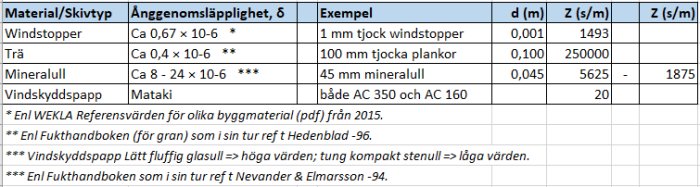
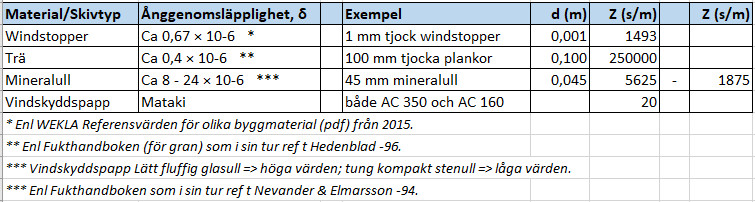
It's not entirely quick and easy to find values for vapor permeability (delta, m2/s) and vapor resistance (Z, [s/m]) for different building materials, even harder to find comparable values. But, after some googling and flipping through the Moisture Handbook, I come up with figures that I consider sufficient for this comparison of the materials' relative vapor resistance.
From my example calculations in the table below, it appears that windproof paper (both AC350 & AC160) has negligible vapor resistance compared to all other layers in the wall (individually). The old rule of thumb that the outside should have 5-10 times less vapor resistance than the inside is more than fulfilled.
A commendable job by @Oldboy! I did know that solid wood has a significant vapor diffusion resistance, increased by its thickness in this case. But that AC 350 had such a poor value was a surprise. The conclusion is that if the plank wall is the only thing present initially, i.e., no old asphalt paper layers, the best solution is to put regular wind barrier on the outside of the insulation, but that it won’t be a disaster with AC 150 or AC 350.
Vi vill skicka notiser för ämnen du bevakar och händelser som berör dig.


Oldboy said:
Ideally, the old panel should also come down. Its insulation capability is marginal, but there is a high risk that cold air can find its way between the boards, diminishing the effectiveness of the outer (new) insulation. Additionally, it reduces the thickness of the wall, so the proportions are less affected.

Rickard.ag said:
I think that ac350 is unnecessarily tight if you don't have anything tight (like building foil) on the inside. I believe more in a modern wind barrier on the outside and nothing else as it becomes the most open solution. Ac350 has an sd value (vapor tightness) of just over 1 somewhere whereas there are wind barriers with as little as 0.03. If it actually changes anything I don't know, but I see no advantages with paper.