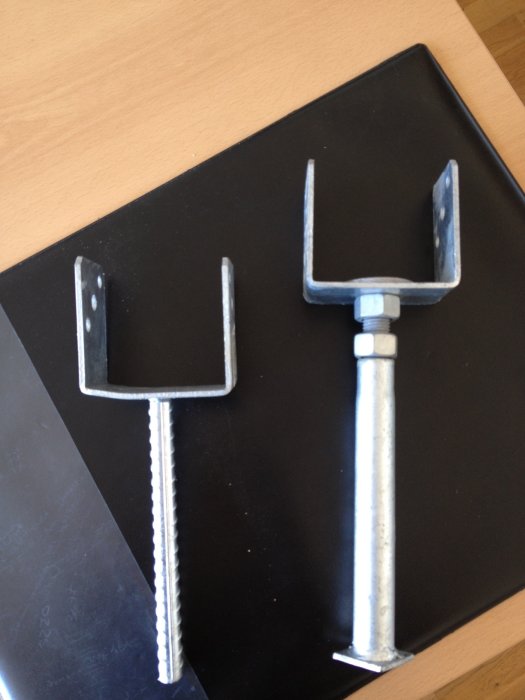
I have ordered paving with associated groundwork. The quote states that NCC, which it concerns, will set pillars for a carport and shed. Now I found out that they are casting pillars without placing pillar irons in them, saying it's easier to get the pillar irons exactly in the right position if you instead drill holes in the cast pillars and attach the pillar irons there afterwards. I have a hammer drill (low price), can the machine handle it? It works perfectly well for concrete walls...
What do you say about that, those of you who know more than I do?
Got a bit curious now. How do they recommend attaching the plinth iron in the drilled hole? Adhesive? How long after casting should one wait before drilling/gluing?
They didn't say anything about how I'm supposed to attach the plinth iron in the drilled hole. However, I have read before that if you have a concrete slab, you can nail plug a rule directly into the concrete. So I guess that it works to use plugs. Should be available in that dimension, right?
When casting piers, one usually uses post shoes. There is a model that is adjustable and cast in place, and a model that is "fixed" for which you drill and fill the hole with chemical anchors before pressing down the post shoe.
...they are casting footings without placing footing iron in...
It’s much faster and easier for them (= cheaper). They basically don't have to measure anything. That job is yours.
They are not exactly wrong, but they could very well have cast in footing iron; however, as mentioned, that would have required significantly more from them.
So as usual, what you gain on one end you lose on the other. => Experience :| (Heavy at first, but easy to carry later.)
If you're going to cast plinths, you usually use post bases. There's a model that is adjustable and is cast in, and a model that is "fixed" where you drill and fill the hole with chemical anchors, and then press down the post base.[image]
It seems convenient to use chemical anchors. How much might be needed for 16-17 plinths?
Is it okay to ask how much they charge per square meter? We are considering the same thing, paving and simultaneously preparing for a carport that we might do next year.
The price we received also includes water and sewage replacement from the street into the house (2 x 30 m) so it's difficult to compare. We will get a specification when the job is completed because we are entitled to ROT-deduction for this particular va-job.
Click here to reply
Vi vill skicka notiser för ämnen du bevakar och händelser som berör dig.