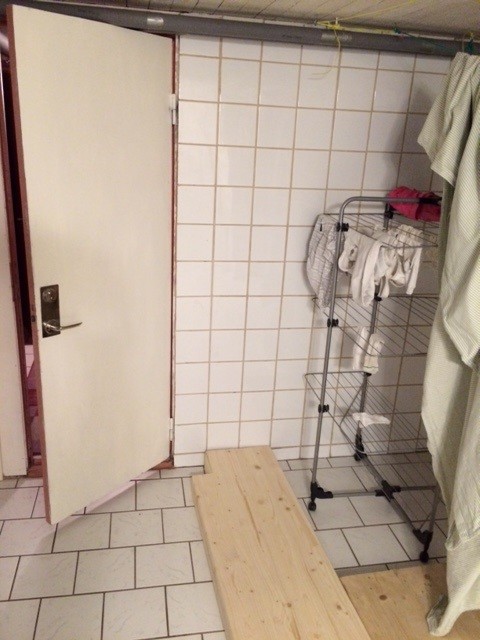
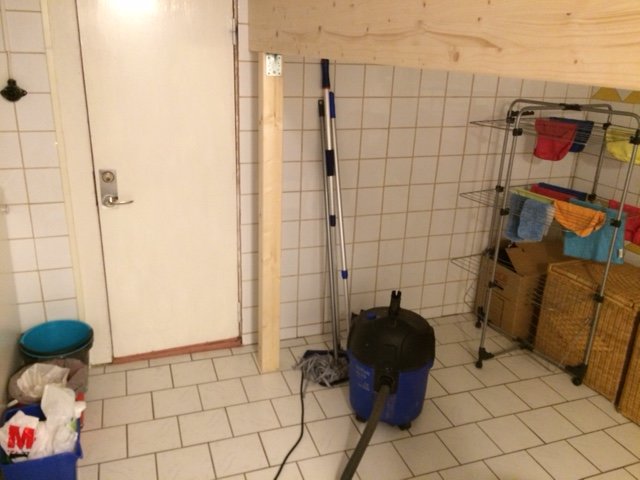
I have a part of the house that is from the early 50s.
On the upper floor, we want to eliminate bounce in the floor (4m span), and I'm considering putting up a "wall" in the basement.
I'm thinking of a glulam beam (290cm long) on two pillars directly on the basement floor.
The floor consists of a slab from the 50s with tiles from the 90s.
Can I put the pillars directly on this, or do I need to distribute the load?
I have a part of the house that is from the early 50s.
On the upper floor, we want to get rid of the bounce in the floor (4m span) and I intend to put up a "wall" in the basement.
I plan to use a glulam beam (290cm long) on two pillars directly on the floor in the basement.
The floor consists of a slab from the 50s with tiles from the 90s.
Can I place the pillars directly on this or do I need to distribute the load?
Assuming you plan to remove the tiles where the pillars will stand, otherwise my opinion is that things were built pretty darn sturdy back in the day. The slab for my patio from 69 was poured with over 2 DM of concrete and a heck of a lot of rebar.
I had planned to place the pillars directly on the tiles.
I guess the slab is thin, but had hoped that the tiles would reinforce somewhat.
How thick does a slab without reinforcement need to be to bear the point load from 90x90 pillars?
Can anyone make a qualified guess?
I want to avoid a beam at the bottom and more posts if possible.
If it's just to support the floor above, maybe the point load won't be that large?!?
That's exactly the question I'm asking myself too.
I'm planning to press up the ceiling in the basement 0.5-1cm and put the beam in place.
I guess the load will be under 3 tons, but it would still be a bit unfortunate if the floor gives way and I have no idea how much it can withstand.
If the load is 3 tons and this is distributed on 2 pillars, it becomes about 18.5Kg/cm2 if that's of any help.
I guess the slab is only a few centimeters and then there's tiling.
The upper floor is already supported by existing walls, so the columns should only take the load from the "sagging." It shouldn't be a major load. The klinker probably doesn't reinforce but rather risks cracking if the tiles are smaller than the columns. I would try to align the columns so they end up in the middle of each tile and place something underneath to absorb the load and distribute it over a whole klinker tile.
You write that you are going to put up a wall in quotation marks. If you mean that you are actually going to put up a wall and not just create the stabilizing function of a wall, it is, of course, even easier. Place a bottom plate on the floor and attach a top plate to the ceiling and use studs between them, e.g., with 45x95. Then you can forget about both a glulam beam and columns.
I meant, of course, that the tile risks cracking if the base of the pillar is smaller than a tile, not the other way around. What do you base the guess of a load of up to 3 tons on? If you push up the floor, you will certainly get a certain increased load on the pillars, but otherwise, the load on the pillars should not be higher than the weight of the person in the room above who is causing the flexing. If that person doesn't manage to step through the basement floor, then the pillars won't do it either.
What I based 3 tons on was that I will use a 3-ton jack, and if it manages to lift the roof, then it's certainly not more. So I thought that if it holds for three tons, it's fine, and that's why I wrote it. I can live with a cracked tile. If that's the only risk, it's worth taking a chance.
I was planning to drill holes and insert an expander where each pillar should be.
Then I drill a hole from underneath in the pillar and thread it onto the expander.
Does anyone know if this is an okay solution?
Is it enough to glue the pillars to the beam and the beam to the ceiling?
The approach didn't turn out as I originally planned. Therefore, the pillars are directly on the tiles without any fixation. Can I use superfix or something else around them to fix them, or what should I do now?
Joking aside, let it be as it is for a while now. The pillar won't move at first if it's under tension. If forces do arise that move the pillar at the bottom, glue around it won't help; you need to reinforce at the base or something similar.
Jokes aside, leave it as it is for now. The post won't move initially if it's under tension. If forces do arise that move the post at the bottom, glue around won't help, you'll need to secure it at the base or similar.
Indeed they are under tension. The floor on the upper level was previously 2cm lower in the middle, but now it’s straight.
An unexpected side effect is that it's downhill to the dining table now (where the beam ends)
I'll leave it in the meantime.
Thanks for the response!
Vi vill skicka notiser för ämnen du bevakar och händelser som berör dig.